 Advances in Engineering Advances in Engineering features breaking research judged by Advances in Engineering advisory team to be of key importance in the Engineering field. Papers are selected from over 10,000 published each week from most peer reviewed journals.

Significance
Propagation of shock waves through different kinds of media is a complex phenomenon that depends on the physical properties of the medium and the characteristics of the shock wave. Shock waves has the ability to travel through solids, liquids, and gases, however, different media interacts with shock waves in differently due to the unique properties such as compressibility, density, and elasticity. For instance, in gases, shock waves propagate rapidly due to the high compressibility and low density of the medium. The speed of shock waves in gases exceeds the speed of sound, causing a sudden compression and heating of the gas and this is observed in sonic booms generated by supersonic aircraft. In liquids, shock wave propagation is influenced by the incompressibility and higher density compared to gases and liquids can support strong shock waves that travel at speeds higher than in gases but lower than in solids. In solids, shock waves travel the fastest due to the medium’s rigidity and low compressibility and the interaction of shock waves with solids may cause significant structural damage, which makes the study of these waves critical in the field of material science and earthquake engineering.
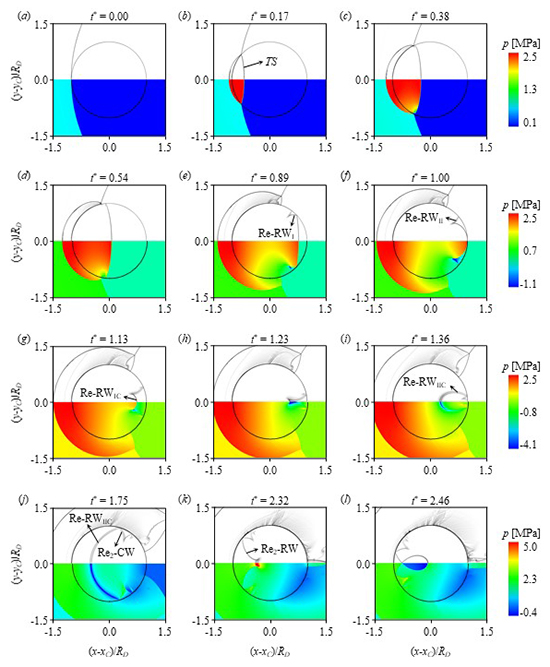
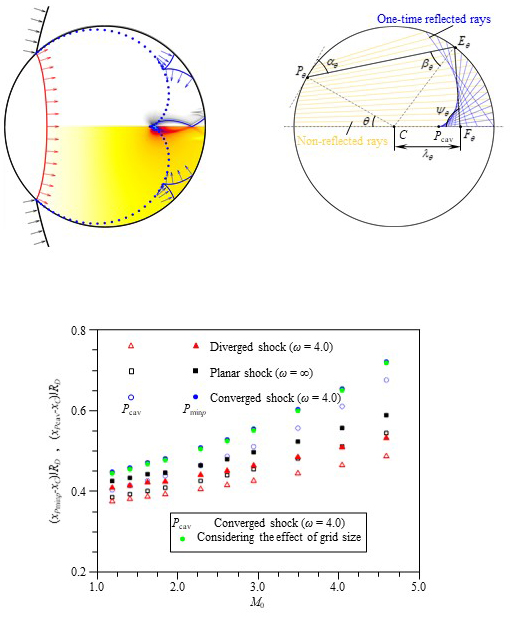
Wave convergence phenomena within a two-dimensional cylindrical water column subjected to various curved shock waves present a particularly interesting case. Shock waves that originate from different points on the boundary of a cylindrical column converge towards the center, focus their energy. This convergence leads to complex wave interactions, including interference, amplification, and diffraction, which can significantly alter the wave’s characteristics. Curved shock waves, such as those generated by underwater explosions or implosions, converge in a cylindrical water column, creating high-pressure regions due to constructive interference. As these waves propagate through the water, their curvature and the cylindrical geometry cause the waves to focus, and can intensify the pressure and energy at the point of convergence. The study of these convergence phenomena is essential to understand underwater explosions, sonar wave propagation, and other applications where shock waves interact with cylindrical geometries. The behavior of converging shock waves in water columns can be modeled using computational fluid dynamics and experimental methods to predict the resulting pressure distributions and potential impacts. To this end, new study published in Journal of Fluid Mechanics and conducted by Dr. Sheng Xu, Dr. Wenqi Fan, Dr. Wangxia Wu, Dr. Haocheng Wen and led by Professor Bing Wang from the School of Aerospace Engineering at the Tsinghua University, researchers performed high-resolution numerical simulations to study the initial interaction between a curved shock wave and a two-dimensional cylindrical water column. They found that upon impact, a transmitted shock wave is generated inside the water column. When the contact angle exceeds a critical value, the transmitted shock wave detaches from the incident shock wave, forming a precursor shock wave. This detachment was influenced by the incident shock wave intensity, the sound-speed ratio of the two phases, and the shape of the incident shock wave. Numerical simulations confirmed that the detachment process leads to complex wave propagation and reflection patterns within the water column. The team’s simulations showed that the transmitted shock wave, upon reflection from the water column surface, generates a series of rarefaction waves. These rarefaction waves tend to focus inside the water column, creating regions of significantly negative pressure. The researchers theoretically and numerically tracked these rarefaction waves and found that the first reflected rarefaction wave, when focused, can induce pressures as low as -10 MPa. This extreme negative pressure exceeds the cavitation threshold, indicating a high probability of cavitation at the focus point. This phenomenon was particularly pronounced when using converged shock waves, which enhanced the negative pressure effects compared to planar and diverged shock waves.
The researchers performed further analysis of the wave dynamics and showed that the secondary reflections of the rarefaction waves generate both compression and rarefaction waves that focus inside the water column. These secondary waves cause highly transient pressure oscillations. They observed that the second reflected wave’s focus, involving a compression wave followed by a rarefaction wave, led to significant pressure oscillations, with pressure variations reaching up to 60 times the initial pressure. This behavior was more intense for converged shock waves, which generated higher pressures and more pronounced oscillations compared to diverged and planar shock waves. The team also investigated the effects of different shock wave shapes and intensities on the wave dynamics within the water column. The researchers found that converged shock waves delay the transition from regular to Mach reflection, while diverged shock waves accelerate this process. Converged shock waves resulted in stronger negative pressures and more significant pressure oscillations, whereas diverged shock waves mitigated these effects. Additionally, the distance from the focus points to the column center varied with shock wave shape and intensity, with converged shocks reducing this distance, thereby enhancing cavitation probability. These findings highlight the critical role of shock wave shape and intensity in determining the internal wave dynamics and pressure effects within the water column.
The study of Dr. Sheng Xu and colleagues has several significant implications. For instance, better understanding the wave dynamics within fuel droplets can enhance the design of hypersonic propulsion systems, and will lead to better atomization of fuel droplets, improved combustion efficiency, and higher thrust. Moreover, the reported demonstration that they can predict and control the focus points and pressure intensities of waves within water columns expected improve the precision and effectiveness of ultrasound assisted medical treatments like shock wave lithotripsy and targeted drug delivery. Furthermore, it can influence of different shock wave shapes and intensities on cavitation, and assist engineers to design equipment that mitigates or harnesses cavitation effects, leading to longer-lasting equipment and reduced maintenance costs. Additionally, principles uncovered in the new study are relevant in astrophysics, particularly in understanding supernova explosions and the dynamics of stellar evolution and also can facilitate the development of advanced materials and nanotechnology applications, such as fabricating materials with unique properties or applications in nanomedicine. In summary, Professor Bing Wang and colleagues from the Tsinghua University successfully performed comprehensive analysis of wave dynamics in shocked water columns, with practical implications that spans from aerospace engineering to medical technology, industrial process optimization, astrophysics, and nanotechnology.
Reference
Xu S, Fan W, Wu W, Wen H, Wang B. Analysis of wave converging phenomena inside the shocked two-dimensional cylindrical water column. Journal of Fluid Mechanics. 2023;964:A12. doi:10.1017/jfm.2023.239