Advances in Engineering Advances in Engineering features breaking research judged by Advances in Engineering advisory team to be of key importance in the Engineering field. Papers are selected from over 10,000 published each week from most peer reviewed journals.

Significance Statement
Wave energy is one of the most promising types of clean renewable energy due to its minimal negative environmental impact and high energy flux density. Different types of wave energy converters have been proposed mainly due to their structural simplicity and high efficiency. Harvesting techniques have however poised a challenge for many empirical and theoretical studies. Oscillating water column devices generate energy from the cyclic falling and rising of water in an air chamber generated by ocean waves. Turbine characteristics and chamber design directly affect the efficiency of the oscillating water column device. Most research has focused on effects of turbine characteristics and chamber design, on the systems’ efficiency. The effect of wave dynamics on oscillating water column devices has had minimal attention.
In a recent paper published in Energy Professor De-Zhi Ning and colleagues at Dalian University of Technology in China studied wave dynamics on a land-fixed oscillating water column device. Their aim was to investigate the effects of wave parameters and the dimensions of the oscillating water column chamber on wave forces acting on the device and provide guidance for the geometry design.
Numerical model and experimental set up were to be conducted. For the numerical model, a two-dimensional fully nonlinear numerical wave flume was used to investigate the hydrodynamic performance of the land fixed oscillating water column. The numerical model was extended so as to simulate the non-linear wave forces on the structure.
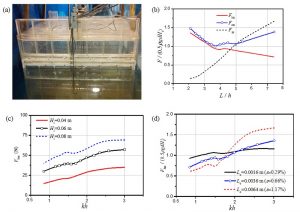
For the experimental set up, physical model tests were carried out in the wave current flume at the preferred institution. The wave current flume was equipped with a piston type unidirectional wave maker which could generate irregular and regular waves of periods 0.5 seconds to 5.0 seconds. The model was also designed to span across the width and depth of the flume so as to avoid wave energy transfer through the device. Seven groups of experiments were carried out so as to investigate the effects of the chamber width, incident wave height, orifice diameter and the front wall draft on the wave pressure on the front wall.
The authors of this paper observed good agreements between the simulations and experiments. The simulated amplitudes were larger than the laboratory measurements but the introduction of an artificial viscous term to the pressure expression enabled better simulation. The total wave force was observed to decrease with the increase of the wavelength and also increased with the increase of the incident wave height. The wave force was observed to have been strongly influenced by the opening ratio: in the low-frequency region, the larger the opening ratio, the smaller the wave force and it shows a reverse tendency in the high-frequency region.
In this study, general characteristics of the wave force on the front wall under the action of non-breaking waves with different chamber geometries have been revealed. The study has developed promising guidance on the effects of the wave parameters and dimensions of the oscillating water column chamber on the wave forces acting on the device.

Reference
De-Zhi Ning1, Rong-Quan Wang1, Ying Gou1, Ming Zhao2, Bin Teng1. Numerical and experimental investigation of wave dynamics on a land-fixed OWC device. Energy volume 115 (2016) pages 326-337.
[expand title=”Show Affiliations”]- State Key Laboratory of Coastal and Offshore Engineering, Dalian University of Technology, Dalian, 116024, China
- School of Computing, Engineering and Mathematics, Western Sydney University, Locked Bag 1797, Penrith, NSW, 2751, Australia
Go To Energy