 Advances in Engineering Advances in Engineering features breaking research judged by Advances in Engineering advisory team to be of key importance in the Engineering field. Papers are selected from over 10,000 published each week from most peer reviewed journals.

Significance
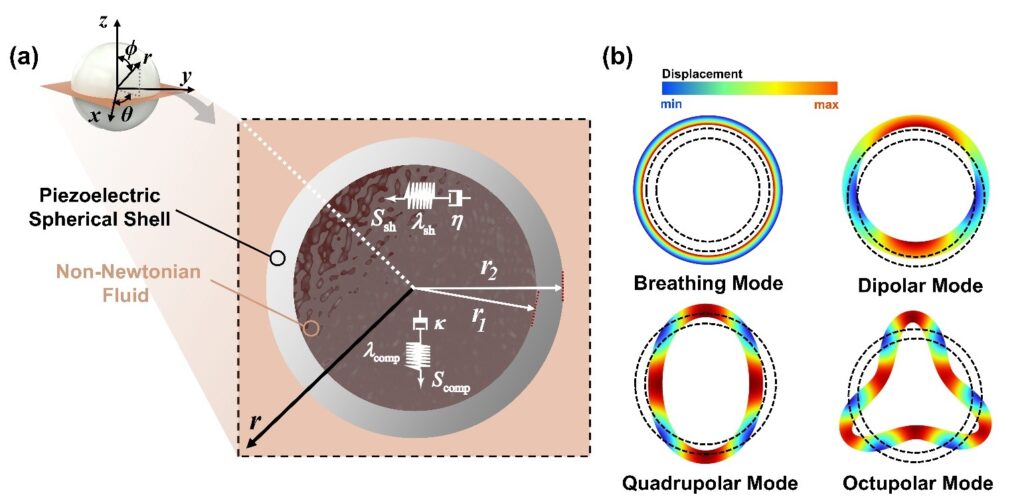
Piezoelectric shells are coupled electromechanical structures in which mechanical deformation, electric polarization, and electric potential must be considered together during vibration analysis. Such coupling manifests particularly complex behaviors for spherical configurations. The curvature of the shell, the radial direction of polarization, and the vibration modes of the spherical structure all influence how mechanical deformation and electric response develop together. The shell motion drives fluid flow, and in turn the surrounding fluid modifies the natural frequencies and damping characteristics of the shell. For an inviscid compressible fluid, the main effect is associated with fluid inertia and pressure coupling, whereas for a viscous fluid, energy dissipation dominates the fluid-structure interaction problem. When the enclosed fluid is non-Newtonian, viscous dissipation and elastic relaxation can act together, changing both the vibration frequency and the rate of energy loss. This distinction is important especially for small spherical shells and high-frequency vibration modes because, under such conditions, the time scale of structural oscillation may approach the relaxation time of the fluid, so a fluid that appears Newtonian at low frequency may show measurable viscoelastic behavior during vibration. A complete description must therefore account for shear relaxation, compressional relaxation, fluid compressibility, and the three-dimensional deformation of the piezoelectric shell. A formulation limited to radial motion, uncoupled elasticity, or purely Newtonian fluid behavior would describe only part of the coupled dynamics. The problem was technically demanding because the piezoelectric shell supported both torsional and spheroidal vibration modes, and the enclosed fluid involved dilatational and equivoluminal motions whose behavior depended on shear and compressional relaxation. These two fields had to be solved in a consistent way and then coupled through interface conditions that enforced compatibility of motion and stress at the inner shell surface.
In a recently published research paper in the Journal of Sound and Vibration, Dr. Yuze Cao, Professor Bin Wu, and Professor Weiqiu Chen from Zhejiang University developed a three-dimensional analytical formulation for the free vibrations of a spherically isotropic piezoelectric shell filled with a compressible non-Newtonian fluid. The new model was distinct because it included both shear and compressional relaxation effects in the enclosed fluid and still retained the coupled electroelastic response of the shell. They separated torsional and spheroidal vibration modes, solved the piezoelectric shell equations using displacement functions and the generalized Frobenius power series method, and represented the fluid motion through velocity potentials. The final characteristic equations, successfully solved with the Müller iteration algorithm, provided complex vibration frequencies and quality factors for different modes, shell sizes, fluid viscosities, and fluid relaxation conditions.
Briefly, the researchers first formulated the piezoelectric shell and the enclosed fluid separately, then coupled them through interface conditions and used the resulting frequency equations to examine the effects of material and geometric parameters. For the piezoelectric shell, they began from linear piezoelectricity in spherical coordinates, with the radial direction aligned with the polarization axis. By introducing three displacement functions, they managed to separate the vibration problem into two independent classes. The first class described torsional modes and reduced to an uncoupled second-order differential equation, whereas the second class described spheroidal modes and remained coupled through radial displacement, tangential displacement, and electric potential. This separation allowed the torsional vibration to be handled independently, while the more complicated spheroidal motion was solved through a matrix form of the Frobenius power series method. In practical terms, the analytical strategy converted the three-dimensional electroelastic field into radial functions associated with spherical harmonics, so that each angular mode could be studied through ordinary differential equations rather than through the direct solution of the original three-dimensional field problem for each mode. The breathing mode received separate treatment because its displacement was purely radial and the tangential component did not contribute to the piezoelastic field.
Cao, Wu, and Chen used a compressible linear viscoelastic fluid model that included both the deviatoric shear relaxation effect and the spherical compressional relaxation effect. Small-amplitude harmonic motion permitted linearization, and the generalized Navier–Stokes equations were solved by introducing velocity potential functions. The Helmholtz decomposition separated dilatational and equivoluminal contributions to the fluid motion, and the finite-velocity condition at the center of the filled shell excluded singular solutions. The coupled frequency equations arose when the shell and fluid fields were matched at the inner interface. Continuity of displacement and stress linked the radial and tangential motion of the piezoelectric shell with the fluid velocity and fluid stress, while electrically open-circuited boundary conditions completed the electroelastic problem. They first validated the approach against available theoretical predictions for a PZT-4 shell filled with a non-viscous compressible fluid, where the natural frequencies were real because the fluid model contained no damping mechanism. The close agreement with prior exact results supported the analytical formulation and the numerical root-finding procedure.
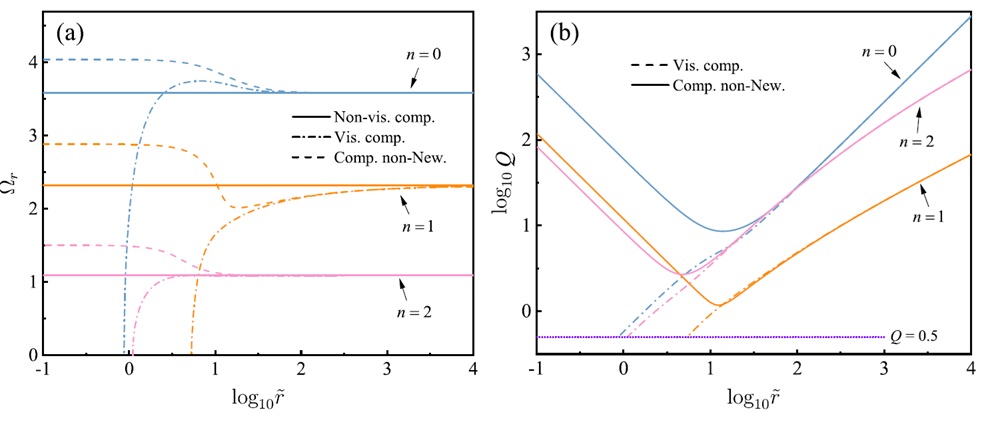
The authors presented numerical examples and showed how the model behaved when dissipation and relaxation were present. For torsional modes, fluid viscoelasticity had little influence on the vibration frequency. Spheroidal modes responded more strongly: fluid-induced added mass effects and fluid viscosity reduced the vibration frequency, while fluid viscoelasticity could increase it by introducing an energy-storage contribution. The quality factor followed a more mode-dependent pattern. In many cases, the viscoelastic fluid model predicted higher quality factors than a purely viscous fluid model, but some lower-frequency torsional modes showed the opposite trend because the elastic relaxation contribution remained weak while dissipation was still enhanced.
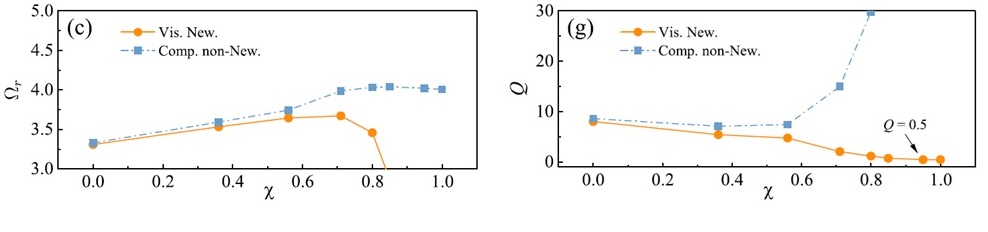
The breathing mode was especially sensitive to the compressional relaxation effect of the fluid. They found that when the shell vibrated radially, the enclosed fluid underwent volumetric deformation, so the predicted quality factor of a model that neglected compressional relaxation could differ significantly from that of the compressible non-Newtonian fluid model. By contrast, for non-breathing spheroidal modes, shear-associated viscous dissipation dominated attenuation, and the distinction between the Maxwell-type treatment and the compressible non-Newtonian model became smaller. Shell size and vibration order sharpened these effects. As the radius decreased or the radial mode order increased, the vibration frequency rose, making the fluid relaxation time more relevant to the coupled dynamics. In glycerol–water mixtures, the Newtonian model predicted a steady decline in frequency and quality factor with increasing glycerol fraction, but the non-Newtonian model could reverse this trend beyond a critical concentration because elastic energy storage began to compete effectively with viscous loss.
The findings of Cao, Wu, and Chen are directly relevant to the design of piezoelectric spherical containers, resonators, and sensing elements that operate with enclosed complex fluids. In such systems, the fluid cannot always be treated as a simple added mass or as a purely viscous damping medium. The study showed that fluid viscosity, viscoelastic relaxation, shell radius, and vibration mode could each change the natural frequency and quality factor of the coupled system. This is important for engineers who need to predict resonance accurately, especially when Newtonian assumptions may not capture the full frequency and damping response. One practical application is in piezoelectric resonators used for fluid characterization. Because the vibration response depends on viscosity and relaxation time, a spherical piezoelectric shell could, in principle, be used to infer the properties of non-Newtonian liquids from shifts in frequency and quality factor. The breathing mode is especially relevant when the compressional relaxation effect is important, since radial vibration produces volumetric deformation of the enclosed fluid. Other spheroidal modes may be more sensitive to shear-related dissipation. This modal selectivity gives designers a way to choose vibration modes according to the fluid properties they want to probe.
The results are also useful for small-scale acoustic or electromechanical devices containing polymer solutions, glycerol-based mixtures, biological fluids, or other viscoelastic media. At small shell radii or higher vibration orders, the vibration frequency increases, making relaxation effects more visible. The study therefore helps identify when a Newtonian model may be acceptable and when a non-Newtonian description is required. This distinction matters in miniaturized resonators, precision detectors, and fluid-filled piezoelectric components where frequency drift or a loss of quality factor can affect device performance. Another engineering implication is damping control. The analysis showed that viscoelasticity did not simply increase dissipation; under some conditions, elastic energy storage in the viscoelasticity fluid could increase the quality factor relative to a purely viscous model. This means that the choice of enclosed fluid could be used deliberately to tune the dynamic response of a piezoelectric shell. For resonant sensing, a higher quality factor may improve frequency resolution, whereas stronger damping may be useful where vibration suppression is desired.
Reference
Yuze Cao, Bin Wu, Weiqiu Chen, Three-dimensional free vibrations of piezoelectric spherical shells filled with non-Newtonian fluids, Journal of Sound and Vibration, Volume 618, Part B, 2025, 119294.
Go to Journal of Sound and Vibration