Advances in Engineering Advances in Engineering features breaking research judged by Advances in Engineering advisory team to be of key importance in the Engineering field. Papers are selected from over 10,000 published each week from most peer reviewed journals.

Significance
The interesting field of optical chaos generation based on external-cavity semiconductor laser (ECSL) has recently attracted significant research attention. In particular, ECSL-based optical chaos exhibits potential applications in numerous areas including true random bit generations, secure optical communications, and chaotic radars. However, the ECSL-generated chaos sources in these systems have limited bandwidth, which restricts the signal transmission capacity of chaos communications, the bit rate of random bit generations, as well as the precision of chaotic radars. Moreover, the optical feedback of ECSL induces a periodicity, which results in the time delay signature in the generated chaos.
The obvious time delay signature would expose the feedback delay time of the external cavity. Unfortunately, the exposes of the time delay signature has the disadvantages of degrading the randomness of random bit generation and the precision of chaotic radars, as well as threatening the security of communication systems. Therefore, development of new chaos generation methods with the ability to simultaneously enhance the bandwidth and suppress the time delay signature is highly desirable.
To this note, researchers at the University of Electronic Science and Technology of China: Anke Zhao (PhD student), Professor Ning Jiang, Shiqin Liu, Chenpeng Xue and Professor Kun Qiu together with Prof. Jianming Tang from the Bangor University developed a new scheme for generating wideband complexity-enhanced chaos. Fundamentally, the numerical and experimental approach made use of the electro-optic phase modulation in conjunction with the delayed interference in the feedback loop of an external-cavity semiconductor laser.
The simultaneous bandwidth enhancement and time delay signature suppression as well as the influences of the feedback strength, interference delay and phase modulation index were investigated both experimentally and numerically. The consistent experimental and numerical results indicate that wideband chaos with flat spectrum and perfect time delay signature suppression can be easily generated with the proposed scheme. The numerical results also predicted that with sufficiently good testing equipment, the effective bandwidth of chaos can reaches beyond 100GHz, which is a worldwide record in the research field of optical chaos generations. The research work is currently published in the research journal, Optics Express.
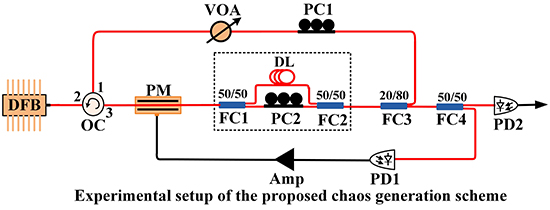
In their scheme, a distributed-feedback laser was used as the chaos optical source and its output of which was passed through an optical circulator before being modulated by an electro-optic phase modulator. Then the phase-modulated light was passed through a Mach-Zehnder interferometer. Additionally, the feedback strength and the polarization feedback light state were adjusted using a variable optical attenuator and polarization controller respectively. To validate the feasibility of the proposed scheme, comparisons were made between this approach and other three relevant schemes, namely the conventional optical feedback case, the self-phase modulated optical feedback case, as well as the Mach-Zehnder interferometer + conventional optical feedback case.
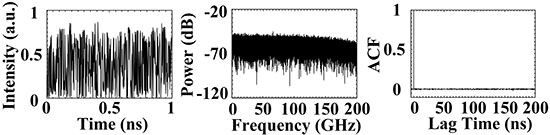
The authors observed that wideband chaos with both flat spectrum and excellent time delay signature suppression characteristics can be generated over a wide dynamic operation range. When compared with the other relevant cases, the proposed method can work efficiently in chaotic regimes with significantly-enhanced bandwidth and perfectly-suppressed time delay signature. The excellent suppression characteristic of time delay signature to a level close to zero also results in the enhancement of complexity of the chaos. Additionally, the interference delay and the self-phase modulation delay did not exhibit any considerable effects on the time delay signature suppression and bandwidth enhancement.
In summary, University of Electronic Science and Technology scientists successfully demonstrated an external-cavity semiconductor laser-based chaos generation scheme supporting excellent features including wideband flat spectrum and perfect TDS suppression. The new proposed scheme will provide wideband chaos that will advance various applications such as secure optical communications and high rate random generations.

Reference
Zhao, A., Jiang, N., Liu, S., Xue, C., Tang, J., & Qiu, K. (2019). Wideband complex-enhanced chaos generation using a semiconductor laser subject to delay-interfered self-phase-modulated feedback. Optics Express, 27(9), 12336.
Go To Optics Express