Advances in Engineering Advances in Engineering features breaking research judged by Advances in Engineering advisory team to be of key importance in the Engineering field. Papers are selected from over 10,000 published each week from most peer reviewed journals.

Significance
The ability of mechanical actuators to respond to external stimuli such as heat, electricity or light and convert it to mechanical energy has recently become a topic of interest amongst scientists. The trigger for this is the tremendous promise that such actuators can offer that would satisfy countless daily and industrial demands. 3D printing is a popular technique for fabricating stimulus-response actuators. Therefore, fabricating flexible shape changing actuators by means of 3D printing has become a prospective research area. Such development already has a benefit in our lives and has the potential to even play more important roles in biomedical devices, soft robotics and other high-tech areas. Unfortunately, the progress of such 3D printed shape changing actuators is restricted due to insufficient 3D printing functional materials and inadequate response sensitivity of the actuators.
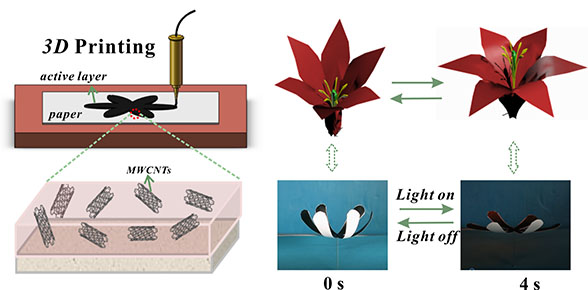
To this note, Professor Xiaoqin Zhang and colleagues at State Key Laboratory of Solid Lubrication in Lanzhou Institute of Chemical Physics which is affiliated with the Chinese Academy of Sciences proposed a study whose main objective was to demonstrate the novel and facile 3D printing of photoresponsive shape changing composites-based on polylactic acid and multi-walled carbon nanotubes (MWCNTs)-on paper substrates with fused deposition modeling printing technology for the construction of flexible photothermal-responsive shape changing actuators. They hoped that their easy 3D printing strategy, if successful, would provide tremendous opportunities for the design and fabrication of biomimetic photothermal actuators and soft robotics. Their work is published in the research journal, Journal of Materials Chemistry C.
The research method entailed fabricating the flexible paper based bilayer actuators on ordinary office paper by printing the MWCNT-polylactic acid composite using fused deposition modeling 3D printing technology. Next, a 19.1 mm radius semicircular actuator was prepared so as to enable study the light-response behavior of the actuator. Eventually, the researchers designed and constructed a biomimetic flower capable of performing both 2D and 3D geometry transformation under infrared irradiation.
The authors observed that the introduction of the MWCNTs to a polylactic acid matrix resulted in the enhancement of processability of the MWCNT-polylactic acid composite during the fused deposition modeling printing process as compared to pure polylactic acid. Additionally, they noted that the fabricated paper-based bilayer semicircular actuators exhibited phototriggered shape changing properties that they deformed under near infrared irradiation and recovered their original shape once the light source was switched off.
The study has successfully introduced a novel and excellent photo-thermal material MWCNT-polylactic acid composite. In this material, MWCNTs have been dispersed homogeneously in a conventional thermally induced shape-changing polymer polylactic acid matrix to enable light triggered shape change and their extrusion into filaments. It has been seen that at near infrared irradiation, the shape changing behavior of 3D printed actuators is triggered. Altogether, the advancement of this facile printing technique will provide tremendous opportunities for both fabrication and design of personal stimuli-responsive actuators, which have possible applicability in the field of attractive and highly personalized biomimetic smart devices and soft robotics.
Acknowledgement
Prof. X. Wang and Prof. B. Yu are grateful for the financial supports from NSFC (51775538 and 51573199), the Gansu province science and technology plan (17JR5RA318, 1606RJZA051 and 17YF1FA139), and the West Light Program of CAS.




Reference
Dechuan Hua, Xiaoqin Zhang, Zhongying Ji, Changyou Yan, Bo Yu, Yuandong Li, Xiaolong Wang, Feng Zhou. 3D printing of shape changing composites for constructing flexible paper-based photothermal bilayer actuators. J. Mater. Chem. C, 2018, volume 6, 2123.
Go To Journal of Materials Chemistry