Advances in Engineering Advances in Engineering features breaking research judged by Advances in Engineering advisory team to be of key importance in the Engineering field. Papers are selected from over 10,000 published each week from most peer reviewed journals.

Significance
Nano-architected metals present a demanding materials-design problem because their geometry, microstructure, and defect populations are intertwined at nearly the same length scale. In conventional architected materials, the load-bearing architecture is often much larger than the characteristic microstructural dimensions of the solid from which it is made. That separation allows one to describe the constituent material by an effective property and then analyze the lattice, shell, or cellular structure at a higher scale. At the nanoscale, that assumption becomes less secure. When beams, shells, grains, and processing-induced pores all fall within tens to hundreds of nanometers, the architecture is not simply a scaled-down version of a familiar cellular metal. Its mechanical response is shaped by a direct encounter between structural geometry and the defects embedded inside the load-bearing members. The central technical challenge is therefore twofold. First, complex three-dimensional metallic architectures must be fabricated with sufficient resolution, structural integrity, and reproducibility to make meaningful mechanical testing possible. Second, the mechanical behavior must be interpreted in a way that connects nanoscale building-block properties with architecture-level deformation and failure. Existing nanoscale additive manufacturing approaches have reached important feature-size regimes, but the paper frames a remaining gap: the need for a method that can combine three-dimensional freeform fabrication, metallic conversion, controlled geometry, and mechanically diagnostic experiments in the same platform. Without that combination, it is difficult to determine whether observed strength reflects architecture, constituent material size effects, processing defects, or some mixture of all three. In a recent research paper published in Nature Communications, Dr. Wenxin Zhang, Dr. Zhi Li, Dr. Huajian Gao, and Professor Julia Greer from California Institute of Technology, developed a two-photon-lithography-based hydrogel infusion additive manufacturing process for complex three-dimensional metallic nano-architectures with approximately 100 nm critical dimensions and tens-of-nanometers surface roughness. They produced beam-based, shell-based, periodic, and non-periodic nickel nano-architectures and coupled their fabrication with in situ nano-compression testing. They also developed a physics-informed finite-element strategy that incorporates experimentally measured building-block behavior and nodal porosity distributions to predict size-dependent strength and failure. Its technical distinction is the direct linkage of nanoscale defect statistics to architecture-level deformation in additively manufactured metals.
The researchers used nano-HIAM to fabricate three representative classes of nickel nano-architecture: beam-based periodic octahedral nanolattices, shell-based periodic Schwarz-P nanolattices, and shell-based non-periodic spinodal-like architectures. The process began with two-photon lithography of polymeric templates, followed by infusion with nickel salt solution and thermal conversion to metallic nickel. A modified photoresist formulation increased printing speed while maintaining spatial resolution, allowing the preparation of more complex three-dimensional structures. The resulting architectures had feature dimensions in the hundreds of nanometers, surface roughness on the order of tens of nanometers, and structural relative densities of roughly 20–40%. Their nickel microstructure was nanocrystalline and nanoporous, with grain dimensions near 50 nm and uniform nanoporosity at smaller feature sizes.
The authors carried out mechanical testing by in situ nano-compression, which allowed deformation to be followed while stress–strain behavior was measured. Most specimens showed an extended linear loading regime followed by catastrophic global collapse. In the periodic lattices, short strain bursts sometimes preceded the final collapse, consistent with local events occurring before global failure. A smaller number of samples showed gradual layer-by-layer deformation associated with visible fabrication imperfections; these were distinguished from the dominant material-failure response so that the analysis could focus on the intrinsic size-dependent behavior of the nano-architectures. The strength data revealed that architecture-level compressive strength depended not only on relative density but also on feature dimension. That second dependence is central to the paper. At these sizes, the metal building blocks themselves have size-dependent strength, and the architectural structure inherits part of that behavior. The authors described the architecture strength as a product of a density-dependent term and a feature-size-dependent term. Periodic octahedral and Schwarz-P lattices showed a stronger size scaling than the non-periodic spinodal-like architectures. This difference was interpreted through the distribution and severity of defects: periodic architectures contained concentrated porosity at nodal or locally thickened regions, whereas the non-periodic structures had a more stochastic distribution of shell thickness and stress concentration.
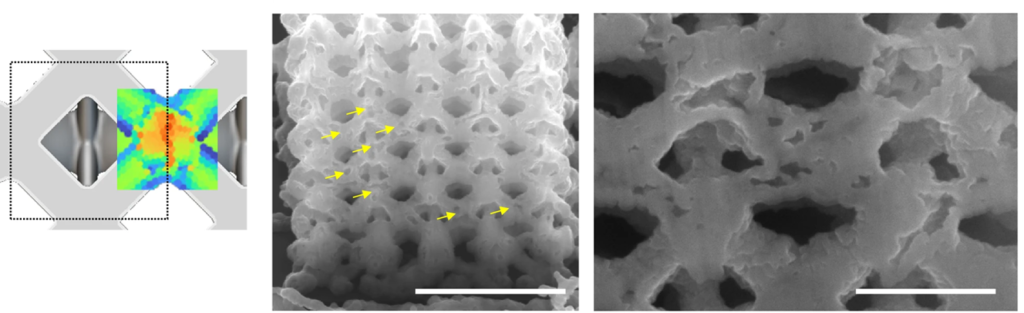
The researchers found that in octahedral lattices, concentrated pore regions appeared preferentially at nodal junctions, where local effective feature dimensions were larger than the average beam diameter. The scientific consequence is important: the same architectural sites that carry high stress also tend to contain more severe porosity, making them likely origins for deformation and fracture. The researchers quantified nodal porosity distributions and used them as input for finite-element simulations. Their simulations first incorporated building-block stress–strain behavior and nanovoids at the unit-cell level, then introduced degraded nodal properties into full-lattice models. Failure initiated at local nodal elements and progressed toward global collapse, matching the experimental observations. Both a homogeneous nodal-degradation model and a porosity-distribution-based model captured the measured size effects in periodic nanolattices. This connection between measured nanoscale defect statistics and architecture-level prediction is one of the paper’s strongest scientific contributions.
The engineering applications of Professor Julia Greer and colleagues findings are most immediate in the design and manufacturing of mechanically reliable nanoscale metallic components. The study shows that nickel nano-architectures can be fabricated with feature dimensions of roughly 100–500 nm while retaining high structural definition, low surface roughness, and specific strengths . That combination is relevant for nanoscale manufacturing systems where small metallic architectures must carry load without losing geometric precision. Possible application areas include nanoelectromechanical systems, nanorobotic components, miniaturized load-bearing metallic parts, and small functional structures where stiffness, strength, and three-dimensional geometry must be controlled together. The practical value is not simply that the structures are small; it is that their mechanical response can be linked to fabrication-induced nanoporosity, feature size, relative density, and architecture type. For engineers, this gives a clearer route for deciding whether a beam-based lattice, shell-based lattice, or non-periodic architecture is more suitable for a given load-bearing requirement. Periodic architectures may offer higher axial load-bearing capacity, while non-periodic structures may distribute local stress and defect sensitivity differently. The paper therefore supports a more careful design logic for metallic nano-architectures: feature size, topology, nodal geometry, and porosity distribution must be treated as coupled design variables rather than independent details.
A second important application is in predictive engineering of hierarchical materials. The authors show that concentrated nanoporosity, especially at nodal junctions in periodic lattices, can control deformation initiation and architecture-level strength. This is highly relevant for any nanoscale device or micro-structure expected to undergo repeated loading, compression, vibration, or contact stresses, because failure may begin at nanoscale defect-rich regions rather than in the average material volume. By measuring porosity distributions and incorporating them into finite-element simulations, the study provides a practical computational pathway for diagnosing and predicting the strength of nano-architected metals before device integration. This could help engineers avoid overestimating performance by simply extrapolating from isolated nanopillar properties. The approach may also guide the development of more robust nano-architectures for biomedical microdevices, flexible electronics, aerospace micro-structures, and other small engineered systems where metallic components must be both lightweight and mechanically dependable. The broader manufacturing implication is equally important: nano-HIAM is described as adaptable to other metals, ceramics, and composites through infusion and thermal treatment chemistry, meaning the same fabrication-and-diagnosis strategy could be extended beyond nickel. In that sense, the work provides not just a material result, but an engineering methodology for designing, testing, and modeling complex nanoscale architectures with defect-aware mechanical reliability.

Reference
Zhang W, Li Z, Gao H, Greer JR. Nanoporosity-driven deformation of additively manufactured nano-architected metals. Nat Commun. 2026;17(1):3279. doi: 10.1038/s41467-026-69845-8.
Go to Nat Commun