Advances in Engineering Advances in Engineering features breaking research judged by Advances in Engineering advisory team to be of key importance in the Engineering field. Papers are selected from over 10,000 published each week from most peer reviewed journals.

Journal of Materials Science, February 2014, Volume 49, Issue 4, pp 1839-1853.
Zubayda S. Saifaldeen, Khedir R. Khedir, Mehmet F. Cansizoglu, Taha Demirkan, Tansel Karabacak.
Department of Applied Science, University of Arkansas at Little Rock (UALR), Little Rock, AR, 72204, USA.
Abstract
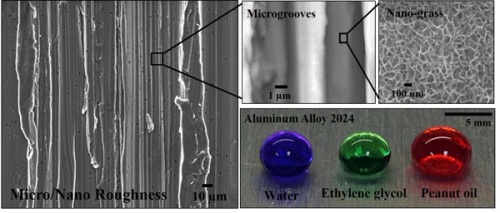
Superamphiphobicmetallic aluminum alloy (Al-alloy) surfaces with water and oil contact angles of more than 150º and sliding angles of less than 10º were developed using a facile and environmentally friendly technique. The two facile surface processing techniques of mechanical sanding and treatment in boiling de-ionized water were utilized to impart micro and nano rough structures onto the Al-alloy surfaces. The surface energy reduction of the rough structured surfaces was performed by a simple vapor-phase coating of the surfaces with a long chain fluorocarbon molecules (1H, 1H, 2H, 2H-perfluorodecyltriethoxysilane) inside an oven under 90 ºC. The rough Al-alloy surfaces with superamphiphobic property were obtained only for hierarchical structures with combination of engineered microgrooves and nano-grass like structures. The effect of two approaches of random and one-directional mechanical sanding and utilized sandpaper grits as well as time period of treatment in boiling de-ionized water on their surface wetting properties were also investigated. This facile approach of engineering single and multiscalerough metallic surface could see wide range of industrial applications such as tuning the metallic surfaces wettability and enhancing their corrosion resistance.