 Advances in Engineering Advances in Engineering features breaking research judged by Advances in Engineering advisory team to be of key importance in the Engineering field. Papers are selected from over 10,000 published each week from most peer reviewed journals.

Significance Statement
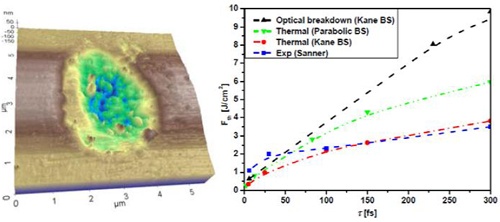
Ultra-short laser systems can be used for very precise material processing, thus extending the number of both industrial and medical laser applications. Femtosecond laser marking and machining have found many applications in optics, photonics, anti-counterfeiting, ophthalmology and other fields. In addition, the development of extremely powerful laser systems is currently underway requiring the damage threshold definition for their optical components. Further progress in these areas will be based on a better understanding of the fundamental processes involved in these laser interactions. To better control over the laser-induced material modifications, one needs a better understanding of the physical mechanisms involved in laser interactions with dielectric materials. In particular, laser-induced electronic excitation, absorption and relaxation are the key issues in ultra-short laser interactions with dielectric materials. To numerically analyze these processes, a detailed non-equilibrium model is developed [1] based on the kinetic Boltzmann equations without any appeal to the classical Drude model. The calculations yield not only free carriers density, but also their energy distribution allowing a better analysis of the role of avalanche ionization. The calculations performed reveal a remarkable effect of the laser-field on collision frequencies resulting in smaller free-carriers absorption than the one predicted by commonly used rate-equation models. In addition, modeling clearly demonstrates laser intensity limits for the applicability of Keldysh’s equation for the photoionization process. Furthermore, both electron-electron and electron-phonon relaxation are examined, and the energy of the electron sub-system is investigated as a function of laser fluence and pulse duration. Because efficient bond breaking requires energy, these calculations provide the required thresholds. The dependency of the calculated fluence threshold on laser pulse duration is compared with the available experimental data. The obtained results also explain several recent pump-probe experiments. The developed model is useful for many laser applications including high precision in laser treatment, laser-assisted atomic probe tomography, and for the development of new powerful laser systems.
[1] N. S. Shcheblanov and T. E. Itina, Appl. Phys. A DOI: 10.1007/s00339-012-7130-0 (2012).
Applied Physics A, 2013, Volume 110, Issue 3, pp 579-583.
Nikita S. Shcheblanov, Tatiana E. Itina
Laboratoire Hubert Curien, UMR CNRS 5516/Université de Lyon, Bat. F, 18 rue de Professeur Benoît Lauras, 42000, Saint-Etienne, France.
Abstract
Electronic excitation–relaxation processes induced by ultra-short laser pulses are studied numerically for dielectric targets. A detailed kinetic approach is used in the calculations accounting for the absence of equilibrium in the electronic subsystem. Such processes as electron–photon–phonon, electron–phonon and electron–electron scatterings are considered in the model. In addition, both laser field ionization ranging from multi-photon to tunneling one, and electron impact (avalanche) ionization processes are included in the model. The calculation results provide electron energy distribution. Based on the time-evolution of the energy distribution function, we estimate the electron thermalization time as a function of laser parameters. The effect of the density of conduction band electrons on this time is examined. By using the average electron energy, a new criterion is proposed based on determined damage threshold in agreement with recent experiments (Sanner et al. in Appl. Phys. Lett. 96:071111, 2010).