Advances in Engineering Advances in Engineering features breaking research judged by Advances in Engineering advisory team to be of key importance in the Engineering field. Papers are selected from over 10,000 published each week from most peer reviewed journals.

Separation and Purification Technology, Volume 103, 2013, Pages 109-113.
Kazuaki Tomono, Hirotoshi Furuya, Seiji Miyamoto, Yuki Okamura, Michinori Sumimoto, Yoshihisa Sakata, Ryuichi Komatsu, Masaharu Nakayama.
Materials Chemistry, Graduate School of Science and Engineering, Yamaguchi University, 2-16-1 Tokiwadai, Ube 755-8611, Japan.
Abstract
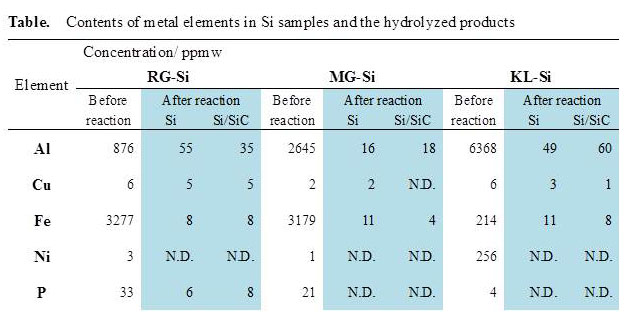
Hydrobromination of three types of silicons (reagent grade silicon (RG-Si), metallurgical grade silicon (MG-Si), and kerf loss silicon (KL-Si)) has been investigated in a flow reactor with and without abrasive grains of silicon carbide (SiC) under various conditions. All the silicons reacted with HBr to form bromosilanes around 400 °C, irrespective of the presence or absence of SiC. The reactivity of each Si sample was evaluated with respect to the conversion of HBr, while the purity of products was analyzed after hydrolyzing them to silicon dioxide. Metal impurities such as Al, Fe, and Ni in the starting materials were dramatically reduced in the hydrolyzed products. The addition of SiC did not cause any increase in impurities. Rather, it resulted in an improvement of the reaction kinetics in a temperature region of 350–400 °C, probably as a result of better heat transfer in the reactant owing to the high thermal diffusivity of SiC. This demonstrates that the bromination reaction is effective to extract pure silicon from kerf loss waste even where SiC is present.