Advances in Engineering Advances in Engineering features breaking research judged by Advances in Engineering advisory team to be of key importance in the Engineering field. Papers are selected from over 10,000 published each week from most peer reviewed journals.

Significance
Photocatalytic hydrogen generation from semiconductor nanostructures is an attractive route toward solar-to-fuel energy conversion. Among the candidate materials, cadmium sulfide (CdS) is especially relevant because of its visible-light absorption, tunable electronic structure, and the capacity to support directional charge separation when engineered into anisotropic morphologies. One-dimensional CdS nanorods, for instance, offer a geometric advantage: the elongated structure provides a pathway for spatial separation of photogenerated electrons and holes along the rod axis. Such structural asymmetry can increase the probability that charges reach reactive interfaces before recombination occurs. However, in practice, the intrinsic recombination dynamics of CdS still present a limitation and carrier lifetimes on the nanosecond scale remain poorly matched to the slower timescales associated with catalytic redox processes, which typically unfold over microseconds to seconds; that mismatch leaves a large proportion of photoexcited carriers not contributing to photocatalytic hydrogen evolution.
Previous studies and efforts to overcome this limitation relied on the introduction of co-catalysts that act as charge sinks and catalytic sites. Noble metals have proven effective in this role and have offered high conductivity and favorable energetics for proton reduction. Their cost, however, has driven a search for alternatives based on more abundant transition metals. Metal hydroxides derived from first-row transition elements have emerged as one such class of candidates which can provide active surfaces for redox reactions while still maintaining suitable overpotentials for hydrogen evolution. At the same time, their electronic structure and stability differ markedly from noble metal catalysts, and electron transfer from the semiconductor hosts into these hydroxides is often less efficient. The resulting performance gap reflects not only differences in catalytic activity, but also the difficulty of sustaining long-lived, spatially separated charge carriers within the hybrid system.
A different strategy involves modifying the semiconductor itself through the introduction of dopants that reshape the energy landscape. In CdS, Mn(II) dopants create discrete states within the bandgap that support long-lived excited states on the millisecond scale. These dopant-associated excitations offer a temporal bridge between rapid photoexcitation and slower interfacial chemistry. Whether such long-lived dopant states can mediate charge transfer to non-noble hydroxide co-catalysts is the question that need to be addressed. In a recent research paper published in Journal of Materials Chemistry A, Dr. Walker MacSwain, Prof. Xia Hu, Rongzhen Wu, Prof. Zhi-Jun Li, Vanshika, Prof. De-Kun Ma, Prof. Ou Chen and Prof. Weiwei Zheng from Syracuse University, Shaoxing University and Brown University developed Mn(II)-doped CdS nanorods coupled with Ni, Co, and Fe hydroxide co-catalysts that operate without noble metals. The new system introduces dopant-mediated long-lived excitonic states that enable charge transfer from CdS to surface hydroxides. Briefly, the authors synthesized of Mn(II)-doped CdS nanorods and then modified them with Ni(OH)₂, Co(OH)₂, and Fe(OH)₃. They found that the nanorods retain the characteristic cylindrical morphology of CdS, with dimensions that are not affected by the introduction of Mn(II) dopants which indicates that doping proceeds without disrupting the underlying crystal growth process. Also, structural characterization confirms that the CdS lattice maintains its hexagonal phase, while the hydroxide co-catalysts form as nanoscale domains on the rod surfaces. In the case of Ni(OH)₂, these domains are sufficiently pronounced to produce distinct diffraction features, whereas Co and Fe hydroxides appear in smaller quantities, detectable primarily through local lattice signatures rather than bulk crystallinity.
The collaborative team incorporated Mn(II) dopants at low concentration, approximately 0.9%, corresponding to a limited but well-defined population of dopant centers within each nanorod. Spectroscopic analysis reveals that these dopants introduce new relaxation pathways. Compared to undoped CdS, the band-edge photoluminescence lifetime decreases slightly, which indicates that energy transfer from the host lattice to Mn states is active. More revealing is the luminescent behavior upon addition of the hydroxide co-catalysts. The emission intensity drops sharply, and lifetimes are further shortened, both of which point towards efficient electron transfer away from the nanorod into the co-catalyst. This effect becomes clear to the authors when examining dopant emission directly: the millisecond-scale lifetime associated with Mn states is very much reduced when Ni(OH)₂ is present, consistent with rapid extraction of charge from the dopant level. The findings of impedance spectra show that Mn doping reduces charge transport resistance relative to pure CdS, and the addition of metal hydroxides leads to further reductions. The magnitude of this effect depends on the specific hydroxide, with Ni(OH)₂ produced the smallest resistance and Fe(OH)₃ the largest.
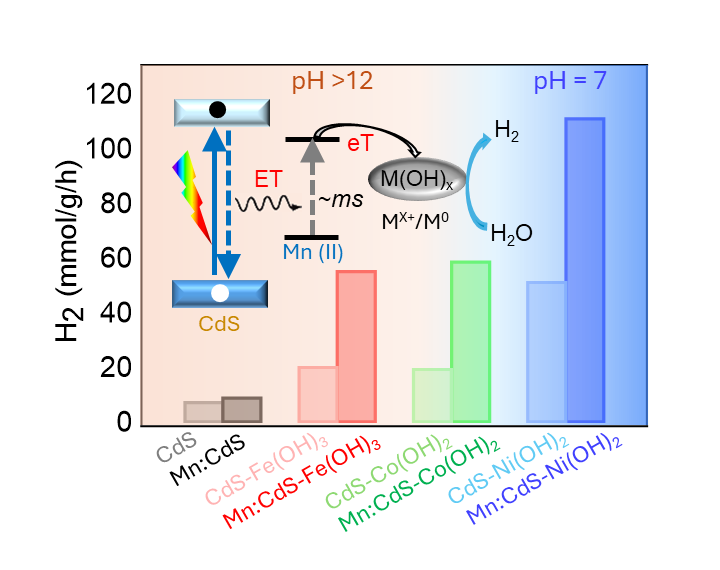
The photocatalytic hydrogen generation experiments conducted by Professor Weiwei Zheng and colleagues provided a direct measure of how these combined effects translate into photocatalytic activity. Undoped CdS nanorods showed only modest hydrogen evolution, and Mn(II) doping into CdS alone didn’t make a significant change. However, once they introduced metal hydroxides, large hydrogen production occured. The enhancement is especially pronounced for Ni(OH)₂ under neutral conditions, while Co(OH)₂ and Fe(OH)₃ show improved performance under strongly basic environments. This indicates that the long-lived Mn-derived states facilitate charge transfer to the co-catalyst, and this transfer enables accumulation of electrons at the hydroxide surface where reduction reactions occur. The efficiency of this process depends on both the presence of dopants as well as the chemical state of the co-catalyst (which varies with pH and influences electron transfer energetics).
The new work demonstrates how dopant-mediated charge dynamics can be coupled to non-noble co-catalysts in semiconductor nanostructures. Instead of relying on highly conductive noble metal domains to extract carriers, the proposed work uses Mn(II) dopants to extend the lifetime of excited states, effectively aligning the timescale of charge separation with that of surface reactions. This temporal alignment appears to compensate for the different electronic characteristics of metal hydroxides and can result in a functional hybrid in which electron transfer proceeds through a three-step process: initial excitation within CdS, followed by energy transfer to Mn states, and finally electron migration to the co-catalyst. Under more alkaline conditions, the formation of charged hydroxide species alters the electrostatic environment, influencing the ease with which electrons can reach the catalytic surface. This introduces a chemical dimension to the charge transfer process that goes beyond simple band alignment. Another important finding is that dopants alone do not significantly enhance hydrogen generation. Their role is not to serve as catalytic sites but to mediate charge transport. The co-catalyst remains essential for providing active sites, while the dopant modifies how efficiently those sites are supplied with electrons and this clarifies why combining both elements produces a synergistic effect. The study therefore clarifies how dopant-mediated charge transport can be used to connect semiconductor light absorption with non-noble hydroxide catalytic sites



Reference
MacSwain, Walker & Hu, Xia & Wu, Rongzhen & Li, Zhi-Jun & Vanshika, Vanshika & Ma, De-Kun & Chen, Ou & Zheng, Weiwei. (2026). Noble-metal-free metal hydroxide Co-catalyst coupled Mn(ii)-doped CdS nanorods with bridged charge transport for enhanced photocatalytic hydrogen generation. Journal of Materials Chemistry A. 14. 11456-11470. 10.1039/D5TA08886K.
Go to Journal of Material Chemistry A