Advances in Engineering Advances in Engineering features breaking research judged by Advances in Engineering advisory team to be of key importance in the Engineering field. Papers are selected from over 10,000 published each week from most peer reviewed journals.

Significance Statement:
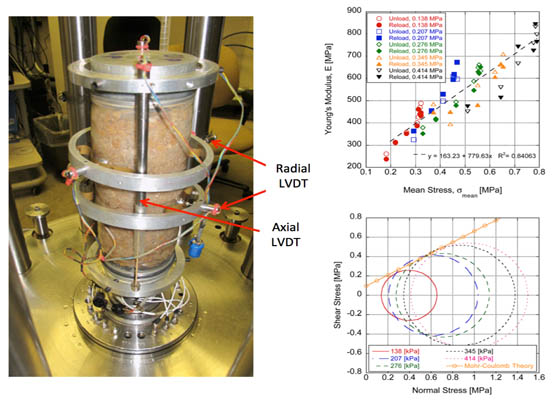
Thermocline tanks have been considered as an alternative to traditional two-tank molten salt thermal storage in concentrating solar power systems due to their potential for cost reduction. One concern for thermocline usage is thermal ratcheting caused by the internal rock bed deformation during cyclic operation and significant temperature fluctuations. Thermal ratcheting studies have been performed in the literature to identify the possibility of tank rupture. However, these studies numerically modeled the ratcheting behavior utilizing bed properties that have never been measured for the materials used in thermocline storage systems. This work presents triaxial test data for quartzite and silica thermocline filler materials to better inform future investigations of thermal ratcheting. Material property data for cohesion, dilatancy angle, internal angle of friction, Young’s modulus, Poisson’s ratio, and bulk modulus are presented for 0.138–0.414 MPa confining pressure. Cohesion values of 0.096–0.112 MPa and internal angle of friction values of 29.5–33.5 were obtained using Mohr–Coulomb failure theory. Dilatancy angles of 14.5–24.1 degrees were obtained using plastic volume strain and axial strain. Significantly higher Young’s modulus values are expected at pressures near the tank bottom than that considered by thermocline ratcheting studies performed in the literature. Additional material properties were compared to those assumed in the literature and implications on the potential impact of this property data relative to thermal ratcheting are provided.
Journal Reference
Journal of Solar Energy Engineering, Volume 136, Issue 4, research-article.
Brian D. Iverson 1, Stephen J. Bauer 2 , Scott M. Flueckiger 3
- Department of Mechanical Engineering, Brigham Young University, Provo, UT 84602Sandia National Laboratories,
Albuquerque, NM 87185 . e-mail: [email protected] - Sandia National Laboratories,Albuquerque, NM 87185 ,
- School of Mechanical Engineering, Purdue University, West Lafayette, IN 47907.
Abstract
Thermocline tanks have been considered as an alternative to traditional two-tank molten salt thermal storage in concentrating solar power systems due to their potential for cost reduction. One concern for thermocline usage is thermal ratcheting caused by the internal rock bed deformation during cyclic operation and significant temperature fluctuations. Thermal ratcheting studies have been performed in the literature to identify the possibility of tank rupture. However, these studies numerically modeled the ratcheting behavior utilizing bed properties that have never been measured for the materials used in thermocline storage systems. This work presents triaxial test data quartzite and silica thermocline filler materials to better inform future investigations of thermal ratcheting. Molten salt is replaced with water as the interstitial fluid due to similarity in dimensionless numbers and to accommodate room temperature measurement. Material property data for cohesion, dilatancy angle, internal angle of friction, Young’s modulus, Poisson’s ratio, and bulk modulus are presented for 0.138–0.414 MPa confining pressure. The material properties are then compared to those assumed in the literature to comment on the potential impact of this property data relative to thermal ratcheting.
Copyright © 2014 by ASME