 Advances in Engineering Advances in Engineering features breaking research judged by Advances in Engineering advisory team to be of key importance in the Engineering field. Papers are selected from over 10,000 published each week from most peer reviewed journals.

Significance Statement
The research interests of Dr Lanbo Di at Dalian University, China, focus on fabrication of nanomaterials by atmospheric-pressure cold plasma technologies and their environmental and energy applications, in particular
(1) Dry plasma fabrication of supported metal catalysts and their environmental applications;
(2) In-solution plasma fabrication of semiconductor materials and their photocatalytic applications.
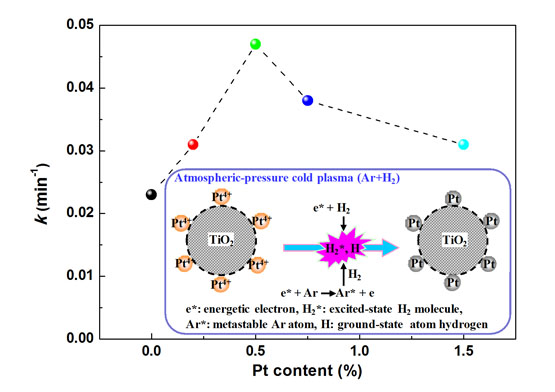
Figure Legend: Synthesis mechanism of Pt/TiO2 by plasma. The optimal Pt content is 0.5wt%, which is much lower than that in previous works (1.0-1.5wt%). Atmospheric-pressure DBD cold plasma was proved to be an environmentally friendly and efficient method for preparing high performance Pt/TiO2 photocatalyst.
Plasma Chemistry and Plasma Processing, March 2014, Volume 34, Issue 2, pp 301-311.
Date: 23 Dec 2013.
Lanbo Di, Xiuling Zhang, Zhijian Xu, Kai Wang.
College of Physical Science and Technology, Dalian University, Dalian, 116622, People’s Republic of China.
Abstract
Atmospheric-pressure dielectric barrier discharge (DBD) cold plasma was employed to fabricate Pt/TiO2 photocatalyst using the mixture of Ar and H2 as working gas. X-ray photoelectron microscopy (XPS) and transmission electron microscopy (TEM) measurements were used to characterize the Pt/TiO2 photocatalyst. The results showed that H2PtCl6 was completely reduced to metallic Pt nanoparticles when the treating time was increased to 6 min. In addition, the Pt/TiO2 photocatalyst prepared by atmospheric-pressure DBD cold plasma (Pt/TiO2-P) showed high dispersion and smaller size of Pt particles, and enhanced metal-support interaction. The photocatalytic degradation of methylene blue (MB) was chosen as a model reaction to evaluate the activity of the Pt/TiO2photocatalyst. The apparent rate constant of 0.5 wt% Pt/TiO2-P for the MB photodegradation was 1.4 times higher than that over 0.5 wt% Pt/TiO2-C sample (prepared by thermal reduction method). This may be attributed to the smaller size and high dispersion of Pt particles, and the enhanced metal-support interaction in Pt/TiO2-P sample, which was consistent with the results of XPS and TEM. The influence of Pt content on photocatalytic activity of Pt/TiO2-P was investigated, and the highest apparent rate constant was obtained at 0.5 wt% Pt content. This was much lower than that prepared by conventional methods. Optical emission spectra (OES) were observed during the reduction process of Pt ions by atmospheric-pressure DBD cold plasma, and the reduction mechanism was further discussed.