 Advances in Engineering Advances in Engineering features breaking research judged by Advances in Engineering advisory team to be of key importance in the Engineering field. Papers are selected from over 10,000 published each week from most peer reviewed journals.

Significance Statement
It is well known that pH is a key parameter for the Cr(VI) removal during electrocoagulation (EC) process. Higher or lower solution pH may lead to an unsatisfactory EC performance. Hence it is of some significance for understanding the factors that influence the finial pH and quantifying the relationships among them. Up to now, the topic about this, however, has never been documented. Therefore, in this work we aim to build a pH evolution-Cr(VI) removal theory that elaborates the influence factors of finial pH. Our results suggested that when p[Cr(VI)] = pHi, the finial pH was neutral; p[Cr(VI)] < pHi, alkaline; and p[Cr(VI)] > pHi, acidic.
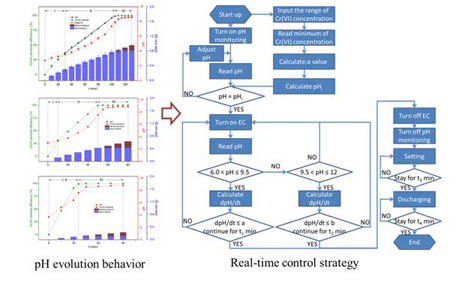
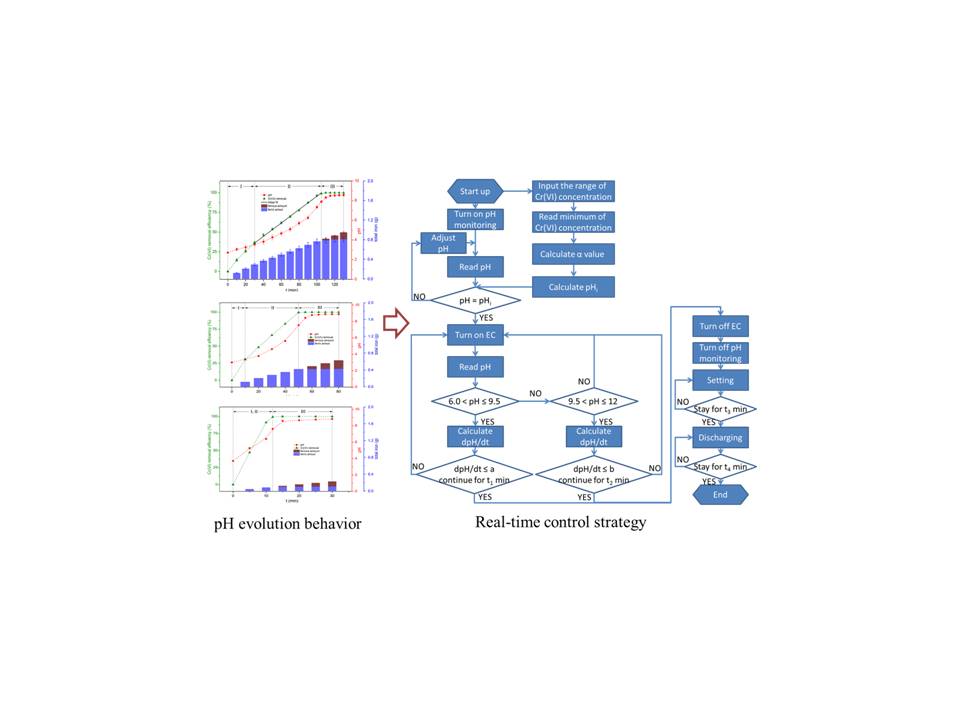
On the other hand, the implementation of field-scale Electrocoagulation (EC) systems usually operates under continuous and excess current supply conditions to guarantee Cr(VI) removal completely, hence, resulting in a high iron materials and electric energy consumption. Fortunately, reports showed that the real-time control process, operated with online monitoring by specific index (such as pH) offers many advantages such as self-adjusted to various treatment conditions and energy savings. Consequently, our research concentrated on the investigation of pH evolution with Cr(VI) removal for three different conditions of finial pH (neutral, alkaline and acidic respectively). Afterwards, an integrated real-time control scheme was firstly proposed for fluctuant (or stable) Cr(VI)-containing wastewater treatment based on the feature of pH evolution, which would possesses guiding significance for precise control of current density for Cr(VI) removal during EC process.
Figure Legend Figure 1. Real-time control strategy of EC process for Cr(VI) removal.
Chemical Engineering Journal, Volume 239, 1 March 2014, Pages 132-140.
Hai-yin Xu, Zhao-hui Yang, Guang-ming Zeng, Yuan-ling Luo, Jing Huang, Li-ke Wang, Pei-pei Song, Xi Mo.
College of Environmental Science and Engineering, Hunan University, Changsha 410082, PR China.
Abstract
The pH value is easily monitored and widely used in real-time control processes. It is also a key parameter in removing Cr(VI) during electrocoagulation. We developed a theory of relations between initial pH (pHi) and chromic alkalinity (p[Cr(VI)]), and the final pH of a solution. That was, when p[Cr(VI)] = pHi, the final pH was neutral; when p[Cr(VI)] < pHi, the final pH was alkaline; and when p[Cr(VI)] > pHi, the final pH was acidic. Response surface methodology confirmed that final pH was influenced by initial pH and initial Cr(VI) concentration rather than by current density. Subsequently, the relationship between pH evolution and Cr(VI) removal was investigated for the aforementioned final pH conditions. Our results suggested that the point of final pH can be detected by the features of pH evolution in case of p[Cr(VI)] = pHi and p[Cr(VI)] < pHi. Rapid Cr (VI) removal rate was achieved when p[Cr(VI)] > pHi. However, the major fraction of dissolved Cr (III) and the uncertain point of final pH were observed in this condition. Finally, we proposed a real-time control strategy for treating fluctuant (or stable) Cr(VI)-contaminated wastewater based on the features of pH evolution.
