Advances in Engineering Advances in Engineering features breaking research judged by Advances in Engineering advisory team to be of key importance in the Engineering field. Papers are selected from over 10,000 published each week from most peer reviewed journals.

Significance Statement
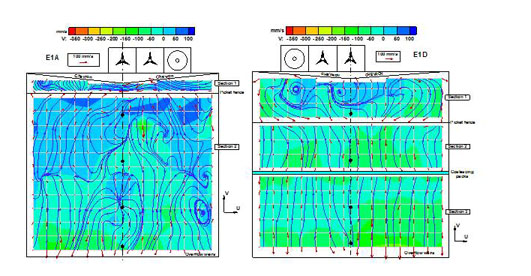
Figure Legend 2D velocity vectors, streamlines and longitudinal velocity contours of the organic layer inside settlers with old (left) and new furniture (right), highlighting the improved flow behaviour obtained with the new furniture.
Chemical Engineering Science, Volume 104, 18 December 2013, Pages 925–933.
K. Mohanarangam a, , , W. Yanga, K.R. Barnardb, N.J. Kellyb, D.J. Robinsonb
a CSIRO Process Science and Engineering/CSIRO Minerals Down Under National Research Flagship, P.O. Box 312, Clayton South, VIC 3169, Australia and
b CSIRO Process Science and Engineering/CSIRO Minerals Down Under National Research Flagship, P.O. Box 7229, Karawara, WA 6152, Australia.
Abstract
Details behind the experimental technique of ultrasonic velocity profiling (UVP) to obtain in situ velocity measurements of both aqueous and organic phases in commercial solvent extraction Solvent Extraction settlers are presented. The commercial applicability and benefit of the process is demonstrated via the on-site analysis of two settlers at a commercial copper solvent extraction operation. The two settlers had the same dimensions and were operated under essentially equivalent conditions but differed in terms of being assessed before and after routine maintenance, with the internal ‘furniture’ configuration of the latter also being modified. UVP-determined organic and aqueous flow pattern results from the two settlers are reported and compared in relation to the furniture configuration/maintenance status of each. The results highlight the potential for UVP analysis to ascertain flow patterns in commercial solvent extraction settlers to benefit industrial operations directly and to enable the development of improved mathematical (computational fluid dynamics) modelling of flow patterns in settlers.