Advances in Engineering Advances in Engineering features breaking research judged by Advances in Engineering advisory team to be of key importance in the Engineering field. Papers are selected from over 10,000 published each week from most peer reviewed journals.

Significance Statement
The authors presented a lock-in technique that allows the modulation of the reaction current to be followed in situ while a small cyclic strain is imposed on the electrode material. It thus provides a new tool for studying strain-dependent catalysis on materials surfaces and for identifying the underlying microscopic processes in the interest of developing improved catalyst materials.
Journal Reference
Journal of Catalysis, Volume 309, January 2014, Pages 351-361.
Qibo Denga, Maxim Smetaninb, Jörg Weissmüllera, c
a Institut für Werkstoffphysik und Werkstofftechnologie, Technische Universität Hamburg-Harburg, Hamburg, Germany and
b Department of Chemistry, University of Guelph, Guelph, Ontario, Canada and
c Institut für Werkstoffforschung, Werkstoffmechanik, Helmholtz-Zentrum Geesthacht, Geesthacht, Germany.
Abstract
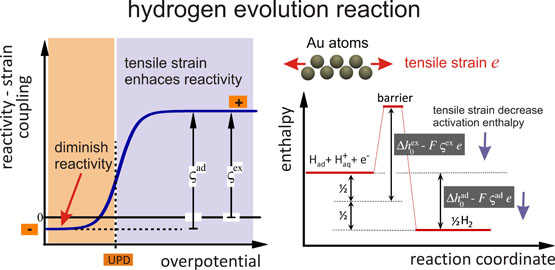
Many modern catalyst materials exploit a strained surface layer as the active component. Here, we explore how the catalytic activity is affected by changes in the lattice parameter, focusing on the hydrogen evolution reaction on Au and Pt electrodes in H2SO4 as a model process. We present a lock-in technique that allows the modulation of the reaction current to be followed in situ while a small cyclic elastic strain is imposed on the electrode material. We find that tensile strain enhances the exchange current density and the reactivity at low overpotential, {DELTA}E, whereas the trend is inverted and the reactivity diminished at higher {DELTA}E. We introduce kinetic rate equations for Heyrowsky and Tafel kinetics, allowing for strain dependence of the hydrogen adsorption enthalpy as well as the activation enthalpy. The results link the reactivity modulation to electrocapillary coupling coefficients that are open to investigation by experiment or ab initio computation. The inversion in sign of the coupling as the function of {DELTA}E emerges in agreement with experiment.