Advances in Engineering Advances in Engineering features breaking research judged by Advances in Engineering advisory team to be of key importance in the Engineering field. Papers are selected from over 10,000 published each week from most peer reviewed journals.

Significance Statement
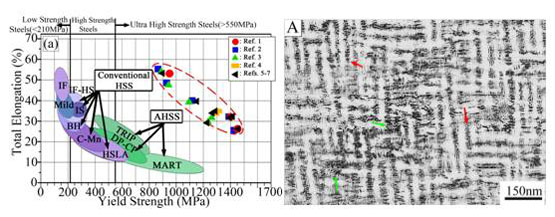
Figure legend: Unprecedented combination of yield strength and elongation exhibited in a series of ultrahigh-strength and high-ductility, light-weighted FeMnAlC alloys (indicated by symbols) and deformation mechanism manifested by bursting dislocations in the austenite nano-channels (TEM image).
Journal of Alloys and Compounds, Volume 586, 2014, Pages 616–620.
Chih-Lung Lina, Chuen-Guang Chaoa, Jenh-Yih Juangb, Jenn-Ming Yangc, Tzeng-Feng Liua
a Department of Materials Science and Engineering, National Chiao Tung University, Hsinchu, Taiwan and
b Department of Electrophysics, National Chiao Tung University, Hsinchu, Taiwan and
c Department of Materials Science and Engineering, University of California, Los Angels, CA, USA.
Abstract
The deformation mechanisms of a bulk nanostructured Fe–30Mn–9.5Al–2.0C (in wt.%) alloy were investigated. After aging at 450 °C for 9–12 h, the alloy exhibits an exceptional strength-ductility combination (e.g. yield strength ∼1406 MPa with elongation ∼32%). The aged alloy exhibits a novel microstructure with isolated austenite nano-channels bounded by an extremely high volume fraction of directional nano-sized (Fe,Mn)3AlC carbides (κ′-carbides). The plastic deformation was found to be dominated by bursting dislocation nucleation within the isolated austenite nano-channels.