 Advances in Engineering Advances in Engineering features breaking research judged by Advances in Engineering advisory team to be of key importance in the Engineering field. Papers are selected from over 10,000 published each week from most peer reviewed journals.

Significance statement.
The spin-polarized electron spectroscopy is a perfect tool for probing the general spin-dependent properties of surfaces, magnetic and nonmagnetic materials. Importantly it provides a direct access to the problems of contemporary applied solid state physics:
Injection of spin-polarized electrons into solid state structure, transport of spin-polarized electrons inside solids and detection of spin-polarized electrons in electronic devices. These are the main issues in the development of a new area of solid state electronics exploiting electron spin, e.g. Spintronics.
New quantum phenomenon, such as Spin Quantum Hall Effect due to a spin-orbit interaction inside a solid slab. The ability to use this effect depends very much on an ability to control the spin-orbit interaction.
Topological insulators – new class of materials exhibiting particular spin-related properties, such as the edge spin-current state. For studying such properties the use of spin-polarized electron spectroscopy is the best choice.
The extension of a “single-electron” spin-polarized electrons spectroscopy (one electron detected) to a “two-electron” spin-polarized electron spectroscopy (two correlated electrons detected) substantially enlarges the information we can extract from measurements.
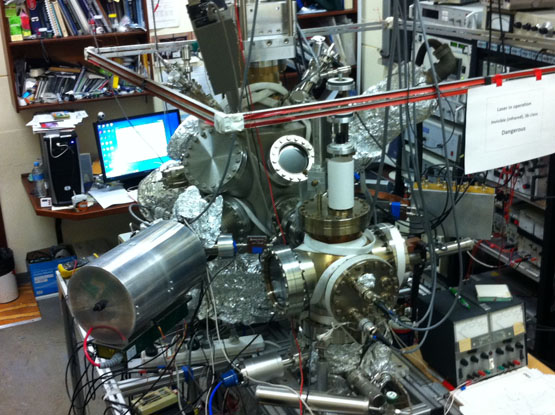
Journal Reference
Surface Science, Volume 617, November 2013, Pages 22–28.
Samarina, , O.M. Artamonovb, P. Guagliardoa, K. Sudarshana, M. Kostyleva, L. Pravicaa, A. Barabanb, J.F. Williamsa
a Centre for Atomic, Molecular and Surface Physics, University of Western Australia, Perth, WA 6009, Australia.
b Research Institute of Physics, St. Petersburg University, St. Petersburg, 199034, Rus.
Abstract
The intensity asymmetry of the secondary emission spectra of thin iron films on W(110) excited by spin-polarized electrons was measured at various geometrical arrangements and various primary energies. The magnitude and shape of the Stoner excitation asymmetry provide information on the magnetic state of the film. The geometrical structure of the film influences its magnetism and this is reflected in the asymmetry of the spin polarized electron energy loss spectra (SPEELS). Oxygen adsorption reduces the asymmetry of Stoner excitations, but not as dramatically as in studies of Ni surface. The kinematics of the scattering process influences the asymmetry of the spectra and should be taken into account while using SPEELS for studying surface magnetism. Theoretical analysis of asymmetry spectra measured at various scattering conditions is required.