Advances in Engineering Advances in Engineering features breaking research judged by Advances in Engineering advisory team to be of key importance in the Engineering field. Papers are selected from over 10,000 published each week from most peer reviewed journals.

Significance Statement
Thin-walled members with open sections are widely used in metal building construction, and also in machinery, shipbuilding and aviation industries.
Increasingly higher strength steels prompt the designers of thin-walled structures to use lightweight elements with small wall thickness. The load bearing capacity of such members is conditioned by local buckling of the section. Thin-walled members are also characterised by small torsional rigidity.
Up to now, calculations for thin-walled members subjected to warping torsion were performed using the Vlasov theory. That is reflected in modern structural design codes for cold-formed steel members, where the possibility of the local buckling of the thin-walled section under warping torsion is disregarded.
In the study, it is experimentally demonstrated and theoretically confirmed that thin-walled bars with open sections, subjected to warping torsion, can undergo local buckling when no other loads act on them. The “local critical bimoment”, which produces local buckling of a thin-walled bar, is defined. It constitutes a limit of the Vlasov theory validity. It is shown that two local critical bimoments are present in bars with asymmetrical sections depending on the sense of the torsional load. Those bimoments differ in their absolute value, the right one is greater and the left one is smaller. In the experiments conducted for the study, the right local critical bimoment was more than three times greater than the left one.
Such substantial differences may significantly affect the reliability of thin-walled structures, in which torsional moments and bimoments occur.
In addition, a method for determining the so-called “local ordered deflection interval” was developed in the study. In this interval, the modelled deflection of the component plates (walls) of a thin-walled member with random wall geometrical imperfections is compliant with the local buckling mode. The “local ordered deflection interval” makes it possible to adjust the known experimental methods so that they could be used to determine critical torsional loads and local critical bimoments.
The phenomenon of “displacement ordering”, discussed in the study, can be expected to have a wider range of application. It can be used to analyse the stability and capacity of those thin-walled structures, in which close eigenvalues of critical loads associated with different buckling modes occur. For very close successive eigenvalues, that can result in the least critical load being undetected in the experiment when classical methods are used. It happens so because every experimental model features an individual set of random geometrical imperfections.
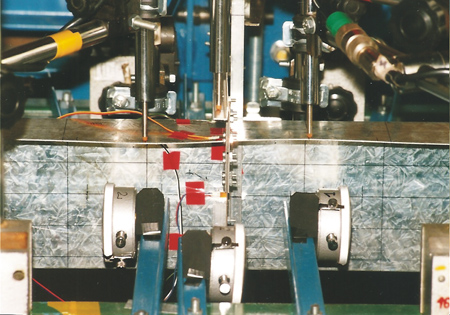
Figure Legend: The local buckling of the top flange of the Z – section subjected to warping torsion.
Journal Reference
Thin-Walled Structures,Volume 75, 2014, Pages 87–102.
Zbigniew Kowal, Andrzej Szychowski.
Faculty of Civil Engineering and Architecture, Kielce University of Technology, Al. Tysiąclecia Państwa Polskiego 7, 25-314 Kielce, Poland.
Abstract
Critical loads were determined experimentally from the condition of the local buckling of thin-walled bars with Z-section subjected to warping torsion. The experimental investigations were carried out using simply supported models, loaded with a concentrated torsional moment at the mid-span. A method of determining the so-called “local ordered deflection interval” was developed. In this interval, the modeled deflection of the component plates (walls) of a thin-walled bar with random wall geometrical imperfections is compliant with the local buckling mode. The “local ordered deflection interval” makes it possible to adjust the known experimental methods so that they could be used to determine critical torsional loads and local critical bimoments. Experimental investigations showed the occurrence of two local critical bimoments in bars with Z-section. The bimoments are different in their absolute values, depending on the sense (sign) of the torsional load. Experimentally determined critical loads were compared with theoretical results.