Advances in Engineering Advances in Engineering features breaking research judged by Advances in Engineering advisory team to be of key importance in the Engineering field. Papers are selected from over 10,000 published each week from most peer reviewed journals.

Significant Statement
Organic field-effect transistors (OFETs) have attracted much attention due to their merits of mechanical flexibility and high compatibility with the large area electronic devices. Nowadays, organic field-effect transistors are widely used in the fields of electronic nose, memory device, and radio frequency identification. Research focusing on OFET over the past 25 years has contributed greatly to the scientific understanding of the fundamental charge transport and injection physics of conjugated polymer and small-molecule organic semiconductors.
However, there are still problems which inhibit its further development to meet the practical requirements. One of the main problems is the presence of the inevitable injection barrier between the organic semiconducting layer and the source/drain electrodes, which is the key factor to determine the charge carrier injection. High injection barrier results in an inferior charge injection, leading to the decrease of the charge mobility of organic field-effect transistors .
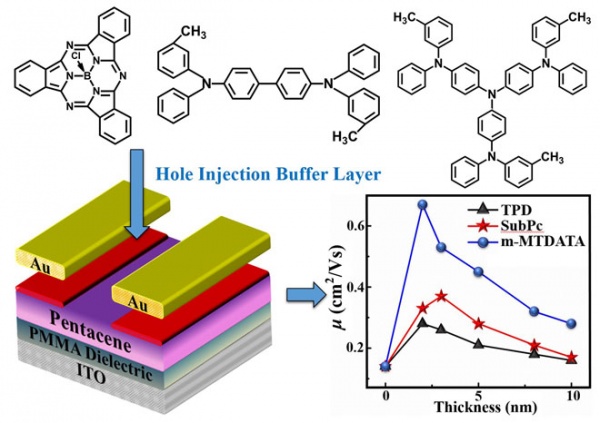
This work contributes knowledge on the effects of three kinds of organic hole transporting materials, i.e. subphthalocyanine chloride (SubPc), triphenyldiamine derivative (TPD), and 4,4′,4”-tris[3-methylphenyl(phenyl)amino] triphenylamine (m-MTDATA), as charge injection buffer layers on the performance of pentacene based organic field-effect transistors . After adding the charge injection buffer layer, the interface between the organic semiconducting layer and the source/drain electrodes was significantly modified. Thus, the injection barrier was significantly decreased, which led to the increase of the device performance. This work provided a way to modify the organic semiconducting layer/electrode interface and brings insights into organic transporting materials for the optimization of organic field-effect transistors performance.



Journal Reference
Jie Li, Wei Shi, Lufeng Shu, Junsheng Yu
State Key Laboratory of Electronic Thin Films and Integrated Devices, School of Optoelectronic Information, University of Electronic Science and Technology of China (UESTC), Chengdu, 610054, People’s Republic of China
Abstract
Top contact organic field-effect transistors (OFETs) based on pentacene active layer, which employed the organic buffer layers of subphthalocyanine, triphenyldiamine derivative, and 4,4′,4″-tris[3-methylphenyl(phenyl)amino] triphenylamine (m-MTDATA) as the hole injection layers were fabricated. The results showed that the electrical performance of these organic field-effect transistors , including the saturation current, the field-effect mobility, the on/off current ratio, and the threshold voltage, were all significantly improved by introducing the organic hole injection buffer layers. By optimizing the film thickness of these organic buffer layers to the appropriate thickness, the charge injection from gold source/drain electrodes to pentacene film could be effectively improved. Also, the interfacial properties and the contact resistance between gold source/drain electrodes and pentacene film was analyzed, and the results indicated that the interface property was significantly improved. Moreover, it was found that organic field-effect transistors with m-MTDATA hole injection layer exhibited the best performance compared to other two kinds of materials, and the intrinsic reason was further revealed.
Go To Journal of Materials Science: Materials in Electronics