 Advances in Engineering Advances in Engineering features breaking research judged by Advances in Engineering advisory team to be of key importance in the Engineering field. Papers are selected from over 10,000 published each week from most peer reviewed journals.

Spin waves are collective oscillations of magnetization in which neighboring magnetic moments undergo coordinated motion. Their energy is carried by magnons, which can propagate through magnetic materials without requiring an electrical current. Controlling these excitations is an important objective in magnonics, where spin waves are being investigated for transmitting and processing information.
Two-dimensional magnetic materials offer unusual forms of spin-wave behavior, including Dirac points, topological states, and flat energy bands. Dirac points occur where two energy bands meet, producing distinctive relationships between frequency and momentum. Flat bands, on the other hand, contain excitations whose frequency changes very little with momentum, allowing spin-wave energy to remain localized instead of propagating through the material.
Studying these states experimentally presents difficulties. Many occur at terahertz frequencies, where available methods for generating and detecting magnons are limited. The atomic structures responsible for their behavior are also difficult to modify locally. Creating comparable spin-wave states in larger, artificially patterned magnetic structures could make their properties easier to investigate and control.
Magnonic crystals provide a possible route. These structures contain periodic variations in magnetic material that alter how spin waves travel. Their geometry determines which frequencies can propagate, where energy gaps appear, and whether particular excitations become confined to selected regions. However, relating a complicated magnonic band structure to a simple physical model is not always straightforward. Without that connection, designing specific electronic-like states requires extensive numerical investigation.
A useful comparison comes from graphene and related two-dimensional materials. Their electronic properties can often be understood through tight-binding models, which describe particles occupying localized states and moving between neighboring sites. If an artificial magnetic lattice could reproduce comparable states, established principles from two-dimensional electronic systems might also become useful for engineering magnons.
In a recent research paper published in Physical Review X, Bobby Kaman, Jinho Lim, Yingkai Liu, and led by Professor Axel Hoffmann from the University of Illinois Urbana-Champaign investigated this possibility using patterned magnetic thin films. They examined whether the spin-wave spectrum of a hexagonal lattice of holes could be described through a compact tight-binding model and whether this description could guide the creation of localized and directional magnon states.
Experiments and Findings
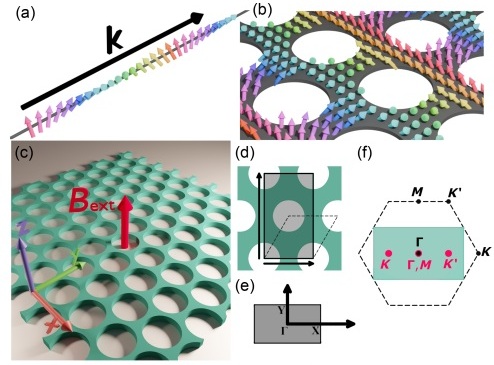
The investigation was conducted through micromagnetic simulations of yttrium iron garnet (YIG), a magnetic material known for its low spin-wave damping. The team considered a 15-nanometer-thick film patterned with a periodic hexagonal arrangement of holes, known as an antidot lattice. An external magnetic field aligned the magnetization perpendicular to the film, giving the spin waves a dispersion more closely resembling that of electrons in two-dimensional materials.
Changing the hole diameter produced substantial differences in the calculated band structure. A continuous film displayed the expected spectrum of freely propagating spin waves, and small holes modified the dispersion without opening complete spectral gaps. Larger holes produced a much richer spectrum, containing graphenelike Dirac points, additional bands resembling those of a kagome lattice, and several nearly flat bands.
The flat bands were especially interesting because they supported strongly localized spin-wave excitations. When the researchers continuously excited one of these bands at approximately 2.08 GHz, energy accumulated near the excitation region instead of spreading through the film. The calculated magnon density was approximately 1,000 times greater than in the comparison structures. Examination of the spatial phase pattern revealed a close resemblance to localized states in kagome lattices, where destructive interference between neighboring sites prevents wave propagation.
To understand the underlying band structure, the team analyzed the spatial distributions of the spin-wave modes. They identified three groups of localized basis functions: s-like and p-like modes associated with the honeycomb lattice, and s-like modes associated with kagome sites. Together, these provided nine degrees of freedom per primitive unit cell.
A nine-band tight-binding model, using localized mode energies and coupling between neighboring states, reproduced the main features of the simulated spectrum. This established a connection between the collective magnetization dynamics of a continuous patterned film and the localized-orbital description commonly used for electronic materials. The model did not capture every detail, including certain effects of magnetic dipolar interactions, but it provided a practical way to understand and manipulate the principal bands.
The researchers next examined whether breaking the symmetry between the two honeycomb sublattices could produce controllable band gaps. In graphene, the equivalence of these sublattices contributes to the existence of Dirac points. Making the sites inequivalent removes that symmetry and can separate the bands in frequency.
The simulations confirmed that modifying the antidot geometry opened gaps in both the lower-frequency s-like bands and higher-frequency p-like bands. These changes could be represented in the tight-binding model by assigning different energies to the two sublattices. The gap frequencies could also be shifted by adjusting the external magnetic field.
A further investigation considered boundaries between two patterned regions with opposite symmetry-breaking configurations. The corresponding bands possessed different valley-dependent Berry curvature, a quantity describing the geometric properties of their wave states in momentum space. This distinction supported boundary-localized modes analogous to those found in quantum valley Hall systems.
Spin waves excited at frequencies inside the bulk gaps propagated along the boundary rather than spreading into the surrounding material. Their direction of travel was associated with the valley index, which distinguishes the inequivalent K and K′ regions of momentum space. The team demonstrated boundary-guided propagation through sharp turns for both s-like and p-like modes.
The simulations also showed an important distinction from fully protected unidirectional topological states. Oppositely propagating valley modes can scatter into one another when a defect connects their valley states. Consequently, the boundary modes can experience reflection, despite their ability to follow curved interfaces.
Finally, the team investigated localized modes created by individual defects in the patterned lattice. Replacing one honeycomb site with a different magnetic geometry produced an isolated mode below the continuum of propagating spin waves. Placing two defects next to one another allowed their modes to couple, splitting a single resonance at approximately 1.47 GHz into two frequencies near 1.38 and 1.56 GHz. The resulting symmetric and antisymmetric states agreed with the tight-binding interpretation and remained spectrally separated from the extended spin-wave modes.
Engineering Significance
Professor Axel Hoffmann and colleagues establishes a connection between the electronic physics of two-dimensional lattices and the dynamics of spin waves in patterned magnetic films. Its scientific value lies in showing that a continuous magnetic structure can support an effective set of localized orbitals, allowing its complex spectrum to be understood using a relatively simple model.
This connection provides a means of designing magnonic states through geometric symmetry and the coupling between localized modes. It also explains why different regions of the same band structure can exhibit distinct behavior, including dispersive propagation, flat-band localization, and valley-dependent transport.
The existence of both s-like and p-like valley modes expands the possibilities for controlling spin waves. Their different frequency ranges provide separate channels for valley-dependent propagation, and an externally applied magnetic field offers additional control without changing the patterned structure.
Strong confinement in flat bands could be useful for exploring nonlinear magnon interactions, since localized excitations can reach high magnon densities under continuous excitation. Spectrally isolated defect modes provide another form of confinement, with possible applications in resonant magnonic elements and coupled-mode systems.
The new study is based primarily on simulations and theoretical modeling rather than an experimental demonstration of operating devices. Nevertheless, the proposed YIG structures use dimensions and patterning methods compatible with established nanofabrication techniques. The authors also examined the effects of fabrication-related imperfections, finding that the principal features persisted under the simulated conditions.
Beyond the hexagonal structure, related calculations for square antidot and artificial kagome lattices suggest that localized-orbital descriptions may be useful for other patterned magnetic systems. This provides a basis for designing microwave-frequency magnonic structures using physical concepts normally associated with atomic-scale two-dimensional materials.

Reference
Bobby Kaman, Jinho Lim, Yingkai Liu, Axel Hoffmann. Emulating 2D Materials with Magnons. Physical Review X, 2026; 16 (1) DOI: 10.1103/t7tm-nxyl