Advances in Engineering Advances in Engineering features breaking research judged by Advances in Engineering advisory team to be of key importance in the Engineering field. Papers are selected from over 10,000 published each week from most peer reviewed journals.

Significance Statement
Acid mine drainage (AMD) results from the microbiological oxidation of the sulfide residues (largely pyrite FeS2) which remain after primary processing of sulfidic metal ores. This biological process initially yields sulfuric acid and iron in the 2+ oxidation state (Fe2+), along with solubilization of other metals from the ore body. Subsequent chemical processes lead to the atmospheric oxidation of iron to the 3+ oxidation state and precipitation of an unsightly orange precipitate of iron oxyhydroxide that smothers biota. Acid mine drainage prevention is the optimal approach but is not always possible; as a result acid mine drainage remains a significant problem worldwide, especially at abandoned mine workings.
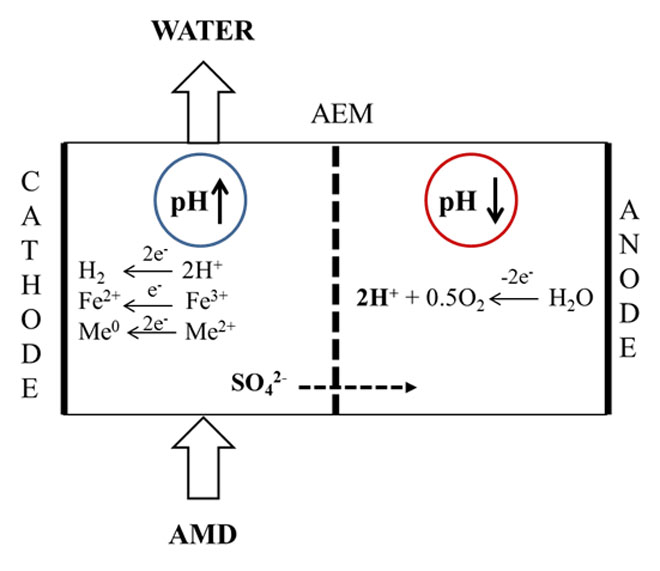
Conventional treatment of acid mine drainage involves neutralization of acid mine drainage with a base such as powdered limestone, but this yields a voluminous hydroxocarbonate sludge that is very difficult to dewater. Our paper reviews various electrochemical approaches to both prevention and treatment of acid mine drainage. One of the most promising possibilities involves water splitting using a divided electrochemical reactor in which reduction of H+ at the cathode is physically separated from formation of H+ at the anode. The result, known as water splitting, is the transfer of acidity from the contaminated catholyte to the ‘clean’ anolyte. Sulfate ions are simultaneously transferred from the catholyte to the anolyte through a separator such as an anion exchange membrane (AEM).
Many other possible technologies are also under consideration, including electrodialysis, electrocoagulation, and electrochemical recovery of metals from the acid mine drainage (electrowinning). None of these technologies have been applied at full scale, and it is the objective of this review to stimulate research interest in a major environmental problem, not the least of which is the danger of massive environmental damage caused when untended ‘tailings ponds’ are breached and discharge their contaminant load into biologically productive rivers.
Journal Reference
Journal of Applied Electrochemistry, December 2015, Volume 45, Issue 12, pp 1239-1254.
Dorin Bejan, Nigel J. Bunce
Department of Chemistry, Electrochemical Technology Centre, University of Guelph, Guelph, N1G 2W1, Canada
Abstract
Acid mine drainage, caused by biological oxidation of sulfide minerals in the presence of air and water, is a significant environmental problem because of its acidity and the presence of high concentrations of iron and solubilized toxic metal ions. The focus of this review is to consider the prospects for electrochemical technologies for either prevention or remediation of acid mine drainage, with physico-chemical technologies mentioned for comparison.
Go To Journal of Applied Electrochemistry