Advances in Engineering Advances in Engineering features breaking research judged by Advances in Engineering advisory team to be of key importance in the Engineering field. Papers are selected from over 10,000 published each week from most peer reviewed journals.

Significance Statement
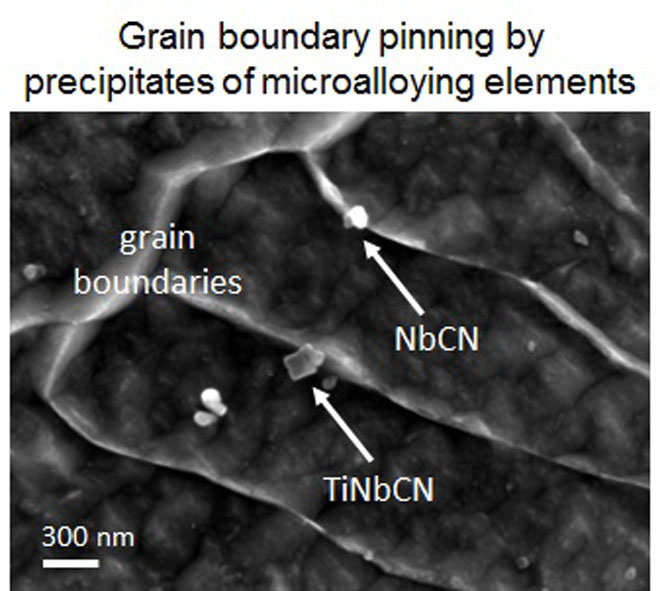
High strength low alloyed steels are a group of structural materials used in construction of buildings and bridges, manufacturing of cranes and heavy vehicles, extraction and transportation of oil and gas. Careful design of chemical composition (in particular, low C and presence of Ti, Nb and V) and thermomechanical processing (in particular, finish deformation temperature, cooling rate and cooling stop temperature) of these steels may result in high strength-to-weight ratio at a moderate cost. In the predominantly ferritic microstructure, characteristic for these steels, the four strengthening mechanisms operate: grain size, solid solution, precipitation and dislocation strengthening. In the paper presented below we investigated the effect of finish deformation temperature on relative contributions of the strengthening mechanisms on mechanical properties in one NbTi-microalloyed steel. To assess these contributions a thorough investigation of the microstructure was carried out. The following points define the significance of the obtained results:
- With a decrease in finish deformation temperature from 1075 to 825 °C the ambient temperature yield stress did not vary significantly, which was explained by compensation of the increased grain size strengthening by the decreased precipitation strengthening.
- With a decrease in finish deformation temperature from 1075 to 825 °C the ambient temperature tensile strength decreased (elongation to failure increased) as a result of a decrease in the work hardening rate, which followed a decrease in the precipitate number density and a decrease in the potential number of dislocation-particle interaction sites.
- The existing equations widely applied to assess the solid solution strengthening and precipitation strengthening contributions showed a significant overestimation with respect to measured properties, which can be related to two major reasons: (i) the equations assume that all solute atoms and precipitates become obstacles to the dislocation motion, although in reality they do not; and (ii) the equations disregard dislocation density, although it is equally responsible for a potential number of dislocation-obstacle interaction sites for any amount of precipitates and solute atoms.
Journal Reference
Metallurgical and Materials Transactions A,2015, Volume 46, Issue 8, pp 3470-3480.
Andrii G. Kostryzhev1, Olexandra O. Marenych2, Chris R. Killmore3, Elena V. Pereloma1,2
[expand title=”Show Affiliations”]- Faculty of Engineering and Information Sciences, School of Mechanical, Materials and Mechatronic Engineering, University of Wollongong, Northfields Avenue, Wollongong, NSW, 2522, Australia
- UOW Electron Microscopy Centre, University of Wollongong, Squires Way, Wollongong, NSW, 2519, Australia
- BlueScope Steel Limited, Five Islands Road, Port Kembla, NSW, 2505, Australia [/expand]
Abstract
The effect of deformation temperature on microstructure and mechanical properties was investigated for thermomechanically processed NbTi-microalloyed steel with ferrite-pearlite microstructure. With a decrease in the finish deformation temperature at 1348 K to 1098 K (1075 °C to 825 °C) temperature range, the ambient temperature yield stress did not vary significantly, work hardening rate decreased, ultimate tensile strength decreased, and elongation to failure increased. These variations in mechanical properties were correlated to the variations in microstructural parameters (such as ferrite grain size, solid solution concentrations, precipitate number density and dislocation density). Calculations based on the measured microstructural parameters suggested the grain refinement, solid solution strengthening, precipitation strengthening, and work hardening contributed up to 32 pct, up to 48 pct, up to 25 pct, and less than 3 pct to the yield stress, respectively. With a decrease in the finish deformation temperature, both the grain size strengthening and solid solution strengthening increased, the precipitation strengthening decreased, and the work hardening contribution did not vary significantly.
Go To Metallurgical and Materials Transactions A