Advances in Engineering Advances in Engineering features breaking research judged by Advances in Engineering advisory team to be of key importance in the Engineering field. Papers are selected from over 10,000 published each week from most peer reviewed journals.

Significance
Halide perovskites differ from many conventional semiconductors in the extent to which their electronic properties are coupled to lattice motion. In bromide perovskites, the lead-halide octahedral framework does not act as a rigid scaffold; its response depends strongly on the A-site cation and on the soft, anharmonic character of the lattice. Light, heat, electrical bias, and mechanical strain can all perturb the structure, and those perturbations can feed directly into absorption, emission, carrier transport, and lattice stability. For this reason, the structural response of halide perovskites under operating conditions is not a secondary detail; it is part of the functional physics of the material. Much of the technological interest in halide perovskites has been built around thin-film devices, yet polycrystalline films bring grain boundaries, substrate interactions, and residual strain into the interpretation of structural change. Single crystals offer a cleaner setting for examining how the lattice itself responds to optical excitation. They remove many of the complications associated with interfaces and grain-boundary disorder, allowing the intrinsic relation between photocarriers and lattice deformation to be examined more directly. That distinction matters when the central question is not simply whether a perovskite device changes under illumination, but how the crystal framework responds when above-bandgap light generates carriers inside a soft, anharmonic lattice.
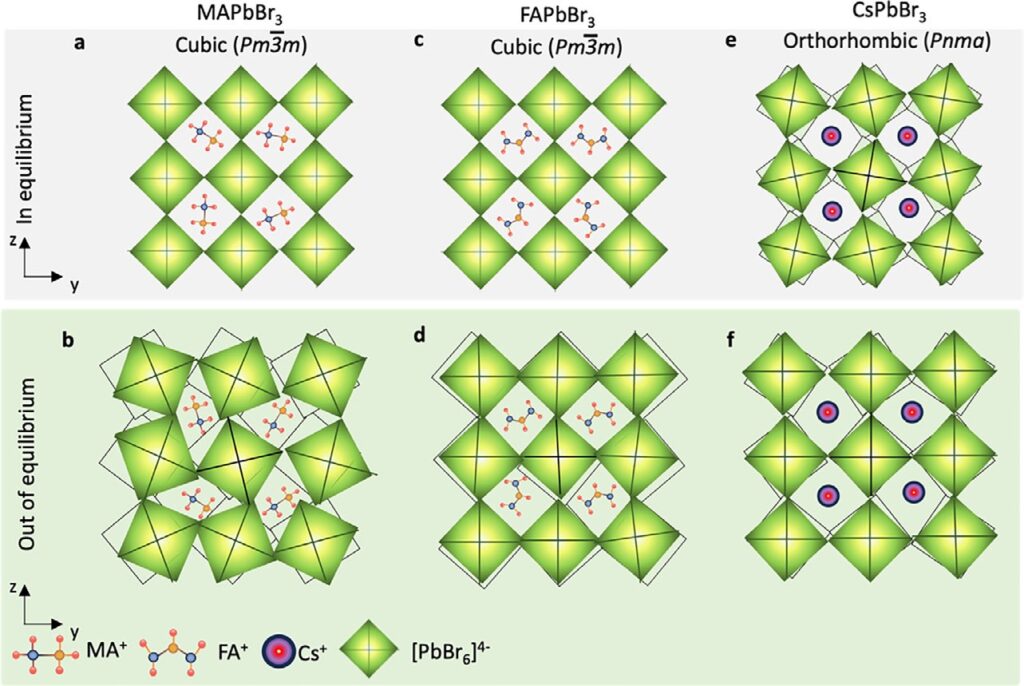
In a recent research paper published in Advanced Materials PhD candidate Mansha Dubey and Professor Marina S. Leite from University of California, Davis working together with Dr. Bekir Turedi, Dr. Andrii Kanak Professor Maksym V. Kovalenko Empa-Swiss Federal Laboratories for Materials Science and Technology developed an in situ optical-pump X-ray-probe approach for measuring photoinduced lattice distortions in halide perovskite single crystals. They applied it to MAPbBr3, FAPbBr3, and CsPbBr3 to compare how organic and inorganic A-site cations control reversible out-of-equilibrium lattice deformation. The technically distinct contribution is the demonstration of hysteresis-free, power-dependent, multi-state lattice distortion under above-bandgap illumination, with full recovery in the dark. They also established experimental controls showing that the measured distortion is primarily associated with photocarrier-lattice interaction rather than ordinary heating or phase segregation.
The researchers examined three bromide perovskite single crystals that differ in their A-site cation: MA+, FA+, and Cs+. MAPbBr3 and FAPbBr3 crystals were grown by inverse-temperature crystallization, while CsPbBr3 crystals were prepared using Bridgman growth. The use of single crystals was important because the measurements were intended to isolate lattice distortion from grain-boundary and substrate effects. Above-bandgap 532 nm laser excitation served as the optical stimulus, and X-ray diffraction provided the structural probe. By increasing and decreasing the pump power while repeatedly returning the crystal to dark conditions, the team could distinguish reversible elastic distortion from irreversible structural change.
The diffraction response revealed a clear dependence on cation chemistry. The investigators noticed under increasing laser power, the organic perovskites displayed shifts of the out-of-plane Bragg peaks toward smaller diffraction angles, consistent with an expansion of the relevant interplanar spacing. At the same time, the peak intensity decreased, especially for MAPbBr3, and the peak shape developed multiple components. This behavior indicates more than uniform lattice expansion. It reflects a distribution of interplanar spacings and distortions in the diffracting planes, consistent with lattice deformation involving octahedral tilting and local structural rearrangement. A design choice at the A-site therefore had a direct scientific consequence: molecular cations with orientational dynamics produced stronger photoinduced lattice distortion than the inorganic cesium analogue.
The team found MAPbBr3 gave the strongest structural response among the three materials. At high pump power, its diffraction profile showed a pronounced decrease in relative peak intensity and a broader spread in diffraction angle, with multiple peak components becoming distinguishable. FAPbBr3 also distorted under illumination, but its main peak remained more dominant across the pump-power range, indicating a lower degree of structural disruption despite measurable lattice expansion. CsPbBr3 behaved differently. Its diffraction peaks shifted only slightly, and their intensities remained comparatively stable, pointing to much greater resistance against photoinduced deformation.
The authors found that the organic cations introduce rotational and orientational degrees of freedom inside the lead-bromide octahedral cage, and the paper links their different dynamic character to the different distortion amplitudes observed experimentally. MA+ is associated with stronger dynamic disorder than FA+, while Cs+ lacks molecular dipoles and does not introduce the same cation reorientation. The inorganic lattice of CsPbBr3 therefore responds with a smaller structural change. Quantitatively, the reported change in the out-of-plane lattice parameter reached approximately 0.3% for MAPbBr3, 0.18% for FAPbBr3, and 0.062% for CsPbBr3. A central part of the analysis was the separation of photoinduced distortion from heating and the researchers estimated the temperature rise that would result if the laser energy were treated conservatively as heat, then compared that expectation with controlled temperature-dependent diffraction measurements. Heating produced the expected thermal expansion but did not reproduce the same intensity loss or peak-shape changes seen under illumination. Sub-bandgap excitation also did not generate the structural changes observed with above-bandgap light. These comparisons support the assignment of the distortion to photocarrier-lattice interactions rather than simple laser-induced warming.
Cyclability gave the most direct evidence that the deformation is elastic and reversible. After each illuminated measurement, the authors measured the crystals again in the dark, and the diffraction response returned to its equilibrium state. Across repeated increases and decreases in pump power, the lattice distortion recovered with about 99% reversibility. MAPbBr3 and FAPbBr3 also maintained stable illuminated states over the minutes-long measurement window, without progressive structural drift. When cycled between laser-on and laser-off conditions while the pump power was varied, MAPbBr3 displayed multiple distinguishable distorted states, whereas FAPbBr3 showed a sharper early response followed by a plateau in intensity. This power-dependent structural modulation is one of the most important observations in the paper.
The new collaborative study directly connects photoexcitation, A-site chemistry, and reversible lattice deformation in bulk halide perovskite single crystals. Rather than treating light-induced structural change as an incidental instability, the paper defines it as a controllable, recoverable response of the soft lattice. That distinction is scientifically important because it shifts attention from permanent degradation or phase change toward elastic structural modulation under optical excitation. The crystals do not simply tolerate illumination; their lattices enter reproducible out-of-equilibrium states and return to equilibrium when the stimulus is removed.
The comparison among MAPbBr3, FAPbBr3, and CsPbBr3 gives the findings their interpretive strength. The same experimental strategy applied across three A-site cations shows that the magnitude and character of lattice distortion are not generic properties of bromide perovskites. They depend on how the cation interacts with the lead-bromide framework and on how strongly the resulting lattice couples to photogenerated carriers. MAPbBr3 offers the largest and most tunable distortion, FAPbBr3 provides a substantial but more structurally concentrated response, and CsPbBr3 offers higher resistance to optical deformation. This cation-dependent behavior gives a concrete materials-design basis for selecting perovskites according to whether structural modulation or structural resilience is desired.
The study also demonstrates the methodological value of in situ X-ray diffraction under controlled optical excitation. By monitoring the lattice while the crystals are driven away from equilibrium, the researchers could identify reversible distortion, separate it from thermal expansion, and compare the response over many pump-power states. That capability matters for future studies of ionic semiconductors because the relevant material state during operation may not be the dark, equilibrium structure. For halide perovskites, where photocarriers and lattice motion are closely coupled, the operating lattice can carry information that conventional static measurements would miss. The implications remain properly bounded by the demonstrated systems: single-crystal bromide perovskites under above-bandgap optical excitation. Within that scope, the new findings support the use of halide perovskites as materials for strain-driven optical and electrostrictive functionality, especially when reversible, power-dependent lattice modulation is required. The work also clarifies why A-site cation selection should be treated as a structural control parameter, not merely a compositional variable for phase stability or optoelectronic tuning.


Reference
Dubey, Mansha & Türedi, Bekir & Kanak, Andrii & Kovalenko, Maksym & Leite, Marina. (2026). Reversible, Photo‐Induced Lattice Distortions in Halide Perovskites. Advanced Materials. 10.1002/adma.202521800.
Go to Journal of Advanced Materials