Advances in Engineering Advances in Engineering features breaking research judged by Advances in Engineering advisory team to be of key importance in the Engineering field. Papers are selected from over 10,000 published each week from most peer reviewed journals.

Significance Statement
The experiments on the ablative Richtmyer-Meshkov (RM) and the Rayleigh-Taylor (RT) instabilities were performed by a Q-switched ND:YAG laser on the titanium plates by the single pulse in the air at the atmospheric pressure. The rectangular laser beam had the one-dimensional Gaussian-like power distribution in the X-direction and a constant power in the Y-direction. (Es ~ 43 J/cm2; Ps ~ 1.1 GW/cm2 ; t = 40 ns, l = 10.6 mm). The laser pulse caused the plasma detonation and the shock wave that has generated the RM/RT instabilities which evolved on the multimodaly perturbed target surface.
The multimodal perturbation originated from two groups of surface corrugations. (i) the small-scale corrugations with the distance, dsmall that varied from few hundreds nm to ~ 1mm and the amplitude, A0 ~ 500 nm to 2 mm; and (ii) the large-scale ones with the distance, dlarge ~ 40 – 60 mm. The multimodal perturbation of the density interface consisted of a random combination of short wavelength modes (incommensurate modes) and of the long wavelength modes.
The Richtmyer–Meshkov structures that evolve on the surface are the spikes of a heavy fluid which propagate into the light fluid (above the target) and stay frozen permanently after pulse termination. Fast solidification of RMI/RTI structures makes possible a posteriori analysis and the direct insight into their formation and organizational complexity.
The shape and surface organization of RMI/RTI structures were studied by the scanning electron microscope. The analysis of the profiles, of the spatial amplitude variation as well as the Fast Fourier Transform of the modes, have been done by the Atomic Force Microscope.
The initial multimodal perturbation, the inhomogeneous momentum transfer and different Atwood number A and the Reynolds number Re caused the mixing process that has generated different shapes of spikes and bubbles in the Central Region and the Near-Central Region of the spot.
In the Central region, below the Gaussian maximum, (A ~ 1, Re ~ 103), where the vertical flow is strong and horizontal one is weak, the RMI/RTI form:
(i) The “egg carton morphology” of large-scale spikes and bubbles with superimposed random small-scale ones. The growth rate of the large–scale spikes is about 3 -4 times faster than of bubbles indicating scaling according to different laws.
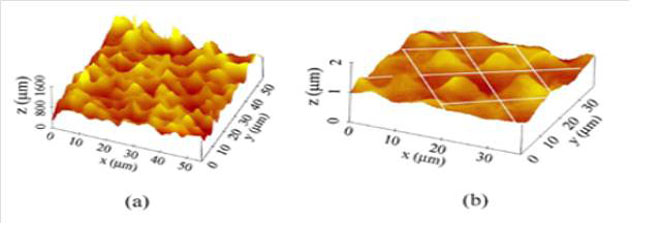
(ii) The wavy-like rows of small-scale spikes oriented in the direction of the constant power distribution. Fig.1a. The incommensurate perturbation modes cause turbulent mixing and merging which occurs in the unstable cycles oscillating as the kicked oscillator between two stable periods 1 and 2. Thus, the cycles of mixing and merging represent the supercritical Hopf bifurcation forming the selfsimilar structures with characteristics of a Cantor set.
(iii) The rows of aperiodic spikes with the periodic spike-segments oriented in the direction of the constant power distribution. The coherent flow intervals appear inside the incoherent flow field (along the rows) as the 1D periodic lattice segments inside the aperiodic ones.
In the Near Central Region, below the Gaussian wing (A < 1, Re ~ 104), where the vertical and horizontal flows are strong, the RMI/RTI, the mushroom-shape spikes and bubbles are organized on a 2D discrete square and the rhombic symmetry lattices. Fig.1b.
The nucleation of the isotropic square lattice appears due to balanced local momentum (Mlocal = 0), while the imbalanced local momentum (Mlocal ≠ 0) causes the formation of anisotropic lattices. The imbalanced momentum causes first the transformation of the square lattice with the period l ~ 3.2 mm into the anisotropic one and further, the increase (multiplication) of the lattice periods. The multiplication of the periods causes formation of the rhomboid lattice either with l1 ~ 2l and l2 ~ 3l, or with l1 ~ 3l and l2 ~ 4l. The increase of the periods l1 and l2 for 2, 3 or 4 times indicates formation of superstructure with double, triple, or quadruple lattice size.
It follows from this experimental study that the growth of sharp asymmetric spikes in the CR is an uncorrelated fast linear process. However, the growth of thick symmetric mushroom-type spikes on 2D lattice in the NCR is much slower, correlated and nonlinear process. The formation of 2D lattice of the RMI/RTI mushroom-shape spikes in local domains occurs as the nucleation of the new phase inside the old one indicating the analogy with the phase transitions.
Keywords: Laser ablation, Richtmyer-Meshkov instablity, Rayleigh-Taylor instability, Turbulent mixing, Self-similar structures, Coherent structures

Journal Reference
Laser and Particle Beams, Cambridge University Press, January, 2016.
Stjepan Lugomer
Rudjer Boskovic” Institute, Center of Excellence for Advanced Materials and Sensing Devices, Bijenička c. 54, 10000 Zagreb, Croatia
E-mail: [email protected]
Abstract
In this experimental study, the ablative Richtmyer–Meshkov (RM) and the Rayleigh–Taylor (RT) instabilities were generated by the laser pulse of Gaussian-like power profile. The initial multi-modal perturbation, the inhomogeneous momentum transfer and different Atwood numbers generate different shapes of spikes and bubbles in the central region (CR) and the near-central region (NCR) of the spot. A one-dimensional Gaussian-like power profile causes the formation of the wavy-like rows of aperiodic spikes. The periodic spike segments inside the rows appear due to locally coherent flow. In the NCR, the mushroom-shape spikes tend to the organization on the isotropic square and the anisotropic rhombic lattices. The increase of the lattice periods two, three, or four times indicates formation of superstructures. The growth of sharp asymmetric RM/RT spikes in the CR is fast, uncorrelated and linear, while the growth of the symmetric mushroom-shape ones in the NCR is slow, correlated, and nonlinear.
Go To Laser and Particle Beams