Advances in Engineering Advances in Engineering features breaking research judged by Advances in Engineering advisory team to be of key importance in the Engineering field. Papers are selected from over 10,000 published each week from most peer reviewed journals.

Journal Reference
Solar Energy Materials and Solar Cells, Volume 140, 2015, Pages 275-280.
Félix Urbain1, Vladimir Smirnov1, Jan-Philipp Becker1, Uwe Rau1, Jürgen Ziegler2, Bernhard Kaiser2, Wolfram Jaegermann2, Friedhelm Finge1
[expand title=”Show Affiliations”]- IEK-5 Photovoltaik, Forschungszentrum Jülich, D-52425 Jülich, Germany
- Institute of Materials Science, TU Darmstadt, D-64287 Darmstadt, Germany
Abstract
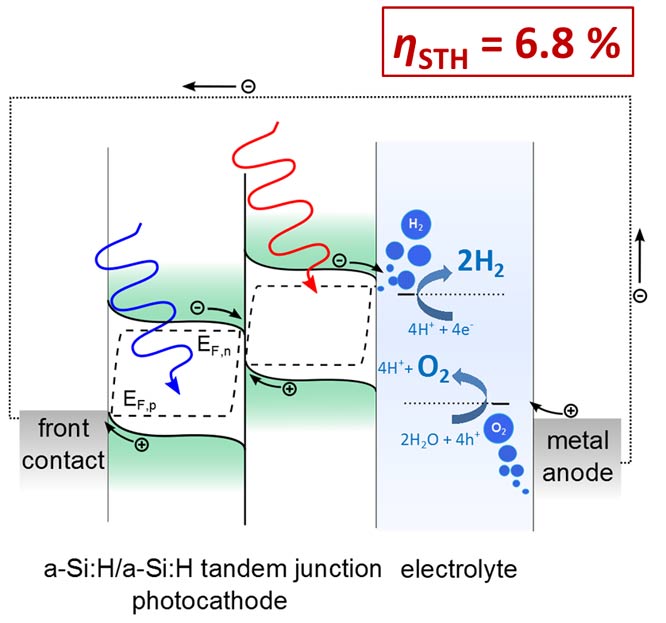
Direct solar-to-hydrogen conversion via water splitting was demonstrated in an integrated photovoltaic–electrochemical (PV–EC) device using a hydrogenated amorphous silicon thin film tandem junction (a-Si:H/a-Si:H) solar cell as photocathode. The solar cell was adapted to provide sufficient photovoltage to drive both the hydrogen and oxygen evolution reactions. The best results, in terms of photoelectrochemical stability and performance, were obtained with an Ag/Pt layer stack as H2 evolving photocathode back contact and with a RuO2 counter electrode for O2 evolution. Under irradiation by simulated sunlight (AM 1.5 spectrum with 100 mW/cm2), we achieved 6.8% solar-to-hydrogen efficiency at 0 V applied bias in a two-electrode set-up. This sets a fresh benchmark for integrated thin film silicon tandem based photoelectrochemical devices. In addition, the photovoltage at constant current (−3 mA/cm2) was measured over a prolonged period of time and revealed an excellent chemical stability (operation over 50 h) of the photocathode. Furthermore, we present an empirical serial circuit model of the PV–EC device, in which the corresponding photovoltaic and electrochemical components are decoupled. This allows for a detailed comparison between the solar cell and the PV–EC cell characteristics, from which the relevant loss processes in the overall system could be identified. The model was further used to compare calculated and measured photocurrent–voltage characteristics of the investigated PV–EC device which showed excellent agreement.
Go To Solar Energy Materials and Solar Cells