 Advances in Engineering Advances in Engineering features breaking research judged by Advances in Engineering advisory team to be of key importance in the Engineering field. Papers are selected from over 10,000 published each week from most peer reviewed journals.

Significance Statement
The work described in this manuscript demonstrates the capability of architected nanolattices to serve as unconventional 3D photonic crystals with scattering properties that can be substantially and reversibly tuned by the application of mechanical strain. As such, these novel 3D polymer lattices previously not seen in the optics/photonics community, have direct impact and applications in fields like nanophotonics, nano- and microscale opto-mechanics, and actuating nanodevices. The fabrication and characterization of these nanolattices is detailed, and it is shown that the opto-mechanical response of this photonic crystal structure is incredibly broad and tunable, opening up a number of potential applications which rely on modulation of mid-infrared light.

Journal Reference
Appl. Phys. Lett. 107, 101905 (2015)
F. Chernow 1, H. Alaeian2,3, J. A. Dionne3 , J. R. Greer1,4
[expand title=”Show Affiliations”]- Division of Engineering and Applied Sciences, California Institute of Technology, Pasadena, California 91125, USA
- Department of Electrical Engineering, Stanford University, Stanford, California 94305, USA
- Department of Materials Science and Engineering, Stanford University, Stanford, California 94305, USA
- The Kavli Nanoscience Institute, California Institute of Technology, Pasadena, California 91125, USA [/expand]
Abstract
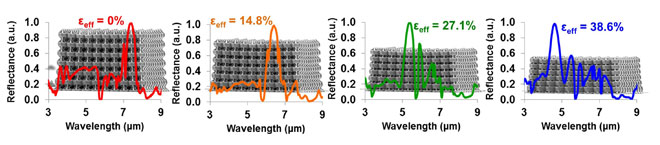
Broadly tunable photonic crystals in the near- to mid-infrared region could find use in spectroscopy, non-invasive medical diagnosis, chemical and biological sensing, and military applications, but so far have not been widely realized. We report the fabrication and characterization of three-dimensional tunable photonic crystals composed of polymer nanolattices with an octahedron unit-cell geometry. These photonic crystals exhibit a strong peak in reflection in the mid-infrared that shifts substantially and reversibly with application of compressive uniaxial strain. A strain of ∼40% results in a 2.2 μm wavelength shift in the pseudo-stop band, from 7.3 μm for the as-fabricated nanolattice to 5.1 μm when strained. We found a linear relationship between the overall compressive strain in the photonic crystal and the resulting stopband shift, with a ∼50 nm blueshift in the reflection peak position per percent increase in strain. These results suggest that architected nanolattices can serve as efficient three-dimensional mechanically tunable photonic crystals, providing a foundation for new opto-mechanical components and devices across infrared and possibly visible frequencies.
© 2015 AIP Publishing LLC
Go To Appl. Phys. Lett