 Advances in Engineering Advances in Engineering features breaking research judged by Advances in Engineering advisory team to be of key importance in the Engineering field. Papers are selected from over 10,000 published each week from most peer reviewed journals.

Significance Statement
Nanocomposites based on alpha nickel hydroxide nanoparticles and clays with ion exchange capacity are interesting for application in several electrochemical and electrocatalytic devices, particularly considering the control of materials morphology and enhancement of those properties by as simple method as the final drying process by lyophilization. In fact, this strategy keep the highly open three dimensional structure of colloidal materials in suspension thus maximizing the surface area and activity. This contrasts with conventional drying processes that usually result in pore collapse, reducing the surface area and adsorption capacity [1]. That strategy is particularly interesting for the preparation of materials for catalytic and electrocatalytic application, since the electrochemical activity is strongly influenced by the surface area and interlayer spacing, for example, facilitating the diffusion/ion intercalation processes while enhancing the concentration and access of molecular species to the active sites [2,3].
[1] Nunes Jr., C. V.; Danczuk, M. ; Bortoti, A. A.; Gonçalves, J. M.; Araki, K.; Anaissi, F. J.; Unexpected effect of drying method on the microstructure and electrocatalytic properties of bentonite/alpha-nickel hydroxide nanocomposite. Journal of Power Sources 297, 408-412, 2015.[2] Danczuk, M.; Nunes Jr., C. V., Araki, K., Anaissi, F. J.; Influence of alkaline cation on the electrochemical behavior of stabilized alpha-Ni(OH)2. Journal of Solid State Electrochemistry 18, 2279-2287, 2014.
[3] Rocha, M. A., Anaissi, F. J., Toma, H. E., Araki, K., Materials Research Bulletin, 44 (2009) 970-976.






Journal Reference
Journal of Power Sources, Volume 297, 2015, Pages 408–412.
Cícero V. Nunes Jr.1, Marins Danczuk1, Andressa A. Bortoti1, Josué M. Gonçalves2, Koiti Araki2, Fauze J. Anaissi1
[expand title=”Show Affiliations”]- Universidade Estadual do Centro-Oeste do Paraná, UNICENTRO, LabMat-CIMPE, R. Simeão Camargo Varela de Sá 03, CEP 85040-080, Guarapuava, PR, Brazil
- Instituto de Química, Universidade de São Paulo, Av. Lineu Prestes 748, CEP 05508-000, São Paulo, SP, Brazil
Abstract
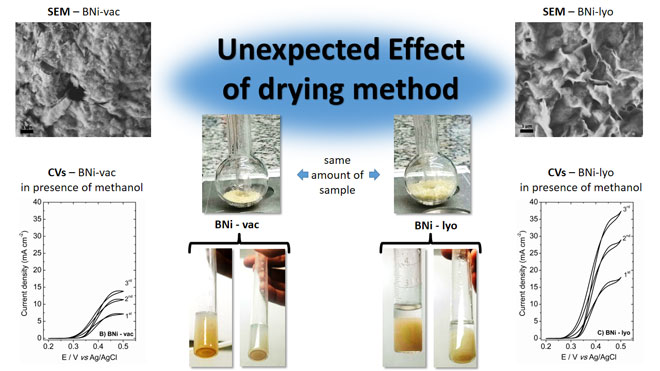
The degree of crystallinity, morphology and electrochemical properties of a nanocomposite formed by stabilized alpha-Ni(OH)2 nanoparticles and bentonite nanoflakes is strongly influenced by the vacuum drying process, either at room temperature or by freeze-drying (lyophilization). Alpha-Ni(OH)2 nanoparticles induced the formation of intercalation nanocomposites exhibiting higher structural organization than in the precursor clay. Also, lyophilization process preserved the structure of the nanocomposites in aqueous suspension and/or induced the disaggregation of nanoflakes, producing materials with lower degree of crystallinity, larger interlamellar distances and electrochemically more active than those obtained by conventional vacuum drying. In fact, the lyophilized materials exhibited more than twice as large density of current for electrocatalytic oxidation of methanol (37 against 14 mA cm−2) indicating its potentiality for development of sensors and fuel cells.
Go To Journal of Power Sources
