Advances in Engineering Advances in Engineering features breaking research judged by Advances in Engineering advisory team to be of key importance in the Engineering field. Papers are selected from over 10,000 published each week from most peer reviewed journals.

Significance Statement
The water–energy nexus (WEN) is part of the global agenda. Recently, the pressure-retarded osmosis (PRO) process has been of interest because it utilizes seawater, which is plentiful, as a resource to help mitigate the global energy shortage. The development of a high-performance membrane is a key for the PRO process in a field application. Among various nanomaterials, such as carbon nanotubes (CNTs), graphene, silica, titanium, and zeolite, CNTs have been extensively studied as an additive due to their unique properties.
Based on this rationale, a thin-film nanocomposite (TFN) membrane with a functionalized CNT-blended support layer was successfully synthesized for energy harvesting from saline water via the PRO process. This was the first attempt to develop a TFN membrane with a carbon nanotube/polyethersulfone support layer for the PRO process. The developed TFN membrane exhibited 110% increased maximum power density compared to house-made thin-film composite (TFC) membrane due to enhanced pore properties and hydrophilicity. Therefore, we believe our study contributes to generating renewable, alternative, and sustainable energy (blue energy) generation, which has been spotlighted as a fundamental solution to global energy scarcity. Detailed highlights are listed as follows:
- The TFN with CNT positioning in the support layer was successfully synthesized.
- The porosity and hydrophilicity of the support layer were increased.
- Membrane permeability induced by the CNT and active layer etching was improved.
- The TFN exhibited significantly enhanced water flux and power density.
- This method is easy to upscale with minimal additional cost.
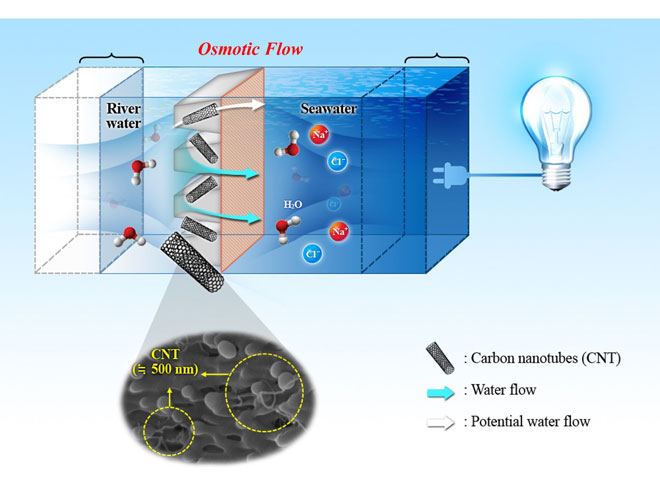
Figure Legend: Blue energy harvesting by using thin-film nanocomposite (TFN) membrane via pressure retarded osmosis (PRO) process.


Journal Reference
Chemical Engineering Journal, Volume 284, 15 January 2016, Pages 68-77.
Moon Son1,Hosik Park2,Lei Liu3,Hyeongyu Choi1,Joon Ha Kim1,Heechul Choi1
[expand title=”Show Affiliations”]- School of Environmental Science and Engineering, Gwangju Institute of Science and Technology (GIST), 123 Cheomdangwagi-ro, Buk-gu, Gwangju 500-712, Republic of Korea
- Center for Membranes, Advanced Materials Division, Korea Research Institute of Chemical Technology (KRICT), 141 Gajeong-ro, Yuseong-gu, Daejeon 305-600, Republic of Korea
- Qingdao Institute of Bioenergy and Bioprocess Technology, Chinese Academy of Sciences, Qingdao, Shandong, 266061, China [/expand]
The pressure retarded osmosis (PRO) process has been considered as an alternative and renewable technology to generate electricity from mixing two solutions of different salinities. However, improving the osmotic performance of semi-permeable membrane is still a major challenge in the PRO system. Therefore, thin-film nanocomposite (TFN) membrane was synthesized by using carbon nanotubes (CNT)-embedded-polyethersulfone (PES) supporting layer and polyamide active layer in this study. The prepared membranes were further employed in the PRO process to harvest energy from saline water. The water flux increase of the TFN membrane was promoted by CNT-induced porosity and the hydrophilicity of the support layer as well as by the chemical etching of the active layer. The water flux and maximum power density of the developed TFN membrane was found to be 87% (averaged from 2 bar to 10 bar) and 110% greater than for bare thin-film composite (TFC) membranes, respectively. Furthermore, the TFN membrane preparation could easily be scaled up using conventional fabrication methods with less than 2% additional material cost. Therefore, this finding could contribute to the commercialization of sustainable energy generation by utilizing the tremendous potential of fresh- and salt-water mixing.
Go To Chemical Engineering Journal