 Advances in Engineering Advances in Engineering features breaking research judged by Advances in Engineering advisory team to be of key importance in the Engineering field. Papers are selected from over 10,000 published each week from most peer reviewed journals.

Significance Statement
For envisaged structural applications of ultrafine-grain (UFG) materials processed by equal channel angular pressing (ECAP), extensive attention has been paid to the fatigue performance. In the low-cycle fatigue tests of UFG metals, shear bands (SBs) and crack paths that were inclined 45° to the loading direction have been commonly observed. Up to now, SB formation and crack growth behavior of UFG materials have been mainly discussed from the viewpoints of microstructure and morphological features of surface damage. On the other hand, the discussion from the mechanical viewpoints should be done for a better understanding of the fatigue damage of UFG materials. However, such studies are few and certain questions remain unanswered.
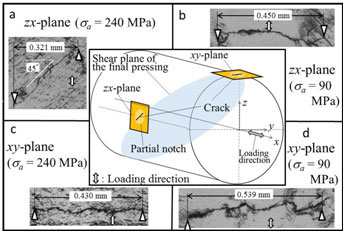
In the fatigue process of smooth specimens, innumerable cracks are initiated over the whole surface, followed by propagation with coalescence and interaction with multiple cracks. However, a few cracks among such innumerable cracks play a major part in the fracture of the specimen. For an understanding of fatigue mechanism in equal channel angular pressing Cu, the effect of equal channel angular pressing microstructure on the growth behavior of a fatal crack, which led to the final fracture of the specimen, should be discussed. To achieve this, the fatal crack must be introduced into the surface with a specific positional relationship toward the orientated microstructure in the equal channel angular pressing samples. However, it is quite difficult to design the initiation of a fatal natural crack at a specific site on the whole surface of a smooth specimen. To overcome this difficulty, a shallow partial notch was introduced on the smooth specimen surface. Using this type of specimen, specification of the initiation site of the fatal natural crack could be achieved despite the microstructural inhomogeneity resulting from equal channel angular pressing.
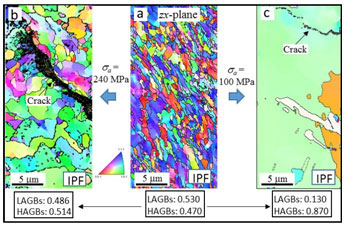
The stress-controlled fatigue tests of smooth specimens were conducted at high and low stress amplitudes corresponding to low- and high-cycle fatigue regime, respectively. The crack face profile and the crack growth direction on the surface and inside the specimen were monitored. The values of mixed-mode stress intensity factors of an inclined semi-elliptical surface crack were estimated. The objective of this study is to clarify the physical background of the formation mechanism of inclined cracks in terms of the mixed-mode deformation at the crack tip and the microstructural evolution caused by cyclic stressing.
Journal Reference
International Journal of Fatigue, 11 February 2016.
Goto1,,, S.Z. Han2, T. Yamamoto1, J. Kitamura1, J.H. Ahn2, T. Yakushiji3, S.S. Kim4, J. Lee5
[expand title=”Show Affiliations”]- Department of Mechanical Engineering, Oita University, Oita 870-1192, Japan
- Structural Materials Division, Korea Institute of Materials Science, Changwon 642-831, Republic of Korea
- Department of Mechanical Engineering, Oita National College of Technology, Oita 870-1052, Japan
- Department of Materials Science & Engineering, Gyeongsang National University, Chinju 660-701, Republic of Korea
- Department of Metallurgy & Advanced Materials Engineering, Chagwon National University, Changwon 641-773, Republic of Korea [/expand]
Abstract
The formation mechanism of inclined fatigue-cracks in ultrafine-grained Cu processed by equal channel angular pressing was studied by using a partially notched specimen in which a fatal natural crack was introduced, to a specific site of the smooth surface was feasible regardless of microstructural inhomogeneity caused by the processing. The crack growth direction depended on the location along the circumferential direction of the round bar specimen and on the applied stress amplitudes. The role of the microstructure and deformation mode at the crack-tip areas on the formation behavior of fatal cracks is discussed in terms of the microstructural evolution caused by cyclic stressing and the mixed-mode stress intensity factor. The in-plane shear mode deformation at the crack tip assisted the formation of the inclined crack paths and the unique crack face profile.
Go To International Journal of Fatigue