Advances in Engineering Advances in Engineering features breaking research judged by Advances in Engineering advisory team to be of key importance in the Engineering field. Papers are selected from over 10,000 published each week from most peer reviewed journals.

Significance Statement
The development of functional films and coatings with superior strength and wear resistance is a major concern of tribologists and materials scientists in general, since they can greatly improve the performance and extend the working life of a wide variety of devices and applications while also reducing costs by allowing the use of less expensive core materials. Examples of this can be found among cutting tools, electrical contacts, magnetic recording devices, biomedical components and microelectromechanical systems, just to name a few.
Nickel-based electrodeposits (including nanocrystalline nickel, alloys and nickel-matrix composites) have been subject of thorough investigations due to their excellent mechanical properties and wear resistance, which can be paired with a relatively high ductility and a remarkable protection against corrosion. In this line, the present work evaluates the dry-sliding friction and wear behaviour of a novel Ni-matrix nanocomposite film which was developed to be applied as electrode material in electrical-contact devices.
The Department of Functional Materials of Saarland University has a long tradition in the study of friction and wear phenomena, both on a fundamental basis and concerning the performance of materials for specific applications and devices. Regarding this, one of its key fields of research involves the functionalisation and structuring of surfaces by means of laser interference and laser patterning techniques. These allow producing distinct grain size arrangements and intermetallic-phase composites with superior tribological properties as well as influencing the frictional response and the oil-retaining capability under lubrication.


Journal Reference
Wear, Volumes 346–347, 2016, Pages 87–98.
F.L. Miguel1, R. Müller2, A. Rosenkranz1,S. Mathur2, F. Mücklich1
[expand title=”Show Affiliations”]- Saarland University, Chair of Functional Materials, 66123 Saarbrücken, Germany
- University of Cologne, Chair of Inorganic and Materials Chemistry, 50939 Cologne, Germany
Abstract
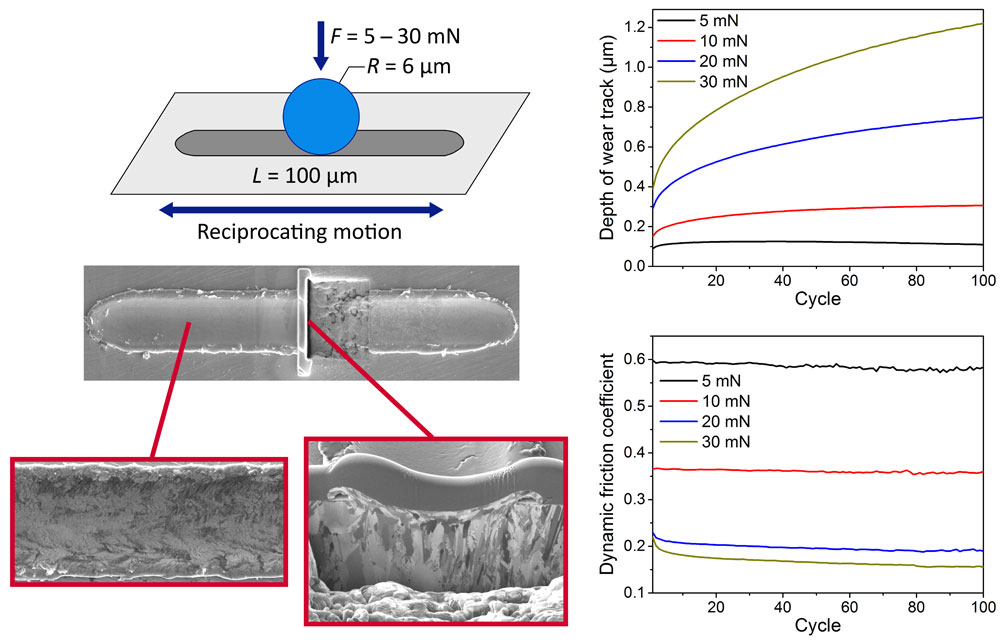
The work here described aimed to assess the tribological behaviour of a Ni-matrix-nanocomposite film and to gain understanding of the role that the reinforcing phases play in it. The composite consisted of an array of Ag-coated SnO2 nanowires grown onto a substrate, around which the Ni matrix was galvanostatically deposited. Friction and wear were evaluated under dry sliding conditions using a linearly reciprocating ball-on-flat setup, with a diamond ball of 5.8 µm radius as counterbody, subjected to loads ranging from 5 to 30 mN. The surface and cross section of the wear tracks were characterised by scanning electron microscopy, energy-dispersive X-ray spectroscopy and white light interferometry. Ploughing-type abrasive wear was observed, with load-dependent dynamic friction coefficients, being this attributed to scale effect. Numerical models were developed for the analysis of wear volume and wear rate, as function of film hardness, applied load and wear track length. Due to their higher hardness, the composite films exhibited superior wear resistance with respect to Ni films produced using the exact same bath and deposition parameters as the composite׳s matrix. This was evidenced by reductions of up to 74 and 65% in wear volume and rate, respectively.
Go To Wear