 Advances in Engineering Advances in Engineering features breaking research judged by Advances in Engineering advisory team to be of key importance in the Engineering field. Papers are selected from over 10,000 published each week from most peer reviewed journals.

Significance Statement
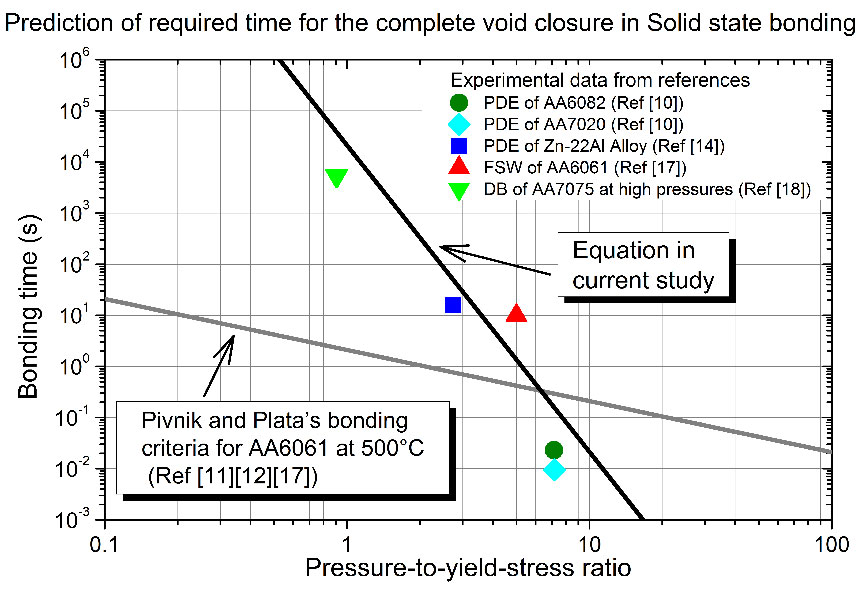
Solid state bonding (SSB) is the critical physical process responsible for joining of metals in many advanced material manufacturing processes, such as friction stir welding (FSW), porthole die extrusion (PDE) and diffusion bonding (DB). Insufficient shrinkage of voids at the bonding interface may lead to formation of defects, which have detrimental effects on the reliability of the solid state bonding joints. This study proposed a new equation to link the percentage of void shrinkage to the bonding conditions. This equation could be applied to predict the required time for complete closure of the interfacial voids, which provides a practical guide line to design the processing conditions for solid state bonding.


Journal Reference
Materials & Design, Volume 89, 5 January 2016, Pages 1223–1226.
Gaoqiang Chen, Qingyu Shi , Yujia Li, Zandong Han, Keyi Yuan
Department of Mechanical Engineering, Tsinghua University, Beijing 100084, China
Abstract
Physical simulation experiments by Gleeble are utilized to understand the kinetics of void shrinkage in solid state bonding at high temperatures and high pressures. By quantifying the void volume via ultrasonic echo magnitude at the bonding interfaces, a mathematical model is established to link the percentage of void shrinkage to the processing conditions. A new equation is proposed to predict the required time for complete void closure, which provides a practical guide line to design the processing conditions for solid state bonding.
Go To Materials & Design