Advances in Engineering Advances in Engineering features breaking research judged by Advances in Engineering advisory team to be of key importance in the Engineering field. Papers are selected from over 10,000 published each week from most peer reviewed journals.

Significance Statement
The article describes the fundamental chemistry behind the separation of two very similar elements, niobium and tantalum, in a fluoride environment. The proposed separation mechanism in SX predicts an extraction limiting step, which involves the preferable formation of the H2TaF7 complex compared to the H2NbOF5 in a highly acidic environment. This chemically favoured neutral H2TaF7 complex is extracted by the MIBK (with almost no H2NbOF5) at high [H+] into MIBK and then easily back extracted into water at low [H+]. This article also emphasizes the fact that the pure metal oxides of these two elements can be used as model starting material to develop new or improve separation processes prior to their evaluation and application using different more complex Ta/Nb containing minerals.


Journal Reference
Hydrometallurgical Separation of Niobium and Tantalum: A Fundamental Approach
JOM, 2016, Volume 68, Issue 2, pp 556–566.
Motlalepula Nete1,2, Walter Purcell1, Johann T. Nel2
[expand title=”Show Affiliations”]- Department of Chemistry University of the Free State Bloemfontein South Africa
- The South African Nuclear Energy Corporation SOC Ltd. (Necsa) Pretoria South Africa
Abstract
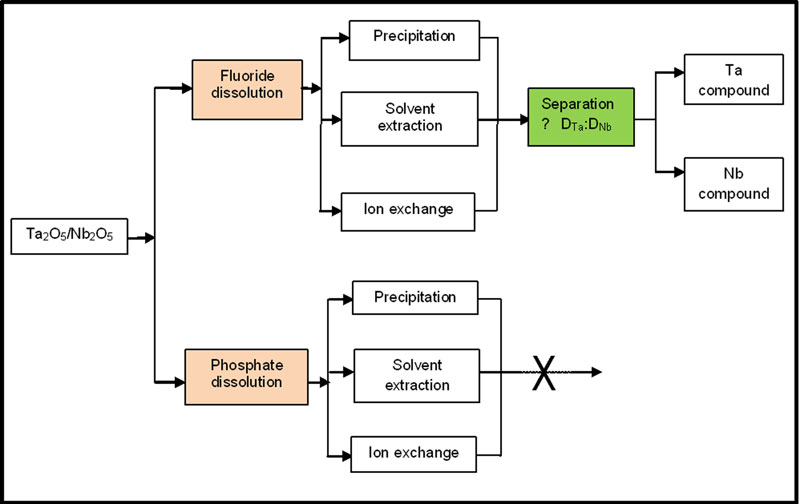
Ta and Nb were separated in two different chemical matrices, namely a fluoride and a phosphate environment. Pure Ta2O5 and Nb2O5 were mixed, digested using NH4F.HF and Na2HPO4/NaH2PO4.H2O fluxes, and the resultant fusion melts were dissolved in water.
Separation of Ta and Nb was investigated with selective precipitation using p-phenylediamine, solvent extraction using methyl-isobutyl ketone, and ion exchange using strong Amberlite and weak Dowex Marathon resins. Separation in the phosphate matrix was unsuccessful. Relatively good separation with a separation factor of 11(4) was obtained using p-phenylediamine as precipitant with 73(3) % Ta and 23(5) % Nb isolated in a one-step reaction.
A one-step extraction step with MIBK at a 4 M sulfuric acid concentration recovered 80% Ta while the two step extraction process recovered 100% Ta with a separation factor of ~2000. Separation of the two metals using ion exchange (strong Amberlite resin weak Dowex Marathon) was unsuccessful and mixtures of the two elements (97.1 % Nb and 73.4 Ta in Amberlite, and 96.1% Nb and 52.3% Ta in Dowex) were obtained in all the experimental conditions that were investigated.
Go To JOM