Advances in Engineering Advances in Engineering features breaking research judged by Advances in Engineering advisory team to be of key importance in the Engineering field. Papers are selected from over 10,000 published each week from most peer reviewed journals.

Significance Statement
Atmospheric CO2 has increased from 316 ppm in 1958 to over 400 ppm and is directly proportionately to world population. Producing electricity from coal is one technology that has satisfied the global energy demand but is a large contributor to greenhouse gases. Scrubbing the exhaust gas from coal fired power plants with traditional processes is capital intensive and inefficient. As much as 30 % of the total energy produced is required to scrub exhaust gas with amine. Calcium looping technology (CaL) is an alternative that is more energy efficient but is yet unproven at a large scale.
CaL technology relies on cycling solid sorbents between several vessels: CaO reacts with CO2 from the combustor flue gas to form CaCO3. A second vessel calcines the carbonate back to CaO and CO2, thereby forming a concentrated CO2 stream that can be compressed and sequestered. To improve further the energy efficiency of the process, a metal oxide supplies the oxygen to calcine the CaCO3 rather than feeding molecular oxygen. Cycling methane between a net reducing and oxidizing environment is known as chemical looping combustion (CLC).
Integrated CaL and CLC avoids an expensive air separation but the process requires circulating even more solids, which increases the mechanical stress they experience due to abrasion (particle-wall contact in cyclones, for example) and particle-particle and particle wall collisions (particularly at high velocity nozzles). Spray drying the sorbents and oxides with silica power may improve the mechanical resistance of these powders but it will then reduce the active ingredient concentration. Circulating the solids at a higher rate will compensate for the lower concentration but that will engender higher compression costs. The binder concentration must be minimized to maximize the concentration of the active sorbents and metal oxides.
Not only due CaL sorbents chip (cleave asperities) and fragment due to mechanical forces, they may also attrit due to thermal stresses. To evaluate the effect of binder concentration on the attrition resistance of catalyst and sorbents, we designed an accelerated jet-cup mill to operate up to 800 oC.
We place 20 g of solids into a 25.4 mm 316SS cup 120 mm in height. Air entered the cup from the bottom through a single orifice at 180 m s-1 to sonic velocity. The jet cup was connected to a 915 mm quartz tube that expanded from 25 mm to 76 mm at the top. The expanded section reduced the entrainment rate of unattrited particles. The top section was 760 mm long and was connected to an Erlenmeyer flask with a 0.3 mm thimble filter.
Solids that accumulated in the thimble filter during the first 6 h were discarded. We defined the attrition rate based on the fines the thimble filter retained during 18 h after the 6 h dump.
To calibrate the mill, we tested FCC catalyst and vanadyl pyrophosphate (VPP), which are commercial powders used in processes that transfer solids through multiple vessels.
The first series of tests compared the attrition rates (Raj) of the powder versus the orifice velocity (Uo), orifice diameter (do) and gas density (Pg):
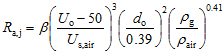
where Pair is air density and Us,air is the sonic velocity of air at standard conditions. The effect of temperature on attrition rate is confounded with gas density, viscosity and the thermal sensitivity of the powders. We tested air, He and CO2 at ambient conditions and the same volumetric flow rate: the attrition rate with CO2 was almost three times higher than it was for He.
The attrition rates of the VPP and FCC at an orifice velocity of 230 m s-1 were 14 mg h-1 and 21 mg h-1, respectively. In DuPont’s commercial circulating fluidized bed process, VPP catalyst attrited at 1 kg h-1.
The attrition rate of the sorbent at ambient conditions (Uo= 230 m s-1) with a mass fraction of 90 % CaO and 10 % cement (CaO)90(cem)10 was 21 mg h-1 but it increased to 50 mg h-1 at 800 °C. Decreasing the mass fraction of cement to 5 % increased the attrition rate to 28 mg h-1 at ambient conditions.
The sorbent with a mass fraction of 50 % CuO, 40 % CaO, and 10 % cement – (CaO)40(CuO)50(cem)10 – attrited at 26 mg h-1. Interestingly, its attrition rate decreased to less than 20 mg h-1 at 800 °C. The +200–400 μm fraction agglomerated to +400 μm powder. Overall the d50 dropped slightly from 450 mm to 420 mm. At ambient conditions the d50 of the powder remaining in the cup dropped to 310 mm. Since the (CaO)90(cem)10 d50 dropped at the higher temperature, we can attribute the agglomeration phenomenon to copper. Surprisingly, the surface area changed little even though copper must have been mobile. The original surface area was 13 m2g-1 and it was 12 m2g-1 after 24 h in the mill at 800 oC. At 500 oC, the attrition rate was slightly higher at 15 m2g-1. The surface area of the (CaO)90(cem)10 increased from 16 m2g-1 to above 18 m2g-1, which indicates that the porosity increased.
The powder attrits in the jet mill by impact and surface abrasion and the fines collected in the thimble filter represent the attrition rate (dp<10 mm). However, the particle size distribution (PSD) of the sorbent remaining in the cup decreases and this change in PSD represents the fragmentation rate: Large mother particles (>400 mm) fragment to smaller particles that are still too big to be entrained by the gas to the filter. By comparing the PSD of the particles in the thimble before and after the test, we estimated that the fragmentation rate of the mother particles is an order of magnitude larger than the attrition rate. The attrited fines may be recovered and recharged to the bed and would have no impact on the operation of the CaL. However, decreasing the PSD will affect the operation of the L-valve, which controls the solids circulation rate. This will increase the complexity of controlling the reactor.


Journal Reference
Asiedu-Boateng, R. Legros, G.S. Patience. Attrition resistance of calcium oxide–copper oxide–cement sorbents for post-combustion carbon dioxide capture. Advanced Powder Technology,Volume 27, Issue 2, 2016, Pages 786-795.
Department of Chemical Engineering, Polytechnique Montréal, C.P. 6079, Succ. CV, Montréal, H3C 3A7 Québec, Canada.
Go To Advanced Powder Technology