 Advances in Engineering Advances in Engineering features breaking research judged by Advances in Engineering advisory team to be of key importance in the Engineering field. Papers are selected from over 10,000 published each week from most peer reviewed journals.

Significance Statement
Magnetic molecules inserted between conducting leads have been known to provide an important forum for investigating fundamental magnetic properties of finite one-dimensional Ising or Heisenberg chains. However, the main established route for molecular transport in spintronics manipulations entail external magnetic fields or ferromagnetic electrodes often exploiting spin transfer torques from spin-polarized scattering or columbic interactions.
Researchers led by Professor Jonas Fransson from department of Physics and Astronomy at Uppsala University in Sweden proposed a different route to molecular interactions which allows all electrical control of the transport properties control and application of individual molecular states. They discussed the possibility of coupling between electronic configuration and magnetic polarization of molecules for molecular spintronics. The study is published in Nanoletters.
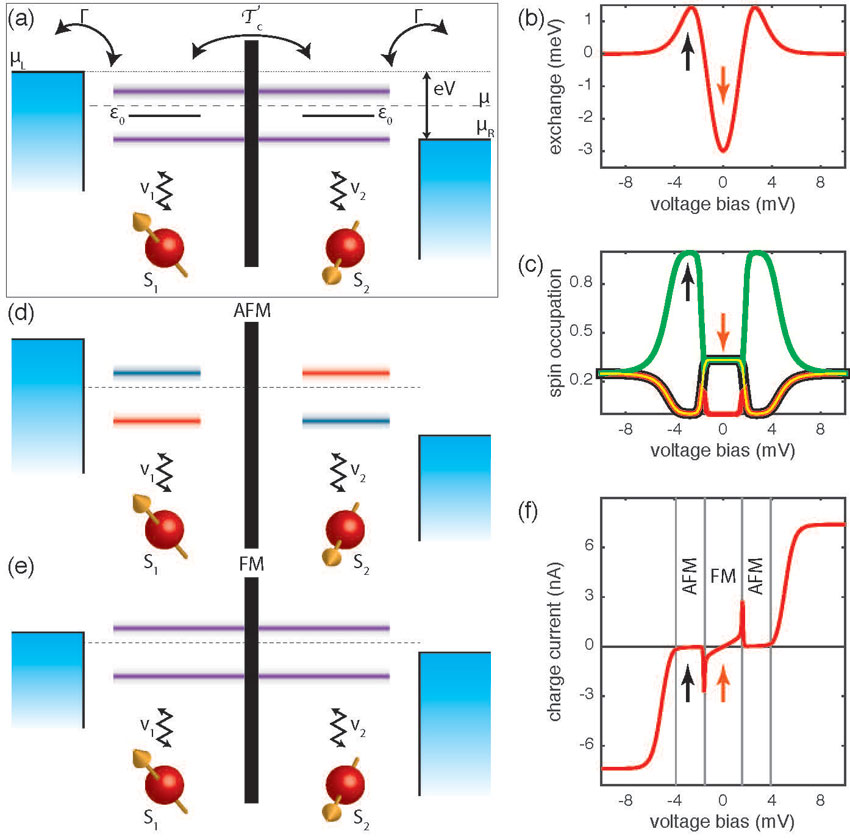
The proposed method by Saygun et al. (2016) demonstrated that voltage-controlled magnetic interactions can be used to switch between regimes of high and low conductance in paramagnetic molecular dimers without using external magnetic fields or ferromagnetic leads. The effective spin-spin interactions is controlled by energies of highest occupied molecular orbits and lowest unoccupied molecular orbitals in individual molecules and intermolecular tunneling rate τC which is therefore possible to switch between high and low conductive states of coupled molecules through variation of electrical environment of molecular structures e.g. gating or voltage bias.
For effective magnetic interactions, a dimer of equivalent paramagnetic molecules inserted in junction between metallic leads was considered. The model that was setup using Hamilton (H) equation provides a spin-degenerate electronic structure that mediates the exchange reactions implying that both Dzyalonshinski-Moriya and Ising interactions vanish while isotropic Heisenberg interaction was retained only in case of non-magnetic leads leading to spin dimer treated in a closed system. Saygun et al. (2016) set up pertained to metal-phthalocyanines and metal porhyrins where metals denoted magnetic transition metals such as chromium, manganese, iron, molybdenum, nickel and copper which can be realized in mechanically controlled break-junctions and scanning tunneling microscope.
With increasing voltage bias, system evolves through regimes with different transport characteristics, first in non-gated case (μ=0) for small voltage biases, the ferromagnetic regime subsequently followed by a low conductance state in the antiferromagnetic regime when increasing the voltage bias. The spin dimer evolves into a new regime with 4-fold degenerate spin states as voltage bias increases.
Application of a gate voltage that shifts energy levels with respect to μ leads to that of ferro- and antiferromagnetic devices as voltage bias increases. Since molecular orbital energies may not lie on either side of μ in equilibrium but requires a finite voltage bias to fulfil this condition. Therefore, for sufficiently large gating conditions, for example, |0-μ| ≥ τC, the system is antiferromagnetic in low bias regime and only enter into ferromagnetic regime for finite voltage biases followed by another antiferromagnetic regime. This behavior illustrates systematic shift of ferromagnetic and antiferromagnetic regimes away from equilibrium to higher voltage biasing with gates. Further results showed robustly realized specific rectification in molecular dimers, however arising suppression of the ferromagnetic regime for one polarity of the voltage bias while not for the other
This study opens up possibilities for electrical switching between different states associated with dramatic changes in different states and molecular complexes with individual gating or non-equivalent paramagnetic molecules which can be fine-tuned for specific function characters.
Journal Reference
Saygun, T. Bylin, J. Hammar, H. Fransson, J. Voltage-Induced Switching Dynamics of a Coupled Spin Pair in a Molecular Junction. Nanoletters, 2016, Volume 16, pp 2824-2829.
Department of Physics and Astronomy, Uppsala University, Box 516, 75120 Uppsala, Sweden.
Abstract
Molecular spintronics is made possible by the coupling between electronic configuration and magnetic polarization of the molecules. For control and application of the individual molecular states, it is necessary to both read and write their spin states. Conventionally, this is achieved by means of external magnetic fields or ferromagnetic contacts, which may change the intentional spin state and may present additional challenges when downsizing devices. Here, we predict that coupling magnetic molecules together opens up possibilities for all electrical control of both the molecular spin states as well as the current flow through the system. By tuning between the regimes of ferromagnetic and antiferromagnetic exchange interaction, the current can be at least an order of magnitude enhanced or reduced. The effect is susceptible to the tunnel coupling and molecular level alignment that can be used to achieve current rectification.
Copyright © 2016 American Chemical Society
Go To Nano Lett.