Advances in Engineering Advances in Engineering features breaking research judged by Advances in Engineering advisory team to be of key importance in the Engineering field. Papers are selected from over 10,000 published each week from most peer reviewed journals.

Significance Statement
Platinum-based nanoparticles dispersed on carbon supports, which have been employed in polymer electrolyte fuel cells PEFCs, usually consist of low-index crystal facets such as (111) and (100). It has been reported that the (111) face prepared under an ultrahigh vacuum condition exhibited the highest enhancement of kinetically-controlled area-specific activity jk for the oxygen reduction reaction ORR among the low-index crystal faces of Pt-based single crystals alloyed with either nickel Ni, cobalt Co or copper Cu, by a factor of about ten when compared to pure Pt(111) electrodes.
However, the dependence of jk on the alloy composition has not been demonstrated for well-defined alloy single crystals, due to the difficulty in preparing alloy single crystals with controlled composition.
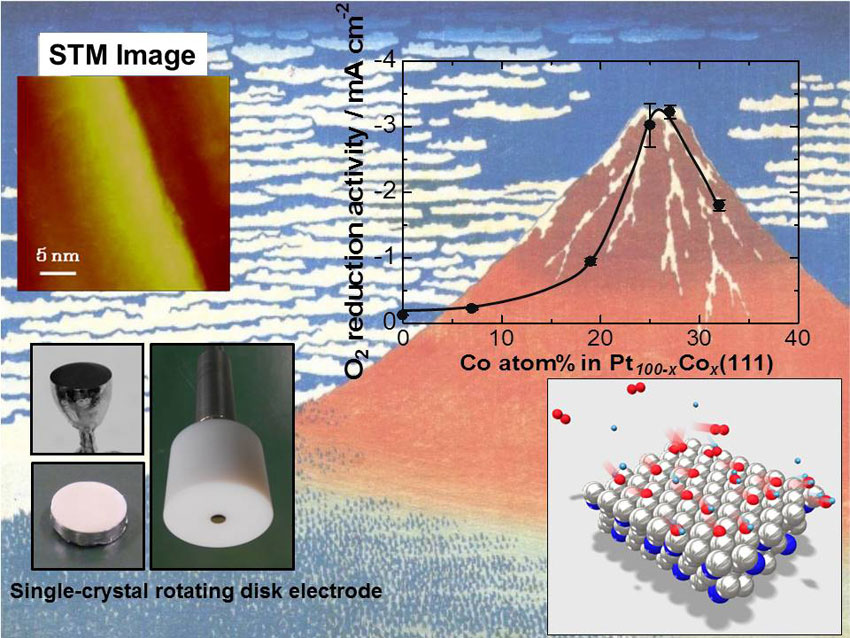
Researchers at the University of Yamanashi evaluated for the first time the jk values for the ORR at well-defined Pt-skin/Pt100-xCox(111) single crystal electrodes as a function of cobalt content by use of the rotating disk electrode RDE technique. They found that the jk value reached a maximum at 25 atom%-Co (x = 25) as high as 3.0 mA cm-2 in air-saturated 0.1 M HClO4 solution at 0.9 V vs. RHE, which is ca. 25 times larger than that on pure Pt(111). The research was recently published in the journal, Electrochemistry Communications.
A low-energy ion scattering spectrum for a Pt-Co(111) surface indicated no Co signal around 280 eV after a heat treatment in hydrogen, demonstrating the formation of a platinum-skin layer on the Pt-Co(111) surface. A low-energy electron diffraction pattern exhibited a hexagonal (1 ´ 1) structure of the platinum-skin layer. An in situ scanning tunneling microscopy image showed atomically flat terraces of platinum-skin layer in nitrogen-purged 0.1 M HClO4.
Dramatic changes were observed in the cyclic voltammograms of Pt-skin/Pt100-xCox(111) single crystal electrodes with the variation of cobalt atom% in nitrogen-purged 0.1 M HClO4 solution: the hydrogen underpotential deposition HUPD wave shifted to less positive potentials, while the hydrogen underpotential deposition charge QHUPD decreased nearly linearly with increasing x, which can be ascribed to the modified electronic structure of the platinum-skin layer by the underlying platinum-cobalt alloys.
The “butterfly-like” wave due to surface oxidation shifted to higher potentials. The authors have demonstrated using X-ray photoelectron spectroscopy with an electrochemical cell EC-XPS that the reversible butterfly wave with a spike peak at pure Pt(111) electrode can be ascribed to OH formation with a honeycomb framework of bilayer water on the Pt(111) surfaces.
The authors then evaluated the surface oxidation charges Qox,0.9 up to 0.9 V, at which the jk values were evaluated, and it was discovered that the Qox,0.9 values were identical with that at pure Pt(111), even at the maximum activity point for 25 atom%-Co. These results indicate that the coverages of OH adsorbed on the platinum-skin layers at 0.9 V were nearly constant, particularly for x < 30. Hence, the enhanced ORR activity of the Pt-skin/Pt-Co(111) electrodes cannot be explained on the basis of the conventional view that alloying leads to decreased site-blocking by spectator oxygen-species due to surface oxidation, often described as OH poisoning.
This study showed that the enhancement factor of the ORR activity at platinum-skin layers prepared by heating in hydrogen was two times larger than those reported for platinum-based alloy (111) single crystal electrodes prepared in ultrahigh vacuum.






Journal Reference
M. Wakisaka1, S. Kobayashi2, S. Morishima2, Y. Hyuga2, D.A. Tryk1, M. Watanabe1, A. Iiyama1, H. Uchida1,3. Unprecedented Dependence of the Oxygen Reduction Activity on Co Content at Pt Skin/Pt–Co(111) Single Crystal Electrodes, Electrochemistry Communications, Volume 67, 2016, Pages 47–50.
[expand title=”Show Affiliations”]- Fuel Cell Nanomaterials Center, University of Yamanashi, 6-43 Miyamae, Kofu 400-0021, Japan
- Interdisciplinary Graduate School of Medicine and Engineering, University of Yamanashi, 4 Takeda, Kofu 400-8510, Japan
- Clean Energy Research Center, University of Yamanashi, 4 Takeda, Kofu 400-8510, Japan
Go To Electrochemistry Communications