Advances in Engineering Advances in Engineering features breaking research judged by Advances in Engineering advisory team to be of key importance in the Engineering field. Papers are selected from over 10,000 published each week from most peer reviewed journals.

Significance Statement
Research work within the “Second generation of biofuel and near future alternative fuels” project conducted by the Institute of Physical Chemistry Polish Academy of Science, Dr. I. S.Pieta in cooperation with University of Malaga, Spain, Prof. L.J. Alemany, University of Virginia, U.S.A., Prof. W.S. Epling, and New Chemical Synthesis Institute, Poland, Dr. P. Kowalik aims at reducing the need of producing hydrogen from fossil fuels by developing an effective technology based on second generation of biofuels. The research study is published in the journal, International Journal of Hydrogen Energy.
Hydrogen-rich gas can be produced by the catalytic conversion of hydrocarbons (HC) and oxy compounds e.g. methane, propane, methanol, ethanol, propanol, acetone and dimethyl ether DME. Of all these, the catalytic conversion of DME and methanol to hydrogen-rich gas has the best performance at low temperature, 250-3000C. The steam reforming of the methanol MeOH-SR has received significant attention for hydrogen production, likewise the steam reforming of dimethyl ether DME-SR can also be used for the same purposes.
The researchers pointed out that the use of DME for hydrogen production has several advantages, such as a high heating value, being environmentally friendly, the ease of storage and self-ignition properties, all with low particulate matter emission. DME provides high reactivity at low temperature, thus making it suitable for reforming reactions with a smaller amount of energy input. DME can be liquefied at -250C under 0.6Mpa, making it inexpensive to store and handle.
There are three major technologies used in the production of hydrogen-rich fuel cell feeds from dimethyl ether DME explained the researcher. They are steam reforming SR, partial oxidation POx and auto thermal reforming ATR. Of the three technologies, DME-SR being endothermic has the advantage of increasing the hydrogen yield in a stream, and being theoretically free of carbon monoxide CO, this makes it an excellent candidate for hydrogen production.
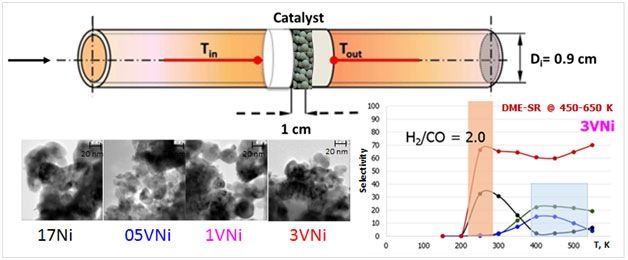
DME and methanol experiments were carried in a micro reactor PID Eng&Tech system consisting of a fixed bed flow reactor equipped with a co-axial thermocouple placed at the center of catalytic bed to monitor the reactor temperature. In their experiments, they found that when a mixture of methanol and water was fed over the supported VNi catalyst, carbon monoxide and hydrogen were produced together as the main products at 2500C, in a H2/CO ratio. At temperatures higher than 3000C, CO2 appears and indicating that direct methanol decomposition was the first step when using VNi as catalyst. Pieta et al. (2016) emphasize that carbon monoxide CO, even in trace quantities can act as poison to fuel cell catalysts.
From the results obtained, the research team deduced that the water molecule needed high temperature to be activated, and vanadium promotes the activity of Ni help to reduce the required temperature, compared to other Ni-based catalysts previously studied.
The VNi catalyst proved active in MeOH and DME-SR reactions and the results showed that DME-SR to be best of the catalytic conversion processes available. Overall, DME-SR produced a higher hydrogen yield with steam. Direct methanol decomposition to CO and H2 was observed at low temperature and low vanadium content, while methanol steam reforming primarily occurs at moderate to high temperature (4000C) over 3VNi to give an almost stoichiometric H2/CO2 ratios.
This research falls within urgent thematic areas such as sustainable energy and environmental protection and has great potential to result in both scientific and economic benefits.
Acknowledgement: This research has been supported by the National Centre of Science, Poland through project SONATA-2013/11/D/ST5/03007.




Journal Reference
Rafael González-Gil1,2, Concepción Herrera2, María Ángeles Larrubia2, Pawel Kowalik3, Izabela S. Pieta1 , Luis J. Alemany2, Hydrogen production by steam reforming of DME over Ni-based catalysts modified with vanadium. International Journal of Hydrogen Energy, Volume 41, Issue 43, 16 November 2016, Pages 19781–19788.
[expand title=”Show Affiliations”]- Institute of Physical Chemistry Polish Academy of Sciences, 01-224 Warsaw, Poland.
- Departamento de Ingeniería Química, Facultad de Ciencias, Universidad de Málaga, E-29071 Malaga, Spain.
- New Chemical Syntheses Institute, 24-110 Pulawy, Poland.
Go To International Journal of Hydrogen Energy