 Advances in Engineering Advances in Engineering features breaking research judged by Advances in Engineering advisory team to be of key importance in the Engineering field. Papers are selected from over 10,000 published each week from most peer reviewed journals.

Significance Statement
Researchers has been gathering findings on how to reduce, if not remove totally the recalcitrant organic pollutants from waste water and industrial effluents. Garrido-Ramirez et al. (2016) also joined the league of researcher to improve on the waste water and industrial effluent. The research work is published in the journal Microporous and Mesoporous Materials.
The research team worked on both heterogenous Fenton reaction HFR and electro-Fenton process which were used before the publication of this work. The HFR make use of solid catalyst where iron and copper are immobilized in the catalyst structure while electron-Fenton process is based on continuous electro-generation of hydrogen peroxide by oxygen reduction on the cathode.
This new study, led by Garrido-Ramirez came up with heterogeneous electro-Fenton (HEF). It was proposed to improve on the existing process. The HEF is the combination of the efficiency of heterogeneous catalyst with electron Fenton process. The process is expected to have higher catalytic efficiency and able to work under a wide range of pH, with low concentration of soluble iron and also with minimum oxyhydroxide precipitation.
In their experiments the authors tried to compare the atrazine oxidation of the newly proposed heterogeneous electro-Fenton process by using iron-oxide supported allophane clay (AlSi2Fe6) as catalyst. The reaction at neutral pH shows HFR achieving 68% efficiency in atrazine oxidation after 48 hours while on HEF 76% atrazine oxidation efficiency after 8hours. HEF was found to be more efficient than HFR, due to the continuous electro-regeneration of iron species (Fe3+/Fe2+).
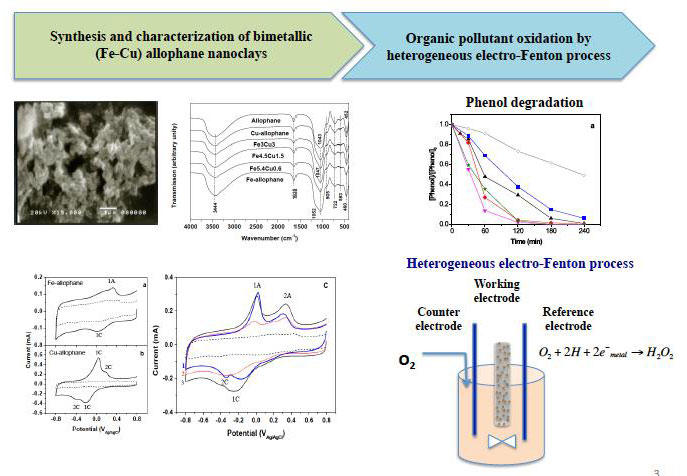
As the aim of this research in improving water treatment, bimetallic (Fe-Cu) allophane nanoclays known as Fenton reagent is used for the degradation of the resistive organic pollutant. The allophane is a nanoclay size mineral, found in southern Chilean soils. Its properties include large surface area, unique structure and high porosity. Allophane are highly adsorbed compounds, enzyme support and solid catalysts. An iron oxide-supported allophane clays with a hydrous feldpathoids structure are highly active and stable in the phenol oxidation of catalystic wet peroxide oxidation, said Garrido-Ramirez et al. (2016). This led to the use of phenol as a model of recalcitrant chemical compound.
The researchers demonstrated the catalyst performance can be improved by simultaneous incorporation of iron and copper species on the allophane nanoclays which can contribute to the production of additional hydroxyl radicals, according to Fenton-like reactions. Catalytic activities of Fe-allophane, Cu-allophane and bimetallic (Fe-Cu) allophane nanoclays were determined in the phenol oxidation by HEF process. Phenol conversion of about 100% at PH 3.0 was observed for bimetallic Fe-Cu catalyst in less than 2 hours of reaction whereas for Fe-allophane and Cu-allophane, it was 71% and 62% phenol conversion respectively after 2 hours of reaction.
This study shows that bimetallic (Fe-Cu) allophane with 5.4 % and 0.6 % of iron and copper oxide contents, respectively, could be used as highly active and stable heterogeneous catalysts for the HEF process in a wide pH range without a significant drop in their catalytic efficiency. This finding solved their proposed goal of removing resistive organic pollutant from waste water and industrial effluents.


Journal Reference
E.G. Garrido-Ramírez1,2 , J.F. Marco3, N. Escalona4,5, M.S. Ureta-Zañartu6, Preparation and characterization of bimetallic Fe-Cu allophane nanoclays and their activity in the phenol oxidation by heterogeneous electro-Fenton reaction, Microporous and Mesoporous Materials 225 (2016) 303-31,
[expand title=”Show Affiliations”]- Departamento de Ecología y Biodiversidad, Universidad Andres Bello, República 440, Santiago, Chile.
- Sustainability Research Centre, Universidad Andres Bello, República 440, Santiago, Chile
- Instituto de Química Física “Rocasolano”, CSIC, C. Serrano 119, 28006 Madrid, Spain.
- Departamento de Ingeniería Química y Bioprocesos, Escuela de Ingeniería, Pontificia Universidad Católica de Chile, Av. Vicuña Mackenna 4860, Macul, Santiago, Chile.
- Facultad de Química, Pontificia Universidad Católica de Chile, Chile.
- Departamento de Ciencias del Ambiente, Facultad de Química y Biología, Universidad de Santiago de Chile, Av. Libertador Bernardo O ´Higgins 3363, Santiago, Chile.
Go To Microporous and Mesoporous Materials
