Advances in Engineering Advances in Engineering features breaking research judged by Advances in Engineering advisory team to be of key importance in the Engineering field. Papers are selected from over 10,000 published each week from most peer reviewed journals.

Significance Statement
The combination of chromatographic mass spectrometry and high resolution mass spectrometry filters have been used in characterization of environmental contamination. However, due to necessity in knowing less-regarded chemical substances that serve as potential environmental hazards, the improved chromatography and high resolution mass spectrometry faces daunting challenges in terms of effective filtering of signals of interest.
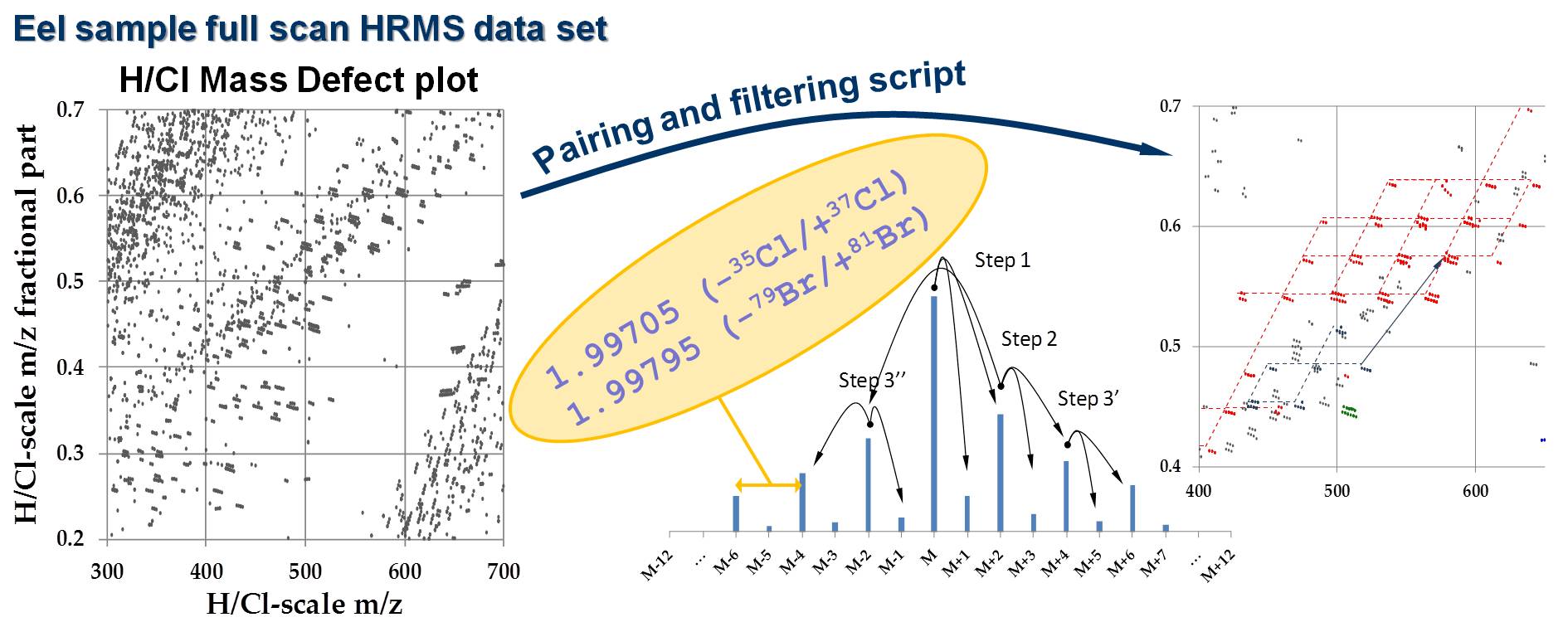
The two criteria used in supplying records for an effective study includes; the mass defect which comprises of heavy atoms compared to major atoms from organic compound and the second criterion which is mainly meant for both chlorinated and brominated compounds.
Researchers from “Laboratoire d’Etude des Residus et Contaminants dans les Aliments” (LABERCA) in France provided new approach capable of detecting a vast variety of organohalogenated compounds in any kind of matrix extract. The research work is published in the peer-review journal, Analytica Chimica Acta.
A purified extract was obtained from an eel muscle sample before being analyzed by liquid chromatography coupled to high resolution mass spectrometry in full scan mode. Automatic peak integration was performed, leading to a list of features characterized by exact mass m/z, retention time and signal intensity. Pairing of features into halogenated isotopic clusters became completed by using a data treatment tool based on mass defect, more precisely the exact mass difference between natural Cl and Br halogen isotopes, the script being developed in Visual Basic for Application language.
After global peak picking step was achieved, the authors eventually obtained 9789 features in the eel sample extract. The filtering script whilst using the visual basics for application macro tool brought about a discounted variety of 1994 features which were paired in 579 potentially halogenated clusters for additional investigation.
When investigating clusters associated with hexabromocyclododecane (HBCDD), 10 clusters which showed the largest spans were found and were all attributed to HBCDD isomers as native form, internal standards 13C12, external standard 2H18 or related adducts. For the three isomers (α, β, γ) of HBCDD. This result supplied an estimate of native forms of three isomers of HBCDD concentration which implies that the approach used by the authors is very effective in detecting contaminants at trace levels in complicated organic matrices.
The authors also identified chlorinated paraffin on the eel sample extract which were grouped as short chain, medium chain and long chain. Rough estimation of the short chain and medium chain chlorine paraffin were in orders of 5 and 50 ng-1, respectively. Various other halogenated compounds were additionally detected showing high efficiency of this method.
The method used by the authors show an improved overall performance of detecting extensive range of organohalogenated compounds in any form of matrix extract.





Journal Reference
[expand title=”Show Affiliations”]
- LUNAM Université, ONIRIS, Laboratoire d’Etude des Résidus et Contaminants dans les Aliments (LABERCA), Nantes, F-44307, France. Electronic address: [email protected].
- LUNAM Université, ONIRIS, Laboratoire d’Etude des Résidus et Contaminants dans les Aliments (LABERCA), Nantes, F-44307, France.
Go To Anal Chim Acta