 Advances in Engineering Advances in Engineering features breaking research judged by Advances in Engineering advisory team to be of key importance in the Engineering field. Papers are selected from over 10,000 published each week from most peer reviewed journals.

Significance Statement
The mechanical behavior of helices is important to be both modeled and characterized, as helices are encountered in a wide range of engineering applications. In a recent work by Nikolaos Karathanasopoulos, Jean-francois Ganghoffer and Konstantin Papailiou, published in the peer-reviewed International Journal of Mechanical Sciences, the mechanical response of helical constructions to thermal loads is analyzed. In particular, the structural response of helical constructions to homogeneous and non-homogeneous thermal fields is explicated.
The study derives closed-form expressions which relate the helix material and geometric attributes with the forces and moments created upon homogeneous and non-homogeneous temperature fields. The validity of the formulas is verified for completeness purposes with the use of appropriately constructed finite element models.
The derived formulas are thereafter exemplarily used to compute the effect of thermal loading in the inner loading state of a single helical layer, axially tensioned cable structure. Thereupon, the bounds of increase or decrease of the cable’s inner forces and moments are computed for a range of typically encountered temperature changes.
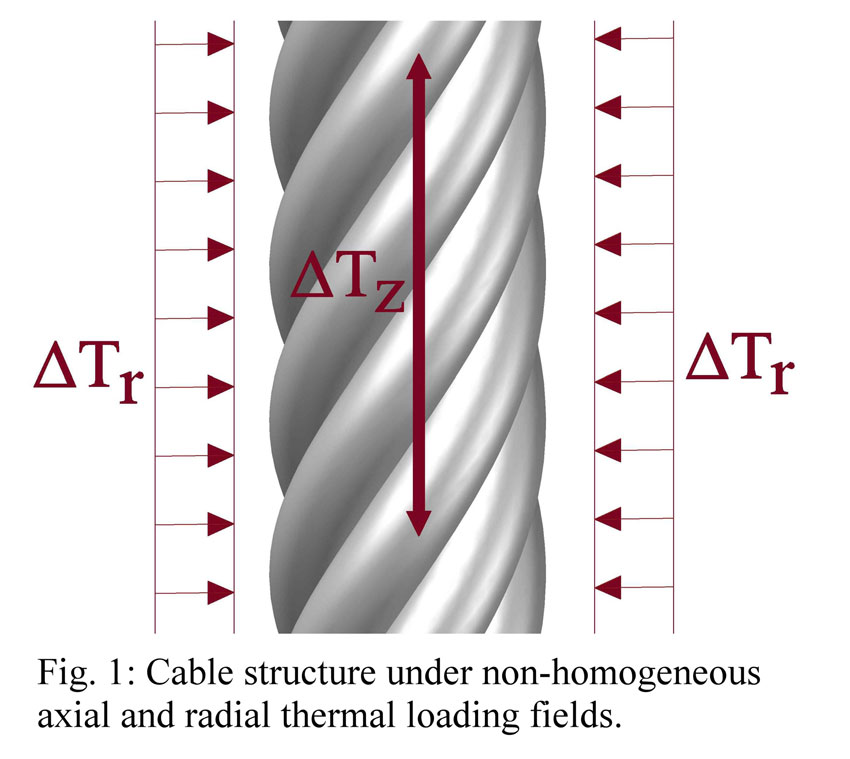
The results highlight the role of temperature changes as unloading and overloading mechanisms, which contribute to the helical construction’s fatigue and wear process. The work subsequently derives useful conclusions on the mechanical implications of the temperature field characteristics (Fig. 1). More specifically, it provides evidence that the inner forces and moments induced by non-homogenous temperature fields considerably differ from the ones created by homogeneous fields of approximately the same intensity, when the helix angle of the construction diminishes (more predominantly for angles below 70o), in contrast to the case of helical constructions that follow steep helix angles for which the nature of the temperature field (homogeneous or non-homogeous) does not play an important role and can be simplified as homogeneous for all practical purposes.
Overall, the study provides not only the necessary generic mechanical formulas to quantify the effect of temperature variations on the loading state of helical constructions, but it also furnishes insights in the geometric and thermal loading characteristics for which their structural effect is more prominent and therefore indispensable part of an accurate analysis.



Journal Reference
Nikolaos Karathanasopoulos1 , Jean-Francois Ganghoffer2, Konstantin O. Papailiou3, Analytical Closed-Form Expressions for the Structural Response of Helical Constructions to Thermal Loads, International Journal of Mechanical Sciences 117 (2016) 258–264.
[expand title=”Show Affiliations”]- Institute for Mechanical Systems, ETH Zürich, Leonhardstrasse 21, CH-8092 Zürich, Switzerland.
- LEMTA – Université Lorraine – Laboratoire d′Energétique et de Mécanique, Avenue de la Forêt de Haye, TSA 60604, 54504 Vandoeuvre, France.
- CIGRE, Malters, Switzerland.
Go To International Journal of Mechanical Sciences