Advances in Engineering Advances in Engineering features breaking research judged by Advances in Engineering advisory team to be of key importance in the Engineering field. Papers are selected from over 10,000 published each week from most peer reviewed journals.

Significance Statement
A cobalt-based Heusler alloy such as the cobalt-iron-aluminium-silicon CFAS alloy films is promising in spintronic devices applications due to their attractive ferromagnetic and semi-conductive properties.
The effects of temperature on the CFAS alloy in view of promoting the structural ordering needed for high spin polarization are of great interest as certain morphological changes happen during the process.
Recent research led by Professor Ke Wang from Huaqiao University in China and published Materials and Design journal studied the thermal effect on the crystallization and magnetic properties in CFAS alloy films sandwiched by magnesium oxide layers.
The authors carried out investigations with the aid of a grazing incidence x-ray diffraction for characterizing the structures of the CFAS alloy films, optical reflectance measurements for monitoring the crystallization process coupled with the use of a vibrating sample magnetometer for analyzing the magnetic and thermomagnetic properties.
The results from the grazing incidence x-ray diffraction patterns of the annealed films of CFAS alloy indicates the as-deposited film as an amorphous structure with minute crystalline size which couldn’t be measured. This nanocrystalline grain size also increased monotonically indicating an improvement of structural ordering.
Coercivity and magnetization of the grown nanocrystalline grain size were found to increase with an increase in annealing temperature. However, annealing temperature of more than 600°C led to a decrease in the saturation magnetization which was attributed to oxidation and decomposition of the CFAS alloy at extreme temperatures.
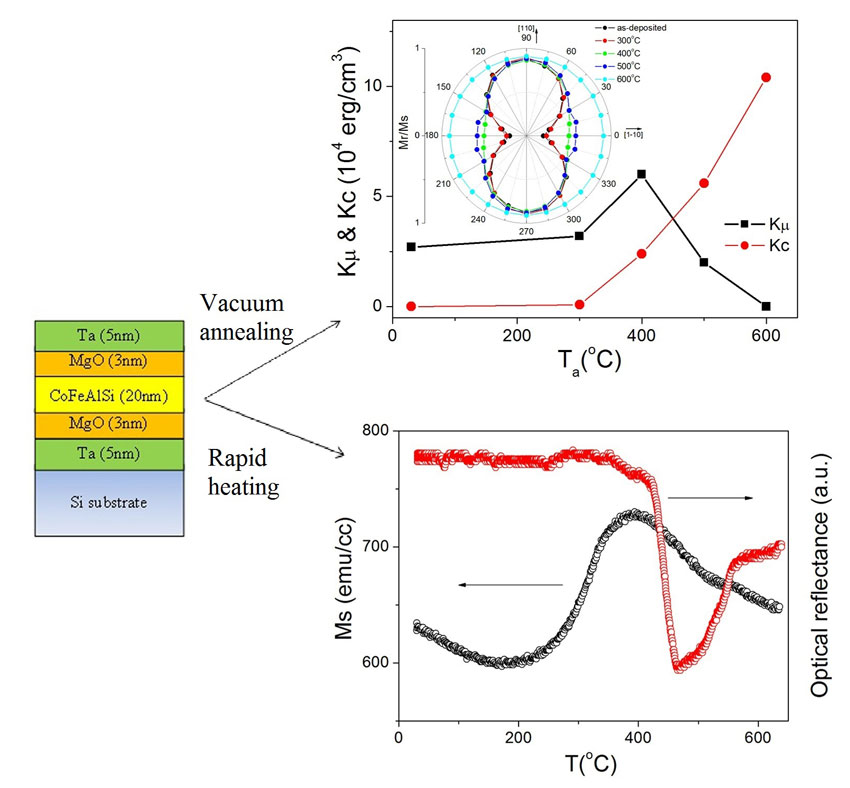
Results from the angular dependent remanent ratio for the CFAS films indicated an increase in magnetic anisotropy of the films until 600°C with a continual increase in crystalline anisotropy which conforms with previous results from the x-ray diffraction analysis.
When the authors looked at thermomagnetic properties, they noticed a higher values than that of that at room temperature was observed at 700°C despite a decline in saturation magnetization at temperatures greater than 400°C, which indicates a high Curie temperature of CFAS alloy which is beneficial for spintronic device application.
Vibrating sample magnetometer studies at a temperature of 330°C for the measured magnetic hysteresis loops and measured angle dependence of remnant ratio showed an increase in saturation magnetization and uniaxial magnetic anisotropy respectively, while that of 650°C led to an observed largest coercivity in loops and a higher order contribution of cubic magnetic anisotropy respectively.
At certain heating rates, results from optical reflectance measurements indicated a drop in optical reflectivity within the range of 400-500°C but increased to a stable reflectance as temperature increases. The discrepancy noticed on the optical reflectance of the CFAS thin films was due to the irreversible change in the amorphous structure to crystalline structure.
According to the authors, a good understanding on effects on temperature in Heusler alloy provides an avenue for performance improvement of spintronic devices. According to Prof. Ke Wang “To the best of our knowledge, this is the first time to report the activation barrier of the quaternary alloy, which is important in evaluating thermal stability of the material”.

Journal Reference
Ke Wang, Ruofei Chen, Zhan Xu, Shuo Dong, Ya Huang. Thermal Effect on Structure and Magnetic Properties in CoFeAlSi Alloy Films, Materials and Design 107 (2016) 290-294.
College of Information Science and Engineering, Huaqiao University, Xiamen City 361021, China
Go To Materials & Design