Advances in Engineering Advances in Engineering features breaking research judged by Advances in Engineering advisory team to be of key importance in the Engineering field. Papers are selected from over 10,000 published each week from most peer reviewed journals.

Significance Statement
Considerable attention, for many years, has been focused on nanostructure materials owing to their unexpected and interesting properties that pave way to new possibilities in areas of chemistry, physics and biology. Most of these materials, including magnetite and hematite, exhibit magnetic properties differing from macrostructural materials. Nanostructure materials are used in mixed oxide systems forming structures with properties not exhibited by individual oxides. Cerium oxide finds various applications in novel foamed porous ceramics and exhibits ferromagnetic behavior at room temperature.
Researchers from the Technical University of Ostrava, Jan Evangelista Purkyně University in Ústí nad Labem and Institute of Physics of Materials, Academy of Sciences of the Czech Republic proposed to investigate thermally stimulated iron oxide transformations and magnetic behavior of cerium dioxide/iron oxide reactive sorbents. They analyzed the structural/compositional and magnetic properties directed predominantly to ongoing thermally induced iron oxide transformations in the presence of cerium oxide. Their work is now published in the peer-reviewed journal, Materials Characterization.
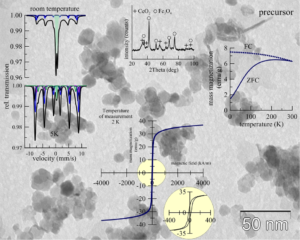
The magnetically separable sorbents were prepared by calcination from the precursor consisting of cerium carbonate on the surface of magnetic grains. The process was done in a muffle furnace by stepwise annealing at various temperatures in air. These resulted in the powdered samples with an active layer of cerium oxide precipitated on iron oxide nanoparticles. The marked changes observed after annealing between 773 K and 973 K became a driving force for detail investigations of the sample morphology and phase composition in close connection to magnetic behavior at room temperature supported by low temperature measurements.
Micro- and macrostructure sensitive experimental methods are applied for exact identification of iron oxides and their transformations Fe3O4 → γ-Fe2O3 (ε-Fe2O3) → α-Fe2O3 in dependence on calcination temperature which simultaneously influences also the room and low temperature magnetic characteristics and particles size distribution of the powdered samples.
Thermal treatment at 773K
This treatment does not change the irregular form of particles of the precursor but their size distribution 5-50 nm is on the contrary visibly narrower. The presence of ferrimagnetic oxide phases, magnetite and maghemite, determined by Mössbauer spectrometry influences the high values of the room temperature saturation and remnant magnetization. Non-zero hysteresis at low temperature indicates blocking state of the magnetic nanoparticles.
Thermal treatment at 873K
The increasing treatment temperature contributes to a slight increase in particle size and their size distribution broadening. A diminishing of maghemite and an increasing contribution of the weakly ferromagnetic hematite are determining factors of magnetic behavior with a substantial decrease in saturation magnetization.
Thermal treatment at 973K
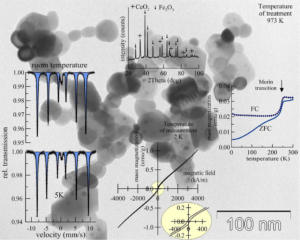
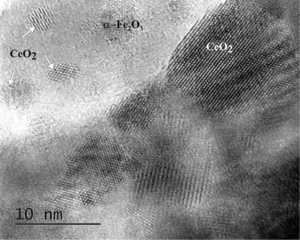
The highest annealing temperature of 973 K produces well defined rounded particles of dominating size of 20 nm. According to high resolution transmission micrograph the small and medium-sized CeO2 particles occur on a surface of the larger hematite, α-Fe2O3 particles. The dominating presence of hematite is reflected in low saturation magnetization.





Journal Reference
J. Luňáček1,2, O. Životský1,2, Y. Jirásková3,4, J. Buršík4, P. Janoš5. Thermally stimulated iron oxide transformations and magnetic behavior of cerium dioxide/iron oxide reactive sorbents. Materials Characterization 120 (2016) 295–303.
[expand title=”Show Affiliations”]
1 Department of Physics, VŠB – Technical University of Ostrava, 17, listopadu 15/2172, 708 33 Ostrava-Poruba, Czech Republic.
2 Department 606, VŠB – Technical University of Ostrava, 17, listopadu 15/2172, 708 33 Ostrava-Poruba, Czech Republic.
3 CEITEC IPM, Institute of Physics of Materials, Academy of Sciences of the Czech Republic, Žižkova 22, 616 62 Brno, Czech Republic.
4 Institute of Physics of Materials, Academy of Sciences of the Czech Republic, Žižkova 22, 616 62 Brno, Czech Republic..
5 Faculty of the Environment, University of Jan Evangelista Purkyně, Králova Výšina 7, 400 96 Ústí nad Labem, Czech Republic.
[/expand]Go To Materials Characterization