Advances in Engineering Advances in Engineering features breaking research judged by Advances in Engineering advisory team to be of key importance in the Engineering field. Papers are selected from over 10,000 published each week from most peer reviewed journals.

Significance Statement
High temperature polymers such as polyimides (PIs) poly(benzoxazole)s (PBOs) are polymers that find an extensive application in aerospace and microelectronic industries owing to their remarkable high thermal stability, mechanical strength, chemical resistance, and excellent insulating ability. PIs and PBOs exhibit poor solubility in most organic solvents, therefore, processing is done in the soluble precursors such as poly(amic acid). Fortunately, in spite of intractable structures, soluble PIs and PBOs have been developed by the introduction of bulky substituents or asymmetric kinked structure. Especially for researchers working in the field of organic optical resins, introduction of alicyclic moieties are getting much attention due to the excellent transparency with reasonable thermal stability. However, such structure can cause serious damages on the thermal properties, compared with the wholly aromatic polymers.
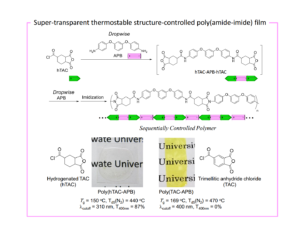
Researchers lead by professor Yuji Shibasaki from Iwate University, Japan, have been studied the cause of the color of PIs and PBOs, and suggested several ideas to diminish the coloring such as introduction of bulky substituents, electro-withdrawing groups into hydroxylamine monomers, decreasing imide contents, and selecting monomers having kinked structure to shorten the conjugation length. In their last paper, they investigated the colorless poly(amide imide)s (PAI)s from hydrogenated trimellitic acid anhydride (h-TAC) with various aromatic diamine monomers. They found that the thermal stabilities of these semi-aromatic PAIs are significantly affected by the sequence of the monomer addition, while those of the wholly aromatic PAIs are free from such polymerization conditions. Their work is now published in peer-reviewed journal, Reactive and Functional Polymers.
Synthesis of PAIs
N,N-Dimethyl acetamide (DMAc) was purified by distillation under low pressure over calcium hydride. Triethyl amine (TEA) was distilled over potassium hydroxide before use. ODA, p-phenylene diamine (pPDA) and mPDA were purified by sublimation process. h-TAC, together with other chemicals, were used as received. For T-D method, h-TAC was dissolved in DMAc, and a diamine monomer was added. TEA was then charged into the reaction mixture, and the stirring was kept continued for 2 h. Finally, the polymerization was terminated with the addition of aniline. For chemical imidization, pyridine and acetic anhydride were added and the mixture was stirred at 85 oC for 5 hours. The reaction solution was then poured into methanol and the resulting precipitate was filtered and dried to become a polymer.
Semi aromatic PAI samples were prepared by the conventional low temperature solution polymerization of h-TAC with aromatic diamines in presence of TEA, followed by reaction with aniline and chemical imidization with pyridine/acetic anhydride. As the acidic monomers of h-TAC possess asymmetric structures, the addition sequence of monomers should significantly affect the monomer sequence in the polymeric structures.
Wholly aromatic PAI samples were prepared by the low-temperature solution polycondensation of TAC with aromatic diamine monomers, followed by chemical imidization, following the preparation of semi-aromatic PAIs. Monomer addition order is significant in determining the microstructure of the obtained polymers. Thermostabilities were evaluated and no large difference was noted between wholly aromatic PAI samples prepared between D-T and T-D processes.
However, these results do not match with those obtained for the semi-aromatic PAI samples. The researchers therefore concluded that monomer sequence order does significantly affect the polymer properties especially for semi-aromatic PAI samples. As the results, they cleared the effective polymerization methods to prepare highly transparent, colorless, and thermostable PAIs, which can be applicable for high temperature optical resins.

Journal Reference
Yutaro Kobayashi1, Yumi Fujiwara1,Takuya Kitaoka2, Yoshiyuki Oishi1, Yuji Shibasaki1. Synthesis of highly transparent poly(amide–imide)s based on trimellitic acid and dependence of thermal properties on monomer sequence. Reactive and Functional Polymers, volume 108, pages 78-85.
[expand title=”Show Affiliations”]- Department of Chemistry & Bioengineering, Iwate University, 4-3-5 Ueda, Morioka, Iwate 020-8551, Japan
- Technical Development Department, Nippon Kodoshi Corporation, 648 Hirooka-kami, Haruno-cho, Kocwhi City, Kochi 781-0395, Japan.
Go To Reactive and Functional Polymers