 Advances in Engineering Advances in Engineering features breaking research judged by Advances in Engineering advisory team to be of key importance in the Engineering field. Papers are selected from over 10,000 published each week from most peer reviewed journals.

Significance Statement
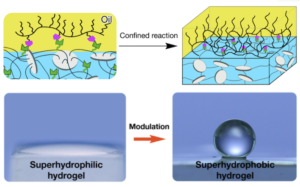
The previous approach used in generating artificial hydrogels often lead to a wetting imbalance as a result of highly favored hydrophobicity. This results in a hydrophobic hindered diffusion and exchange of substances at the hydrogel surface. A method of increasing hydrophobicity with maintaining the intrinsic superhydrophobicity nature of hydrogels would definitely enhance the workability and efficient use of hydrogels. In order to maintain superhydrophobicity and superhydrophicility of the hydrogels, confinement of n-alkylation reaction at the hydrogel surface needs to be achieved.
Researchers led by Professor Mingjie Liu from Beihang University in China and published an article in Advanced Materials introduced a strategic method to superhydrophobize the surfaces of hydrogels by using restrained reactions involved at the interfaces of hydrogels/oil immiscible boundary.
The authors were able to find a right stability between superhydrophobicity and superhydrophicility of the hydrogels by making use of an immiscible phenomenon between oil and water which aided the confinement of n-alkylation reaction at the surface alone. This result was also backed by the observance of the changes in the water contact angle and Fourier transform spectroscopy results.
An increase in modification time resulted in an increase in hydrophobic layer thickness when controlled by the layer scanning confocal microscopy. The highest value of the hydrophobic layer thickness was observed after 3h. A further proof for the realized superhydrophobicity in hydrogels was indicated when a distance smaller than 1nm was seen as a result of the density of the active sites.
The superhydrophobicity nature of the hydrogels was tested with copper mesh when subjected to oil-water interface. It was discovered that the modified hydrogel with presumed superhydrophobicity prevented water diffusion when observed in case of copper meshes coated with the post-modified hydrogels.
The rate of diffused fluorescein in hydrogels was also monitored with the aid of a UV-vis spectroscopy. The authors found that the post-modified hydrogels had a higher potential for suppressing the drug release when the drug carrier is being placed in the release media.
The C16I-modified hydrogels when compared with the unmodified pristine hydrogel-coated copper mesh was found to have a far less diffusion rate due to the presence of the modified superhydrophobic layer, indicating prevention of quick diffusion scenarios for drug delivery applications. The modified layer when theoretically analyzed also revealed a lower release rate constant and diffusional exponent which was due to the presence of hydrophobic layer.
The C16I- and P4BrMS-modified hydrogel surface had a far less reaction rate compared with the unmodified hydrogel surface in view of the reaction time for enzyme substances in the hydrogel surface.
The modified hydrogels obtained in this study can be applied in cases in which gradual feed of drug diffusion or delivery is warranted.

Journal Reference
Yao, X., Chen, L., Ju, J., Li, C., Tian, Y., Jiang, L., Liu, M. Superhydrophobic Diffusion Barriers for Hydrogels via Confined Interfacial Modification, Advanced Materials 28 (2016) 7383 7389.
Key Laboratory of Bio-Inspired Smart Interfacial Science and Technology of Ministry of Education, School of Chemistry and Environment, Beihang University, Beijing, P. R. China.
Go To Advanced Materials
