Advances in Engineering Advances in Engineering features breaking research judged by Advances in Engineering advisory team to be of key importance in the Engineering field. Papers are selected from over 10,000 published each week from most peer reviewed journals.

Significance Statement
Metal oxides have been developed for various industrial as well as domestic applications in volatile organic compound (VOC) detection due to their portability, low cost, ease of use, and real-time operability. In order to attain higher sensitivity, better selectivity, lower working temperature and faster responsivity, nanostructured metal oxide materials have been investigated owing to their increased surface-to-volume ratios and reactive surface areas compared with bulk. Selectivity remains a major challenge for commercial metal oxide gas sensor devices, although several ways, for instance, cross-sensitivity adjustment, gas presentation by other instrument and electronic noses, have been developed to address this challenge.
Metal Organic Framework (MOF) is a class of crystalline framework-structured material constructed by connecting metal center with organic linker. These materials feature ultra large surface areas, regular pores, tunable framework structures, as well as open-metal sites. They demonstrate potential applications on catalysis, gas storage and separation, drug delivery, nanoscale reactors and proton conduction. Their selective gas adsorption behavior makes MOF attractive for over-coming the selectivity problem in gas sensor.
Researchers lead by professor Gang Xu from Fujian Institute of Research on the Structure of Matter, Chinese Academy of Sciences, proposed a new material design strategy to enhance the performance of chemiresistor gas sensor by combining the high sensitivity of nanostructured MOX with the high selectivity and catalytic activity of MOF into one material. Their work is now published in peer-reviewed journal, Advanced Materials.
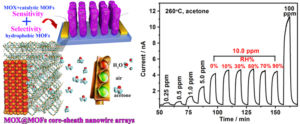
First, MOX nanowire is used as core material for gas sensing reaction and subsequent electrical signal transport. By coating a thin film of MOF on the surface of the MOX nanowire, a MOX and MOF core-sheath nanowire materials is obtained. The porous sheath material is used to selectively usher desired target species and reject interfering gases from passing through to reach MOX surface. In this manner, the selectivity of MOX gas sensor could be significantly improved. Catalytic properties of MOF may also be introduced into such materials to enhance their sensing performance.
For the first time, the above described strategy was successfully demonstrated by coating a layer of hydrophobic and catalytic ZIF-CoZn (isostructural with ZIF-8(Zn) or ZIF-67(Co)) thin film on ZnO to form a core-sheath nanowire array for chemiresistor gas sensor. The gas sensor based on this new material shows the best selectivity between acetone and humidity so far, and the coefficient of variation (CV) with only 7.4% was achieved in large relative humidity range. In addition, compared with the MOX sensor without MOF sheath, significantly improved performances were achieved: 1) the response was enhanced ~20 times; 2) the detection limit was improved by ~2 orders of magnitude; 3) the response & recovery behaviour were accelerated by 48 and 470%, respectively; 4) the operating temperature was decreased by ~125oC.
The results in this paper present an effective method to overcome the bottleneck of poor selectivity between VOC and humidity. It is a great progress in both fundamental study and practical application within the area of chemiresistive gas sensor. Since MOF material has great design-ability on its structure and properties, unique gas selectivity on size, shape, groups, and chirality, the sensor device based on the new material offers a high possibility to attain the detecting on a single gas and provides an exciting and powerful platform for the development of new sensing technologies.


Journal Reference
Ming-Shui Yao, Wen-Xiang Tang, Guan-E Wang, Bhaskar Nath, and Gang Xu. MOF thin film-coated metal oxide nanowire array: significantly improved Chemiresistor sensor performance. Advanced Material 2016, 28, pages 5229–5234.
Go To Advanced Materials