Advances in Engineering Advances in Engineering features breaking research judged by Advances in Engineering advisory team to be of key importance in the Engineering field. Papers are selected from over 10,000 published each week from most peer reviewed journals.

Significance Statement
Production of electrical base load power highly utilizes pulverized coal combustion. The knowledge of coal ignition and combustion is fundamental for improving modern pulverized coal burners. This dictates that knowledge of the underlying physio-chemical processes is necessary so as to predict the pulverized coal combustion performance. The flame characteristics such as pollutant formation, stability and possible extinction are influenced by devolatilization and ignition phenomena. Experiments, which can provide crucial data on the pulverized coal combustion process, have intricate uncertainties and are hence difficult to conduct. Large eddy simulation (LES) has been increasingly used to study pulverized coal combustion since it has the potential to offer more insight as compared to the classical RANS approaches. However, the detailed near-particle processes remain unresolved in LES. Therefore the focus is channeled towards resolved laminar flow simulations of fuel oxidizer mixing, ignition and devolatilization in the immediate vicinity of the particle surface, which provides detailed sub-grid information for LES.
In a recent paper published in Fuel G.L. Tufano and colleagues investigated the effects of enhanced oxygen levels and balance gas atmosphere on single coal particle ignition and compared their numerical data against measured results in well-defined conditions.
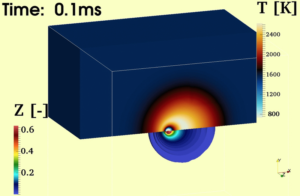
The heating rate history of the particle was obtained by solving for the intraparticle heat transfer and heat exchange between the particle and its surroundings. The authors captured the time evolution of volatile release by using the particle mean temperature to compute the devolatilization rate. The research team assumed volatile compositions which included both light gases and larger hydrocarbons to represent the tar. To accurately describe the homogeneous chemistry, a skeletal kinetic mechanism for pyrolysis and oxidation of hydrocarbons and oxygenated fuels was used. Ignition, pyrolysis, particle heat-up and envelope flame stabilization were characterized in four gas atmospheres differing in oxygen content and the use of either nitrogen or carbon dioxide as balance gas.
The authors were able to observe that enhanced oxygen levels shortened the ignition delay time, therefore resulting in a higher intensity of the combustion process according to temperature and radical production peaks for the studied mixtures. They also found that the presence of the carbon dioxide in place of the nitrogen gas delayed the ignition. It is evident that the observed behavior is coherent with the varying thermo-physical properties of the gas mixtures despite the complex uncertainties in both coal simulations and experiments. It is also observed that absolute values of predicted ignition delay time are functions of potential particle preheating, particle Reynolds number and the criterion employed for extraction of ignition delay, but the relative trends for different gas phase environments stand correct.








Reference
G.L. Tufano1, O.T. Stein1, A. Kronenburg1, A. Frassoldati2, T. Faravelli2, L. Deng3, A.M. Kempf3, M. Vascellari4, C. Hasse4. Resolved flow simulation of pulverized coal particle devolatilization and ignition in air- and O2/CO2-atmospheres. Fuel volume 186 (2016) pages 285–292.
[expand title=”Show Affiliations”]- Institut für Technische Verbrennung, Universität Stuttgart, Herdweg 51, 70174 Stuttgart, Germany
- Dipartimento di Chimica, Materiali e Ingegneria Chimica, Politecnico di Milano, Piazza L. da Vinci, 32, 20133 Milano, Italy
- Institute for Combustion and Gasdynamics (IVG), Chair for Fluid Dynamics, University of Duisburg-Essen, Germany
- Chair of Numerical Thermo-Fluid Dynamics, ZIK Virtuhcon, TU Bergakademie Freiberg, Germany
Go To Fuel