 Advances in Engineering Advances in Engineering features breaking research judged by Advances in Engineering advisory team to be of key importance in the Engineering field. Papers are selected from over 10,000 published each week from most peer reviewed journals.

Significance Statement
Silica membranes synthesized through hydrolysis/condensation, normally referred to as the sol-gel process of tetraethoxysilane has been implemented for separation of gases. The dense structures of these silica membranes are fundamental in the separation of small gas molecules such as nitrogen, helium, and hydrogen. Unfortunately, these membranes are normally too dense for application in separation of water. Above all, silica materials with Silicon-oxygen linkages are unstable towards hydrolysis and therefore cannot be applied for separation of water for a long design life.
However, introducing ethylene bridges and implementing 1,2-bis(triethoxysilyl)ethane as the precursor is helpful in expanding the silicon-oxygen network in a bid to improve porosity, therefore, improving water permeability. Therefore, 1,2-bis(triethoxysilyl)ethane-based membranes with about 1 × 10⁻¹³ m/s·Pa water permeance and over 95% sodium chloride rejection can be implemented as reverse osmosis membranes.
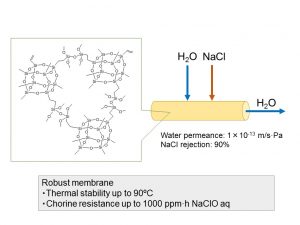
A team of researchers from Hiroshima University in Japan introduced a (triethoxysilyl)ethyl group to every corner of silicon polyhedral oligomeric silsesquioxane, T8 and exposed it to hydrolysis to form bridged silica membranes for separation of water. They then analyzed the functioning of the membranes using reverse osmosis experiments applying 2000 ppm sodium chloride solution. Also, they investigated the robustness of these membranes to heat and chlorine. Their work is published in peer-reviewed journal, Desalination.
The team prepared polyhedral oligomeric silsesquioxane containing silica sols through hydrolysis of octakis(triethoxysilylethyl)-substituted polyhedral oligomeric silsesquioxane. They coated these sols on SiO2/ZrO2/TiO2 porous supports. They were then calcinated at 350 °C to come up with the membranes.
The membranes were then applied for reverse osmosis using 2000 ppm sodium chloride solution. The experiment was done at 25 °C and a pressure of about 1.0MPa. The team then determined the sodium chloride rejection and liquid permeance.
The team also immersed the synthesized membrane in sodium hypochlorite solution in the dark and pH adjusted to 7 using a buffer solution. For every 20h interval, the researchers rinsed the membrane and subjected it to reverse osmosis.
calcination temperature may lead to better separation selectivity since the network densification is improved. However, this could have led to thermal degradation of the framework. Therefore, it was paramount to establish the thermal stability of the gels. Homo-polymer gels were observed to lose weight, which proceeded in two steps. Weight loss at a temperature range of 250-350 °C was due to dehydration of the remaining silicon-hydroxyl groups as well as decomposition of Tetraethyl orthosilicate to form Si-OH which undergoes dehydration. Weight loss between 420-600 °C was due to the decomposition of the ethylene units. Copolymers, on the other hand, experienced less weight loss.
adsorption isotherms synthesized by drying the gels showed that the gels had porous characteristics. The authors analyzed water desalination performance of the membranes using reverse osmosis experiments. They recorded liquid permeance of about 1 × 10⁻¹³ m/s·Pa and sodium chloride rejection of 90% at 25 °C. Liquid permeance (at 90 °C) observed to increase while sodium chloride rejection was relatively the same. The authors observed that the membranes were robust to chlorine and heat. Their performance was unchanged after exposure to sodium hypochlorite solution.
The results of this paper indicate high application potential of the membranes for high-temperature water separation.




Reference
Kazuki Yamamoto1, Sayako Koge1, Takahiro Gunji2, Masakoto Kanezashi3, Toshinori Tsuru3, and Joji Ohshita1. Preparation of POSS-derived robust RO membranes for water desalination. Desalination, volume 404 (2017), pages 322–327.
[expand title=”Show Affiliations”]- Department of Applied Chemistry, Graduate School of Engineering, Hiroshima University, Higashi-Hiroshima 739-8527, Japan
- Department of Pure and Applied Chemistry, Tokyo University of Science, Noda 278-8510, Japan
- Department of Chemical Engineering, Graduate School of Engineering, Hiroshima University, Higashi-Hiroshima 739-8527, Japan
Go To Desalination
