 Advances in Engineering Advances in Engineering features breaking research judged by Advances in Engineering advisory team to be of key importance in the Engineering field. Papers are selected from over 10,000 published each week from most peer reviewed journals.

Significance Statement
Organic electroluminescence has potential applications in flat panel display and lighting. Previous applications have featured the use of heavy-metal complexes of iridium (III) and platinum (II). However, owing to platinum and iridium low abundance, other alternatives have been developed to access earth-abundant materials for organic light-emitting diodes (OLEDs). One approach entails the use of thermally activated delay fluorescence elements. Another approach entails the use of high emissive copper(I) and organic-inorganic lead(II) halide perovskites.
High vacuum evaporation and high temperature deposition processes are applied in the fabrication of light emitting layer in organic light-emitting diodes. The processes are uneconomical for large scale applications and multidopant devices. However, solution process at ambient conditions appears to be a promising economical and convenient approach. It is convenient for multicomponent device fabrication. However, this method needs some improvement.
Manganese (II) complexes have been identified to display strong photoluminescence with a number of emitting colors including red, green, orange and yellow that originate from d-d transitions. High emissive quantum yields make them suitable building blocks for organic light-emitting diodes. Therefore, researchers led by professor Zhong-Ning Chen from Fujian Institute of Research on the Structure of Matter- Chinese Academy of Sciences presented for the first time the use of green-light-emitting tetrabromide manganese(II) in the fabrication of nondoped and doped OLEDs through the solution approach. High-efficiency OLEDs based on manganese(II) emitter have been achieved through solution process. A viable approach to achieve low-cost OLEDs is thus established. Their work is published in peer-reviewed journal, Advanced Materials.
The authors prepared the tetrabromide manganese complex by mixing Tetraphenylphosphonium bromide and manganese bromide in dichloromethane. Layering dimethyl ether on the dichloromethane solution produced the manganese(II) complex as green crystals. The crystals consisted of anionic complex that displayed a tetrahedral geometry. The manganese (II) atom was bonded to four bromide atoms.
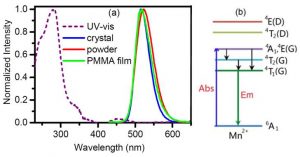
The solid-state UV–vis spectrum of the obtained manganese complex (Ph4P]2[MnBr4) indicated an intense band which was centered at 280 nm. There were two absorption peaks at 350 as well as 460 nm. When radiated, the crystals, powders and poly(methyl methacrylate) doping films displayed brilliant green luminescence which was accompanied with featureless emission bands.
The green emission could be related to the d-d, 4T1–6A1 transition of the manganese ion in the d5 configuration with a tetrahedral geometry. The authors analyzed the excitation spectrum and observed the structured bands with three peaks at 300, 365, and 460 nm. This could be ascribed to the energy splitting.
The resulting manganese compound indicated superior thermal stability without degradation when operating at 400 °C. The compound was found to be highly soluble in acetone, methanol, ethanol and dichloromethane. Its electronic conductance was found to be three orders of the magnitude of the manganese metal organic solid pellets. Good electronic conductance indicated excellent charge mobility of the resulting manganese compound. This along with intense photoluminescence makes this ionic complex a feasible application as an emitting material in organic light emitting diodes via the solution process.
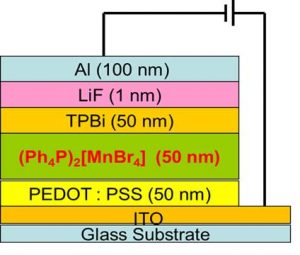
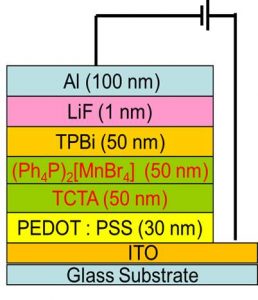
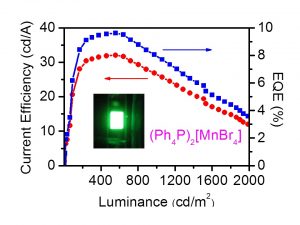
Tetrabromide manganese (II) complex, which is an environmentally and economical benign emitting material was implemented in the fabrication of solution-processed light-emitting diodes. External quantum efficiencies of 7.2% and 9.6% were realized for nondoped four-layer and doped three-layer organic light emitting diodes via orthogonal solvents solution process. This approach presents a feasible path for high-efficiency and low cost light-emitting diodes implementing high luminescent manganese (II) complexes.


Reference
Liang-Jin Xu, Cheng-Zhe Sun, Hui Xiao, Yue Wu, and Zhong-Ning Chen. Green-Light-Emitting Diodes based on Tetrabromide Manganese(II) Complex through Solution Process. Advanced Materials 2017, 29, 1605739
State Key Laboratory of Structural Chemistry, Fujian Institute of Research on the Structure of Matter, Chinese Academy of Sciences, 155 Yangqiao Road West, Fuzhou, Fujian, 350002, China.
Go To Advances Materials