 Advances in Engineering Advances in Engineering features breaking research judged by Advances in Engineering advisory team to be of key importance in the Engineering field. Papers are selected from over 10,000 published each week from most peer reviewed journals.

Significance Statement
Recently, ammonia sensors have attracted significant interest due to their versatile applications in chemical engineering, food technology, medical diagnosis, environmental protection, industrial processing and in control of automotive emissions. Although application based diverse sensing technologies have already been proposed for ammonia detection, zeolites; valuable chemical catalysts and excellent absorbents, have already been identified as auspicious candidates for the fabrication of selective, stable and economical ammonia sensors. Ionic conductivity of ammonia and zeolites can be effectively improved by interaction of the two. The electrostatic attraction of ammonia has been suggested for the sodium-conducting zeolite Y to improve the hopping of the cation. Consequently, a comparison of different types of zeolites for ammonia sensing is therefore necessary so as to develop zeolite-based ammonia sensors and acquire a global view of its sensing mechanism.
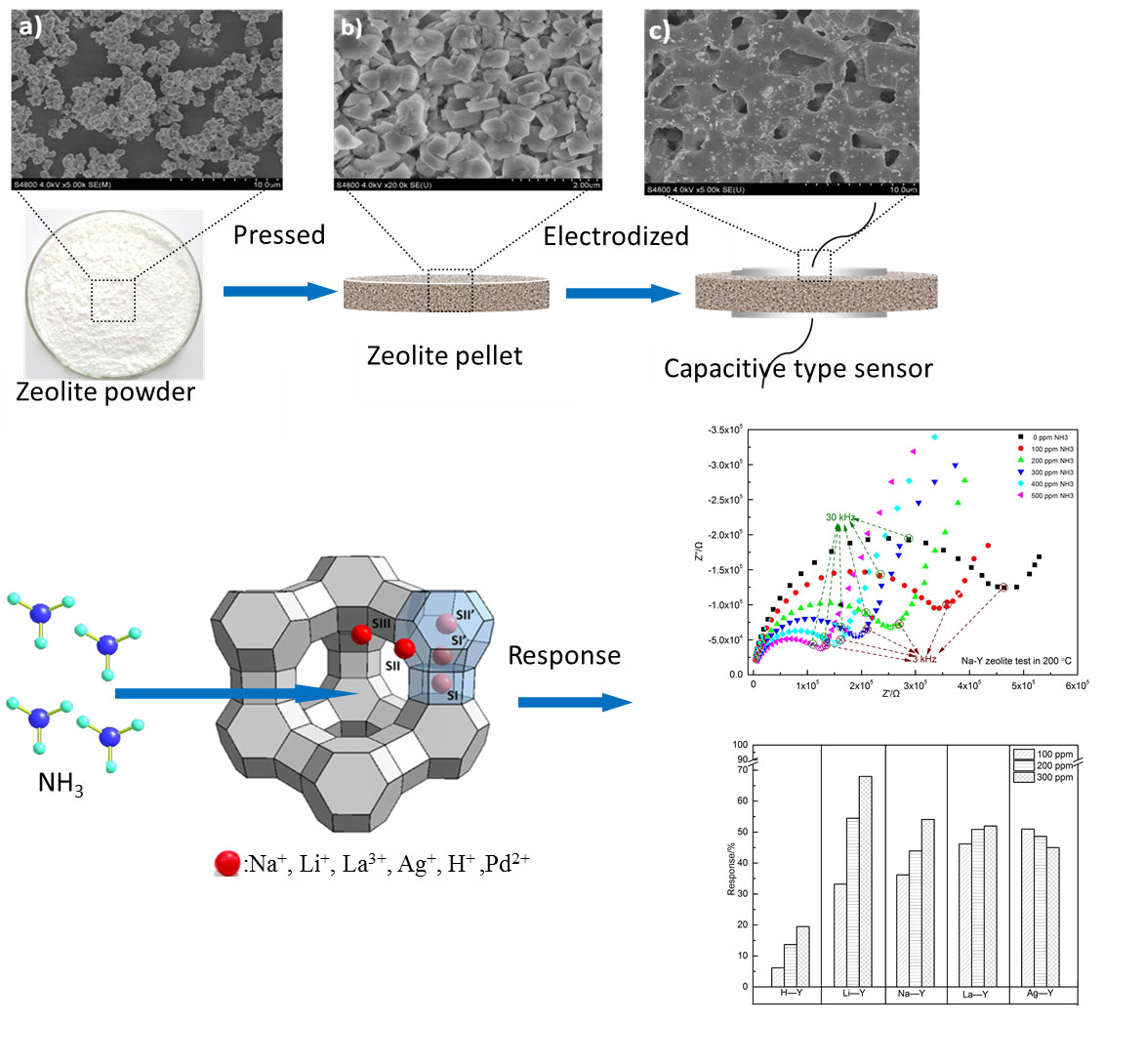
Researchers at Ningbo University of Technology Qishu Wu, Yangong Zheng, Jiawen Jian and Jinxia Wang proposed a study on some aspects of the working principle and the potential for using zeolite Y as an impedimetric ammonia sensor. Their main aim was to systematically investigate the gas sensing performance of ion-exchanged Y zeolites as an impedimetric ammonia sensor. The interactions between the different intrazeolitic cations and ammonia were also of impeccable interest to them. Their work is now published in Ionics.
The research team explored different intrazeolitic cations based on the capacitive configuration for ammonia sensing. The authors observed that temperature variation was crucial to the whole procedure. It was noted that elevated temperatures accelerated the kinetics of the ammonia adsorption/desorption but concurrently, caused a reduction in the adsorbing capacity of the zeolite. It was also observed that the thickness of the zeolite pellet was a crucial parameter for determining the detection limit. The noble metal silver and the proton were observed to have higher working temperatures than the alkali cation-exchanged Y zeolite. The excellent selectivity of silver and sodium was also noted.
Zeolites portraying excellent selectivity characteristics are good potential candidates as practical ammonia sensors. The high selectivity characteristic of the zeolites is a great advantage that affirms their applicability as gas sensing elements. Silver based zeolites have been observed to be the best gas sensors for ammonia as they are least affected by other gases that may be present. As demonstrated in their research work, zeolite Y hold a great capability as an impedimetric ammonia sensor.


Reference
Qishu Wu, Yangong Zheng, Jiawen Jian, Jinxia Wang. Gas sensing performance of ion-exchanged Y zeolites as an impedimetric ammonia sensor. Ionics (2017) volume 23 page 751–758.
Go To Ionics