Advances in Engineering Advances in Engineering features breaking research judged by Advances in Engineering advisory team to be of key importance in the Engineering field. Papers are selected from over 10,000 published each week from most peer reviewed journals.

Significance
The current trend of electronic device miniaturization demands improvements in the thermal conductivity and electrical insulating capacity of materials used for production. With the objective of identifying an effective heat conductor, researchers have sought after polymers due to their attractive attributes such as low cost, light weight and good processability among others. Unfortunately, most polymers are poor thermal conductors and generally cannot reach the dissipation requirements of the electronic device industry. Alternatively, addition of fillers of high thermal conductivities to the polymer matrices helps obtain polymer composites of high thermal conductivity and yet retain their inherent desirable properties. However, composites with appropriate thermal conductivities are mostly achieved with high filler loading, sacrificing the light weights, low costs, and excellent processabilities of the polymeric materials. The work presented herein therefore seeks to address this issue by providing a new approach for the development of thermally conductive and electrically insulating materials by incorporating fluid heat convection into polymer material.
Researchers led by Professor Chuanxi Xiong at Wuhan University of Technology in China proposed a study to incorporate liquid paraffin microcapsules into epoxy resin to prepare fluid-filler/polymer composite materials. Their main objective was to introduce fluid heat convection into thermally conductive and electrically insulting materials to match the desired attributes. Their research work is now published in journal, Composites Science and Technology.
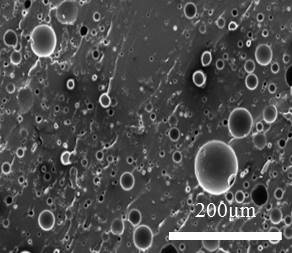
The researchers initiated their experimental procedure by synthesizing liquid paraffin microcapsules which they then added to epoxy resins to prepare the liquid paraffin microcapsules/ epoxy-resin composites. The team then characterized the micro morphologies of the paraffin microcapsules while still analyzing their chemical structures. The thermal and electrical conductivities with various liquid paraffin microcapsules contents were measured, and the heat release efficiencies of the composite with 25 vol% liquid paraffin microcapsules content at different temperatures were obtained as well. Eventually, the effects of the liquid paraffin microcapsules on the tensile and bending strengths and tensile strain to failure were investigated.
The research team observed that the liquid paraffin microcapsules formed neat structures after being acidized for several minutes using polyvinyl alcohol as the emulsifier. The heat dissipation efficiency remarkably improved above certain temperatures with 25 vol% liquid paraffin microcapsules, although there was no significant thermal conductivity enhancement at room temperature. They also noted that the liquid paraffin microcapsules/epoxy composites containing 20 vol% of liquid paraffin microcapsules filler exhibited tensile strengths, bending strengths, and breaking elongations that were 14.3%, 12.5%, and 30.5% higher, respectively, than those of the pure epoxy resin.
The Chuanxi Xiong and co-workers study has introduced fluid heat convection into thermally conductive and electrically insulating material by preparing liquid paraffin microcapsules/epoxy-resin composites. Their work has shown that the fluid heat convection efficiency increases with increasing temperature. Moreover, electrical conductivity and dielectric measurements have demonstrated that the liquid paraffin microcapsules/epoxy-resin composites are good electrical insulators. These results point out that fluid-filler/polymer composites could be promising as heat conduction materials that are effective at relatively high temperatures.





Reference
Zhaodongfang Gao, Qi Zhao, Chuanbin Li, Shan Wang, Lijie Dong, Guo-Hua Hu, Quanling Yang, Chuanxi Xiong. A novel fluid-filler/polymer composite as high-temperature thermally conductive and electrically insulating material. Composites Science and Technology volume 150 (2017) pages 128-134
Go To Composites Science and Technology