 Advances in Engineering Advances in Engineering features breaking research judged by Advances in Engineering advisory team to be of key importance in the Engineering field. Papers are selected from over 10,000 published each week from most peer reviewed journals.

Significance
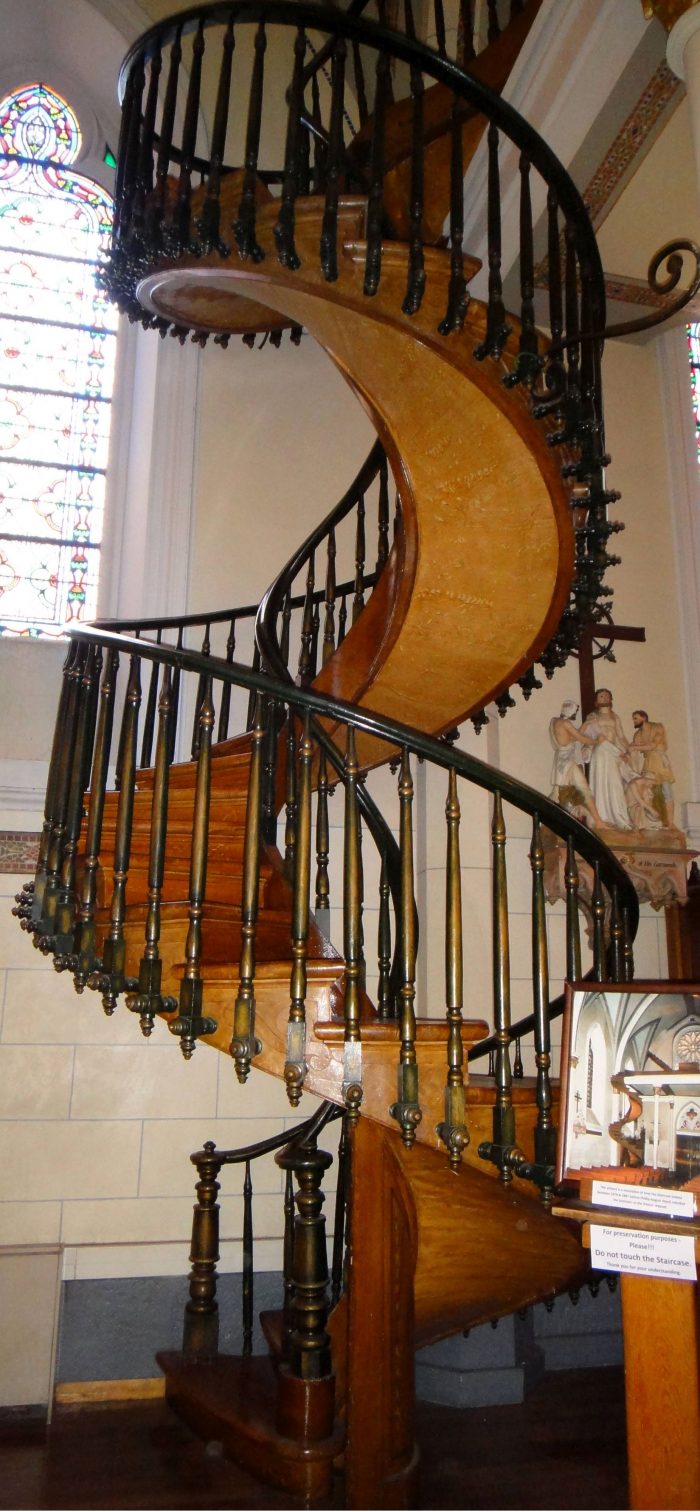
Microscale helical coil structures are commonplace in nature such as the muscle protein tropomyosin, in which 2–7 α-helices are coiled together like the strands of a rope and DNA, which is considered to contain the code of life. At the other extreme, macroscale helical coil geometries are illustrated by, for example, unsupported spiral staircases and stretched telephone cords. The elastic behavior of these structures is governed by the same laws of physics regardless of the scale. Therefore, having some insight on the macroscale will be of help in understanding helical micro- and nano-structures. The rigidity of the unsupported all-wooden helix-shaped spiral staircase in the Loretto Chapel (Santa Fe, New Mexico, USA) is a classical example that that was unexplained up to now.
Professor David Tománek at Michigan State University and Professor Arthur Every at the University of the Witwatersrand in Johannesburg, South Africa, explored the elastic characteristics of this structure using continuum elasticity theory in a bid to establish the reason for its high rigidity. Continuum elasticity theory is applicable, among others, to macroscale and nanometer-sized beams and nanotubes. Therefore, this approach would have been helpful in exploring the rigidity of helical structures on micro- and nanometer scales.
Their decision to implement the continuum theory instead of the finite-element method was motivated by their objective to establish the origin of the high rigidity of the Loretto spiral staircase as well as related helical coils with an asymmetric double helix structure. The theoretical insight gained on the macroscale will be of great interest in understanding the elastic behavior of helical structures on nano- and micrometer scale. Their research work has been published in the journal Physical Review Applied.
The authors estimated the local axial deflections of the staircase initiated by loading to ideally be extremely small, but expect them to be appreciably larger in the actual system owing to defects of human-made joints in the all-wooden staircase. This would be reflected in a substantially reduced, but still nevertheless still very large effective spring constant.
Additional deformation would occur as a result of other deformation modes such as lateral compression or stretching of the wooden steps and, to some extent, bending. Elastic response to shear stress in the stringers was found to contribute significantly to the spring constant, particularly for low pitch spirals. Since the spiral staircase considered in this study was a high-pitch spiral, shear deformations in the stringers did not reduce the effective spring constant much. Allowing for a force constant reduction by even 1-2 orders of magnitude due to all these factors, the maximum local axial deflection was estimated not to exceed 1-2 cm when each of the 33 steps of the 6-meter tall staircase was loaded with the normal weight of a person.
Long after its initial construction, the staircase had been augmented by a railing for safety reasons. However, this railing did not affect the elastic response of the staircase under load. Tománek and Every report that they had not found any asymmetric double-helix structure in nature that was as rigid and did not stretch easily. In case such a structure exists, its rigidity would surely benefit from a constant separation between the helical coils. The proposed model by Tománek and Every offers a versatile tool to explore the mechanics of various helical structures on the micro- and nano-meter scale.


Reference
David Tománek and Arthur G. Every. Origin of Unusually High Rigidity in Selected Helical Coil Structures. Physical Review Applied 8, 014002 (2017)
Go To Physical Review Applied